Owen Paterson: Irish food watchdog acted on 'local intelligence'
The Food Safety Authority of Ireland acted on specific intelligence when testing frozen burgers for horse DNA, it has emerged - despite insisting its tests were simply part of its routine monitoring.
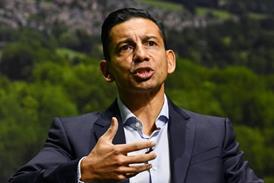
The revelation was made by Defra secretary of state Owen Paterson in a little-noticed comment in the Commons on Monday (11 February). Asked by MPs why the UK’s FSA had failed to test products for horse when the FSAI had done so, Paterson said: “The reason the Irish agency picked up this issue in the Irish plant was that it had local intelligence there was a problem. That is why it did a random check. I cleared that with [Irish agriculture] minister Coveney today.”
Paterson’s revelation raises serious questions about whether the FSAI should have done more to prevent consumers on both sides of the Irish Sea from eating adulterated burgers.
The FSAI started testing burgers in November and announced it had found horse DNA on 15 January, sparking product withdrawals and urgent DNA tests. “If they had intelligence that led them to start looking for horse in November, why didn’t they share this with the [FSA] in this country and why didn’t they alert industry?” said one food industry source.
The FSA said it knew of the tests in November but was only told by the FSAI that horse DNA had been found in products on sale in the UK on 14 January.
Asked by The Grocer about Paterson’s comments, the FSAI repeated its assertion that it had not acted on specific intelligence but said it could not comment on “conversations between ministers”. Coveney’s department also declined to comment, insisting exchanges between ministers were confidential.
The issue was muddled further on Tuesday (12 February) when food minister David Heath appeared to contradict Paterson’s statement on Monday, telling MPs FSAI “explicitly rejects the suggestion it was working on the basis of an intelligence-based system … They did not suspect adulterated meat was going to the UK they did a routine test and notified us when they had adverse results.”
Defra told The Grocer the two ministers’ statements were consistent. “When David Heath said the FSAI had found horse meat through random testing, he was correct,” a spokesman said. “This was because the FSAI got intelligence which led them to increase random testing.”


Readers' comments (3)
vickysecho | 16 Feb 2013 15:35
I am curious just what these regulatory authorities are 'responsible' for? Not testing, not food safety - since they know that bute is in horsemeat and they appear to leave recalls up to the providers? So it appears that basically they run a media campaign to get them to do the 'right' thing..... but then it is up to the providers to test and report results that may damage their business... I would imagine tehy can claim it as a business expense. What have they done since they found bute? Even 3 or 4% is ok in a manufacturing world of PPM? Seems this has happened before with 'mad cow"...
http://www.mad-cow.org/00/dec00_31_news.html
"The incubation period for this is quite lengthy and the disease appears to be a
completely unexpected, novel agent," Ricketts said. "We didn"t think that it
would make human beings ill."
Unsuitable or offensive? Report this comment
steve white | 16 Feb 2013 17:35
Coveney said at EU briefing the prices seemed too low on the products could that be the extent of the local intelligence
Unsuitable or offensive? Report this comment
Jag Singh | 03 Mar 2013 10:46
Well this past week in the Irish parliament, the health minister under whose auspices the FSAI operates said there was no tip off and that it was just routine testing, this despite the fact the minister also said it was the first time the FSAI tested for horsemeat or horse DNA.
Parliamentary question and response here
Deputy Pearse Doherty: To ask the Minister for Health if the Food Safety Authority of Ireland was responding to a tip-off when it tested for horse DNA in certain foods in November 2012; the number of times in 2012 the FSAI tested for horse DNA in foods prior to November 2012; and if he will make a statement on the matter.
Minister for Health, James Reilly: The Food Safety Authority of Ireland (FSAI), as part of their monitoring and surveillance programme on labelling of foods, conducted a small survey in November 2012 to investigate the authenticity of meat products and, specifically, to check on the type of animal species in meat products. There was no tip off involved. This was simply routine work similar to that done in the past with other foods, such as Cod. Prior to November 2012 the FSAI had not tested for horse DNA.
Unsuitable or offensive? Report this comment