



Grocery store openings used to be a quiet affair. Today, supermarkets and convenience retailers alike are using them as an opportunity to create theatre and bring together local communities
Sipping a mimosa at 8am is an indulgence usually reserved for special occasions. A lavish vacation; the morning of a wedding; the reopening of a Waitrose. Wait… what?
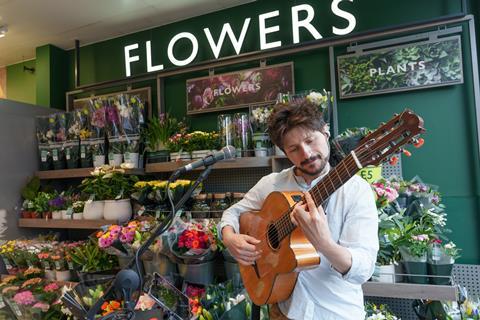
On 24 June, the fizzy treat was being handed out to shoppers who attended the reopening of Waitrose Bloomsbury after a renovation that lasted a full month. What’s more, the cocktails were accompanied by a live guitarist performing acoustic pop covers in the fruit & veg aisle, plus custom chocolate bars and free canvas tote bags.
“I only had a chance to swing by after work around five in the evening, and by then only an Ice cream sampling station remained,” said Bloomsbury local Tobias Cantelo. “But there was still very much a buzz in the air, everyone was in a good mood. It confirmed we’re back in the swing of things after a painfully long month of closure.”
There was a time when supermarket openings were far from being considered newsworthy. However, as competition to win customer loyalty has intensified, retailers have begun adopting increasingly creative marketing strategies. Across the sector, grocers are borrowing wholesale from the playbooks of fashion drops and hospitality launches: mascots, trolley dashes, branded merch and block-long queues. Even a store refit is no longer just a store refit. It has become a PR event that lives on in shoppers’ memories and across social media.
But is this a genuine strategic pivot in how grocers think about physical retail? Does all the theatre translate into sales or just into likes? Can independents and discounters play this game too? And in future does every opening and reopening now require such pageantry?
To understand why some retailers are increasingly keen on spectacle, it helps to remember how recently the opposite was true. Retail theatre in its purest form – scratch bakeries, cheese barges, fishmongers – had spent recent years in retreat, squeezed out by automated checkouts and digital ordering screens. The risk was obvious: bricks & mortar outlets beginning to feel more utilitarian than inviting.
The resulting decline in customer satisfaction has prompted some retailers to reverse course. Morrisons, for example, closed 70 of its meat and fish counters last year as part of a cost-cutting drive, but begun reinstating them last month after feedback from customers.
The tactics now doing the rounds are extensive. At the opening of the nation’s largest M&S Foodhall last month, shoppers in Godalming queued to spin a Percy Pig-themed wheel of fortune for in-store prizes. There are also exclusive merch drops, ranging from canvas tote bags emblazoned with the name of the town hosting a new Waitrose to embroidered baseball caps declaring “I’d rather be in the Clapham M&S Foodhall”.
There are competitions and giveaways, from Iceland’s air fryer raffles and 90-second trolley dashes to Lidl’s build-it-yourself Gingerbread Store kit, 10 of which had £100 Lidl vouchers hidden inside. Meanwhile, mascots like Aldi’s Kevin the Carrot are now turning up for photo ops as reliably as any ribbon-cutter.
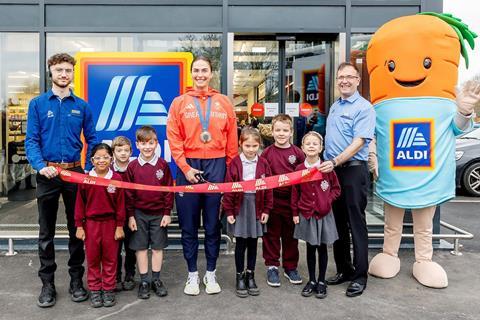
Ribbon cuttings themselves – long a prerequisite of supermarket openings – have been dressed up rather than dropped, with celebrities and schoolchildren now featuring heavily. Richard Thornton, group customer interaction director at Aldi, says the retailer tries to go “beyond a standard ribbon cutting, often inviting Team GB or Paralympics GB athletes to open new stores”.
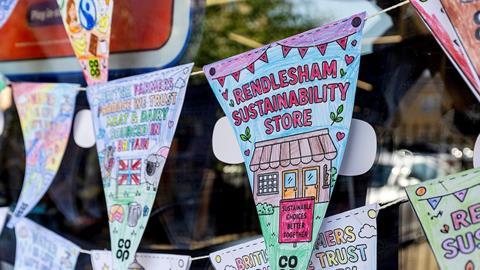
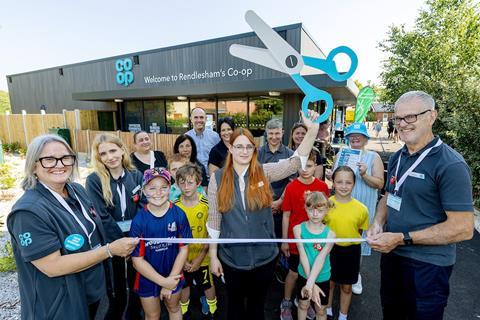
The Co-op in Rendlesham took a local angle by asking year three and four pupils to colour bunting for the store opening this June. Kate McCrae, retail director at Co-op, says that “building relationships with local schools – where Fairtrade and sustainability are often part of classroom activity – [is] part of the process when we launch a new store”. As such, openings are also becoming opportunities to showcase ongoing charitable initiatives that may be overlooked by shoppers.
Meanwhile, Asda capitalised upon local appeal and star power by bringing Leeds native and Spice Girl Mel B to the opening of its first George concept store in the city last May. “Whether it’s one of our new standalone George stores or a refreshed superstore, we make these moments feel special through family-friendly activities that create a real buzz. We’ve had everything from giveaways tailored to each location to stilt walkers – and, of course, plenty of balloon arches,” says Asda spokesperson Elliott Lancaster.
While star power and decor are effective at generating short-term attention, retailers have also taken note of initiatives to reward customer loyalty.
“A Waitrose opening or relaunch is fundamentally about building long-term relationships rather than executing a transactional marketing event,” says Emily Dow, senior local marketing manager of Waitrose. “Our approach provides a dedicated moment to thank our customers for their patience during a period of transformation and thank our partners for their continued hard work.”
The through-line is unmistakable: these aren’t really store openings so much as brand activations. Grocery stores are turning what was once a routine operational milestone into a cultural moment, one that can be designed to generate social media content, optimise local attention and, ultimately, establish emotional resonance. In an era when convenience and price alone offer little meaningful differentiation, an effective opening day sequence can make all the difference. Or can it?
The obvious challenge is whether any of this is “theatre” in the sense that actually matters, or just spectacle for spectacle’s sake. Veteran retail format commentator John Ryan draws a sharp line between the two. Theatre built into daily store design, he argues, is worth far more than a one-day stunt.
Reflecting on his experience attending the June M&S Foodhall opening in Godalming, he recalls that many shoppers queuing for the Percy Pig wheel-of-fortune giveaway grew frustrated by the long wait, illustrating how logistical shortsightedness can undermine customer satisfaction at even the most high-energy of launches.
Theatrical grocery store openings around the world
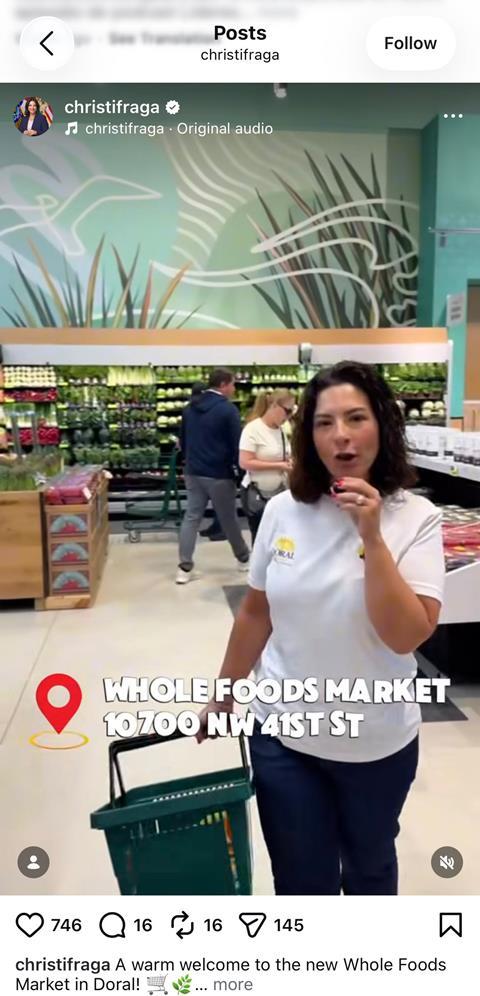
Doral, US: Whole Foods Market’s launch in this Florida city featured a come-shop-with-me Instagram reel from the town mayor drawing 5.5 million views, a giant challah and custom branded sourdough, while the first 300 shoppers took home a limited-edition tote and up to $100 off.
Collingwood, Canada: Canadian supermarket chain Farm Boy’s opening was announced with a communal sheet cake, a cowbell and a ceremony featuring mascots Lulu the Cow and an accompanying ‘farmhand’.
Lynnwood, US: Hundreds queued from 5am for the US debut of Chinese-Canadian grocery chain T&T, with the first 300 customers receiving a $10 gift card and exclusive Lynnwood city-branded magnets.
Doha, Qatar: The opening of Paris Hypermarket’s seventh Doha store ran to a full day of programming that included Arabic dance, balloon twisting, traditional music and a magic show.
Singapore: Grocery giant Sheng Siong has hosted new openings that feature lion and dragon dance performances preceding ribbon-cutting ceremonies.
Hong Kong: Grocery chain Wellcome has opened three retro-themed stores in 2026 featuring neon signage and architectural details inspired by the 1950s to 1970s. To mark the first opening, the retailer released a limited-edition tote based on its iconic red-and-yellow carrier bag, available with a qualifying minimum spend.
His conclusion is blunt: “A big enough and good enough store will get people through the door. If you concentrate on the look and feel of the store internally and less about the pizazz on opening day, people will feel good about it.”
Bryan Roberts of IGD takes a similar line but is more forgiving of M&S, arguing its openings work because they’re aimed at colleagues as much as shoppers. He observes that drone footage of new stores travels well on social media and that the freebies and the Percy Pig mascot reliably pull a crowd. M&S shines in contrast to some competitors, he says, where openings can feel like “more of a box-tick than a genuine celebration”.
On the question of at what cost a theatrical opening is worthwhile, Ged Futter, director of The Retail Mind and a former buyer, points out the cost of taking part is trivial: “All you’re doing is giving free stock. In the scheme of any kind of negotiation, this is peanuts.” The barrier isn’t cost, in his view, but appetite: “I don’t understand why more stores don’t create activations.”
Roberts points out that ROI on opening day extravaganzas are difficult to measure and, anyway, openings are often more of a defensive exercise. Every new store means fewer sales for a rival down the road, while grocers increasingly plan counter-marketing to blunt the impact of a competitor’s launch.
When it comes to competition, Yonder Consulting director Tom Wormald says the challenge (and thus, opportunity) is especially strong for new store openings when compared to reopenings. “Opening-day theatrics aim to change behaviour by persuading customers to establish an entirely new routine. That requires significantly greater investment and a much more deliberate strategy,” he explains. Success, Wormald adds, hinges on knowing how to capture and act on the insights gathered during a store opening, as this data then turns into a valuable long-term asset.
Waitrose has a clear strategy for and a broad set of measures to track opening-day success. Dow explains that, alongside tracking footfall and walk-in sales, the retailer monitors loyalty programme data, promotional incentive redemptions and digital engagement across social channels. It also captures anecdotal feedback on the day from shoppers, as well as sentiment data from ‘Have Your Say’ surveys that aim to establish customer advocacy.
Can smaller retailers afford to opt in?
There’s a reasonable assumption that this is a big-four and premium-tier phenomenon – established outlets have the marketing budgets to pull off flagship-scale launches that convenience chains and independents simply can’t match.
However, Futter points out that “the marginal cost of a few crates of free samples is negligible, so budget is rarely the real constraint – creativity and appetite are”.
Aldi’s recent activity supports his point: a carrot mascot greeting shoppers and a free bag of Super 6 fruit & veg for the first 30 customers, as was the case at the May opening of its new Salford Quays store, can generate attention at a fraction of the cost of a more lavish launch. Lidl follows a similarly restrained formula, often sending a dedicated bakery van to store openings to hand out free croissants, cookies and brownies alongside fresh fruit.
Wormald points out that including local schoolchildren at store openings is a fun and low-budget way to create buzz: “Their presence creates energy, excitement and atmosphere, helping transform a launch into a community event at relatively little cost.”
Yet not every store opening calls for fanfare. For smaller-format stores, a well-chosen location can be enough to draw footfall. Ryan makes this point in reference to openings at airport terminals. June saw a new Sainsbury’s open in Manchester Airport Terminal 3, while the month before Waitrose debuted in airport travel retail at London Heathrow Terminal 2.
“These locations are pretty handy for transient consumers,” Ryan says. “Oftentimes all they want is a meal deal. Do you need balloons around the outside to tell people a new store’s opening? Its presence is self-evident.”
Just as the mascots and balloon arches that once felt novel now feel like the minimum, trendy merch drops and live music performances run the risk of becoming the norm tomorrow. Ultimately, the retailers most likely to benefit long term are the ones treating the daily in-store experience – the sushi counter, the bustling bakery station, the well-lit produce aisle – as the real show, and openings as just the trailer.
“Theatricals and charitable giving should all be part of what a good retailer does every day,” says Wormald, adding that this is even more critical in the digital age. “Renewed investment in bricks & mortar retail isn’t simply about expanding their physical footprint. It’s about creating experiences that Online retailers cannot replicate.”





No comments yet