

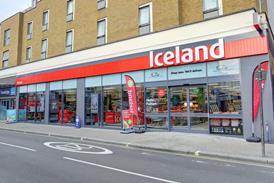




The supermarkets enjoyed a strong 2025 as many investors played defensively. M&S and Princes, meanwhile, are looking ahead to a big 2026
Investors had a wild ride in 2025. Led by a rampantly bullish US tech sector, global stocks have shot up by over 20%, and in the UK the FTSE had its best year since 2009 – all despite trade wars, real wars and tepid growth in developed markets.
 Consumer stocks, usually viewed as relatively dependable, have had their own dramatic gains and losses.
Food retailers
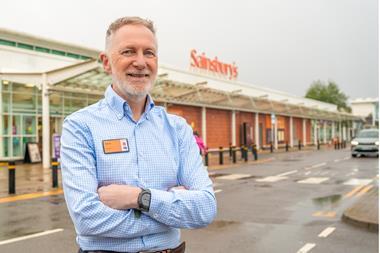
The divide is stark among retailers, with B&M’s share price (–51.8%) unravelling after a torrid year that contrasts markedly with major gains for Tesco (+20%) and Sainsbury’s (+18.8%).
Rewarded for their reliability, and the massive amounts of cash they’re generating thanks to still-elevated inflation, the supermarkets have enjoyed a strong year in part due to their reputation as a safe haven from a depressed consumer market.
“The consumer environment is pretty tough – and it’s tough globally,” says Bernstein analyst William Woods.
“When you look at staples, you have an option between food retailers, beverages companies and fmcg guys – they also have challenges, and therefore food retail is quite a simple and defensive place to hide.
“It doesn’t have very high return on invested capital, but earnings have gone up, they’ve beaten guidance, and inflation is high so it’s driven up the like-for-likes.”
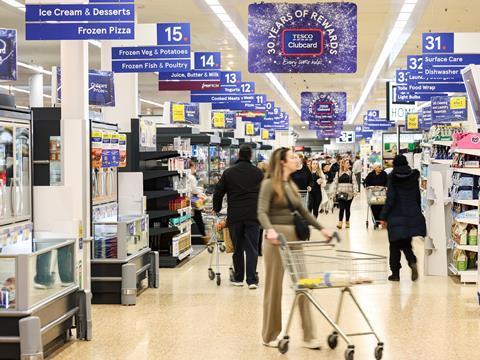
Strong first-half results saw both raise profit expectations, and both gained market share at Christmas.
Tesco’s trading update this week revealed UK supermarket sales rose 3.2% in the six weeks to 3 January, but a 2.1% decline at Booker meant group growth was slower, at 2.4%.
This, together with its strong share performance in 2025, means it will now “be judged more harshly for the slightest misstep”, says AJ Bell’s Russ Mould, despite hitting a more than 10-year high market share of 29.4% [4 w/e 28 December].
Tesco and Sainsbury’s solid good fortune is in contrast to former star performer M&S. While it was only down 12.1% on the year mark, its stock bucked wildly during 2025 due to the cyberattack of April.
Food sales were up 6.6% in the 13 weeks to 27 December according to its trading update, but clothing & home declined by 2.5%, leaving group growth excluding Ocado at 3.3%.
Shore Capital’s Clive Black called it “a solid sales performance… and if the firm meets and beats our unchanged FY27 expectations, its equity is grossly undervalued”.
Ocado Group has a less rosy picture ahead. The continued correction from its overheated pandemic valuation – at £21.7bn it was valued higher than Tesco in late 2020 – has continued, with shares falling 21.1% in 2025 thanks to the dilution of its US partnership with Kroger in November.
WH Smith’s shock revelation in August of a £40m black hole in its US profits knocked 46.3% off its share price last year. CEO Carl Cox fell on his sword in November, and a review has forced it to re-evaluate its expansion strategy abroad.
B&M also had to confess an accounting error. Just weeks after its new CEO launched a “decisive plan” to find growth, a £7m hole was revealed – leaving investors unimpressed with its financial controls, not to mention its falling like-for-likes.
Alongside costing CFO Mike Schmidt his job, the error forced the variety discounter to issue an H1 profit warning in October, having issued two the previous financial year. Shares sank to a 10-year low of 155p in December.
Manufacturers and suppliers
Where the more stable retailers have benefited from their status as cash-rich defensive picks in times of turmoil, a few major consumer staples stocks have hit real trouble.
Worst off has been Treatt, which suffered a 57% drop in its share price last year, as investors fled in the wake of a July profit warning and a sale process spiked by competitor and 28% shareholder Natara.
The sale had been recommended by Treatt’s new CEO David Shannon, who spent much of his year-and-a-half tenure overseeing the deal, which valued it at £174m. He resigned at the end of the year – and thanks to the run on Treatt’s stock following the debacle, its market cap is now well below the deal value, at £125.2m.
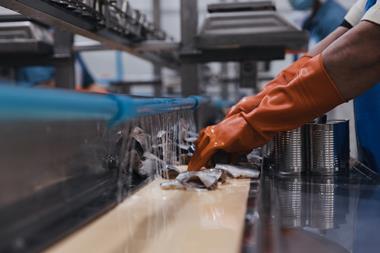
Protein giant Hilton (–44.8%) has likewise suffered, as beef and fish prices rocketed through the year and it was forced to halt work at its Greek smoked salmon factory thanks to a US government shutdown delaying food safety approvals.
“Fish isn’t seen as an everyday purchase: when the price goes up, it’s a lot more impactful than a price increase in poultry,” says Peel Hunt head of research Charles Hall.
Hilton had to downgrade its profit guidance in November, leading CEO Steve Murrells to step aside, replaced by non-executive chair and former Dairy Crest CEO Mark Allen who is leading the business as interim executive chair – a move praised by analysts.
“I think he’ll be very positive for the business,” Hunt says.
“Shareholders can see that there needs to be a bit of work done to put the business back on track, but the long term still looks really attractive.”
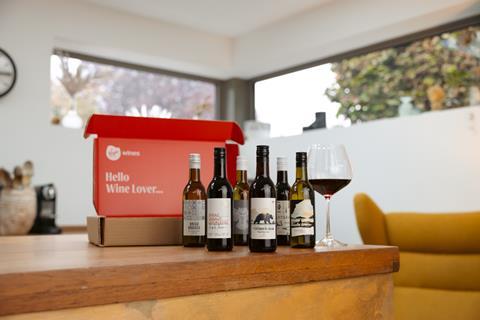
Riding high at the other end of the scale are a pair of DTC wine merchants, Virgin Wines UK (+87.7%) and Naked Wines (+50.7%) – both profiting from successful turnaround programmes that have pulled them up from a post-Covid hangover.
Bakkavor (+63%) and Greencore (+30.1%) have both benefited healthily from their pending merger, which is anticipated to unlock £80m in cost synergies between them.
Cleaning product suppliers McBride (+39.2%) and Reckitt (+26.6%) have both won over investors despite a tough market.
Applied Nutrition (+79.6%), too, has soared in its first year on the public market after knocking out a 24.2% rise in sales to £107.1m, well above initial forecasts.
The company has been continually re-rated as investors take notice of its strong underlying business model, according to Panmure Liberum’s Wayne Brown, who compared it with global beauty players.
“Yes, Applied is relatively smaller than them, but that’s why this opportunity is so exciting. It’s growing rapidly and has a global distribution model that maximises reach,” he says.
But it is on Princes that eyes will be most fixed next year following its October 2025 IPO. Armed with a reputed war chest of £1bn, it now stands behind Pilgrims and Muller as one of the UK’s biggest food suppliers.
While its initial flotation of around just 13% of equity disappointed hopeful onlookers – and shares have broadly remained below the 475p float price – there is much to look forward to, according to Hall.
“Just as Unilever and others are slimming down their portfolios and focusing on core product areas, Princes could easily be the other side of the equation,” he says, pointing to the company’s “very entrepreneurial” focus and urgency – and significant manufacturing capacity.
“There are lots of opportunities for them to be a real business of scale.
This is just the start – it’s not a huge free float at the moment, but as it gets going, more people will look at it with interest.”




No comments yet