


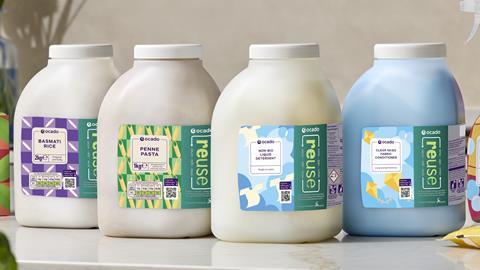
After missed targets and failed pledges, a scaled-up reuse model remains a vision. Can a new retailer promise make a difference?
A potential breakthrough has arrived in the industry’s rollercoaster war on plastic .
.
Last week, a who’s who of supermarkets signed a “declaration of intent” to introduce a game-changing new reuse model in the next five years.
The pledge – by Tesco, Sainsbury’s, Asda, Aldi, Morrisons, Lidl, Co-op, Waitrose and Ocado – is for vast swathes of the supermarket shop to be transformed by the mass rollout of reuse technology.
If the vision is to be achieved, it will require not just an unparalleled collaboration between retailers, but agreement from suppliers to a huge overhaul of packaging, branding and logistics.
So what is the challenge set by supermarkets? How much detail is in the pledge? And does it stand a chance of succeeding without regulatory action from government?
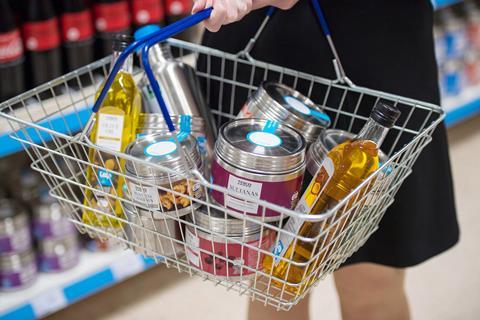
Under the pledge, grocery members of the UK Plastics Pact – overseen by Wrap – have agreed to roll out a new reuse model by 2030. That will aim to achieve the use of interoperable pre-filled and reusable packaging “at scale”.
The packaging design will allow customers to return and refill multiple times, in a bid to eliminate huge amounts of single-use plastic.
Tesco head of packaging James Bull, who chairs the retailer group, describes it as an “important first step” in achieving a more circular economy.
The move follows talks between the retailers and Wrap a year ago, during which the supermarkets were asked to identify at least one key food category that could switch entirely to refillable or reusable packaging.
Wrap also called for 30% of all own-label sales by volume to be delivered in either refillable or reusable packaging by 2035.
Supermarkets aren’t just facing pressure on the environmental front, either. There are also financial penalties at stake in the form of extended producer responsibility (EPR).
The industry could slash EPR bills by over 90% with a nationwide reuse model, suggested modelling from sustainable packaging consultancy GoUnpackaged last month, backed by an advisory panel including representatives from Tesco and Ocado.
Across the 25 categories examined, it identified potential to knock £136m off EPR costs through reuse. The study estimated packaging and waste could be cut by 95%, equating to 300,000 tonnes a year.
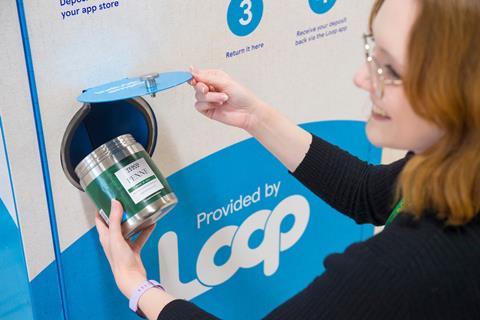
The supermarket announcement last week cited the research as evidence of the rewards at stake. Their united stance comes after the failure of various go-it-alone retailer refill and reuse pilots – including Tesco’s own Loop returnable container trial from 2021 to 2022.
| Plastics Pact progress since 2018 | |
|---|---|
| Target | Achieved |
| Eliminate problematic or unnecessary single-use packaging. | 99.8% reduction in problematic plastic items. |
| 100% of plastic packaging to be | 70% of plastic packaging is reusable or recyclable. |
| 70% of plastic packaging effectively recycled or composted. | 59% is effectively recycled or composted. |
| 30% average recycled content across all plastic packaging. | Average recycled content across all plastic packaging is 26%. |
Devil in the detail
However, apart from the 2030 date, meaningful targets are lacking in the pledge. There is also no mention of the 30% own-label target set by Wrap in last year’s talks.
“This is a significant step forward, as a public collaboration across retailers is absolutely key to driving reuse,” says one leading source close to the developments. “However, it needs more detail in the form of smart (specific, measurable, achievable, relevant, and time-bound) targets. We need to know what percentage of packaging will be reusable and by when. We need specific dates.”
It was also striking that Wrap, which has been at the forefront industry efforts to tackle packaging, was at pains to stay at arm’s length from the announcement. The NGO is in negotiations with retailers and suppliers on the launch of a Plastics Pact Mark II, to follow the “trailblazing” initial campaign launched in 2018.
In November, The Grocer revealed reuse was to be a “core pillar” in the new targets. Greater ambition was seen as necessary after Plastics Pact I, despite high hopes, missed half its key targets and only led to a 7% reduction in packaging.
However, the controversy isn’t all about the lack of targets. An even more glaring absence in the announcement, the source says, is any mention of suppliers. This is seen as the biggest challenge, given suppliers face an enormous shake-up of packaging, with major implications for supply chains and marketing.
Tesco’s Bull says the statement of intent “signposts to our wider supply chains our intent to build reuse at scale”.
But it could spell the end for some suppliers, unless they are able to adapt to the new model.
Collaboration is therefore vital to success, stresses GoUnpackaged director Catherine Conway. “A successful reuse strategy will involve some standardisation of packaging formats across and within product categories.
“To achieve the vision of scaled reuse, there needs to be a collaboration with the supply chain, reuse experts and the government to determine the most relevant and benefit-led (economic and environmental) categories and SKUs to transition.
“We need to determine how best to organise new elements of the supply chain with things such as reverse logistics, sorting and washing, and key elements of packaging standardisation.”

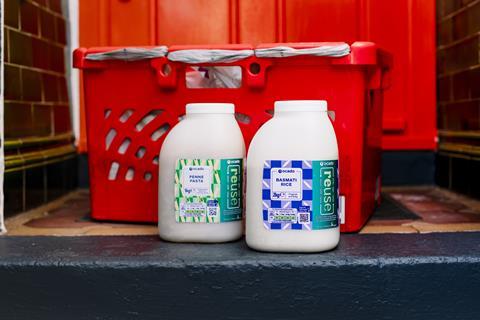
Standardisation was the aim of the Refill Coalition, convened by GoUnpackaged in 2020. The collaborative initiative aimed to create standard refill and reuse solutions, which led to a pilot with Ocado.
The latest agreement may have more supermarkets on board, but any standards “need to be done in partnership [with suppliers]”, Conway stresses.
“Previous trials have often started with just one side of the equation but, to achieve scale, we need to build the correct system. It is in suppliers’ best interests to engage early to have a say in how these standards take shape, and not be left behind by brands and private labels that proactively heed the public demand for action.”
That’s assuming companies don’t leave behind the pact entirely. In the US, there has recently been an exodus of prominent members from an equivalent initiative.
Walmart, Mondelez, Mars, Nestlé and L’Oréal all baulked at the US Plastics Pact’s plans to set tougher targets.
Government buy-in
There is also the question of just how much any pact can achieve. Wrap has previously said voluntary moves by the industry won’t be enough.
Last year, it urged the government to bring in regulation that would obligate retailers and suppliers to make major changes by 2025. It suggested making use of the incoming deposit return scheme, the plastic tax and EPR to encourage a shift away from single-use packaging.
On that note, one senior retail figure sees government involvement as another missing ingredient in the supermarket pledge. “What exactly is the government’s vision?” the source questions.
“If there is to be this huge shift to reuse, we need some political leadership that sets out plans for the next 10 to 15 years.
“This is a massive economic and cultural shift we’re talking about, yet we’ve heard virtually nothing from Defra about what it actually wants.
“The resources and waste strategy was published seven years ago. Why hasn’t that evolved properly?”
Still, Conway urges the industry to avoid using ministerial inaction as a reason for stasis. “The retailers’ proactive stance sends a clear signal to the government that industry is willing to play its part in driving the transition to reuse,” she says.
“Government can now work with industry to design the right regulatory framework to drive reuse, and hold industry to account. Retailers and brands shouldn’t be waiting for regulation to make this happen.”
Forward-thinking retailers and suppliers will know better than to wait for the government to take a lead by now. But the challenges of switching to a new reuse model are such that it is going to test even the biggest companies, let alone those further down the supply chain pecking order.






No comments yet