


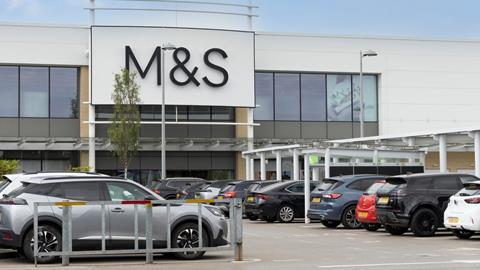
In a flat market, M&S’s volume growth is extraordinary.
This morning the own-brand specialist revealed food volumes were up 11.9% in the first half of the year, powering a remarkable comeback from last year’s cyberattack.
As other major grocers grapple for market share, M&S is sailing past them – and the other grocers will be “looking over their shoulders”, according to eToro market analyst Mark Crouch.
Over the past two years – and despite the disruption of last year’s cyberattack – M&S’s food revenues have climbed by 23.7% to £5.2bn as it makes the shift from purveyor of ‘picky bits’ and fancy Christmas gammon to a full-blown weekly shop grocer.
Over that time, “one-and-a-half million more customers are shopping with us”, boasts CEO Stuart Machin alongside this morning’s results.
“Our continued focus on quality, innovation and value is appealing to more families, as we become more of a shopping list retailer.”
That last point is crucial. In the same way that Sainsbury’s has targeted big-basket growth, M&S now explicitly wants to capture more of the family shop.
High-quality basics
It might seem odd that a premium retailer is doing so well in today’s subdued economic environment. But fundamentally, the M&S Food offering is about value. Its no-frills, own-label approach and strict sourcing policies hold enormous appeal to modern shoppers looking for high quality basics, and it has long played well in the premium end of the market. It also helps that the retailer has invested roughly £50m in pricing this year.
“We upgraded 400 products in the half,” says Machin. “That goes back to our strategy across the whole business – if in doubt, put quality back in.”
And for shoppers increasingly unconcerned about branded ranging, and more interested in trying unusual new foods they’ve seen on TikTok, the retailer offers a strong choice. It introduced more than 850 new products in the half, including, for the first time, own-branded pet food.
“All of this is translating into bigger basket sizes as more families trust us with their weekly shop,” Machin says.
It’s this combination of “strong value for money and innovation” that has powered volume growth, according to RBC analyst Richard Chamberlain.
In today’s health-conscious world, consumer appetite for clean-label, quality versions of familiar products has only cemented the grocer’s appeal, and M&S has cannily played into that trend with its ‘Only X Ingredients’ range of essentials made with eight or fewer ingredients.
It’s an important distinction for M&S shoppers, and, increasingly, shoppers in general.
“Our whole Italian range is UPF-free,” Machin adds. “Our new fresh pasta uses 100% olive oil, and a new Italian flour blend for a silkier texture. Our pasta sauces are now made from 100% Italian slow-cooked tomatoes, and we’ve removed any added sugar.”
M&S’s remarkable revival
The food division’s execution has been driven in part by a £750m capex programme to revitalise its stores, supply chain and technology, and is the product of a four-year-long drive under its Reshaping for Growth strategy under Machin.
The programme has delivered stunning results for M&S’s food division, with an enviable 5.6% adjusted operating margin that will effectively power the group’s profits for the year.
The question now, however, is whether Machin can do the same for M&S’s fashion retail, where margins fell two percentage points below analysts’ expectations.
Continued disruption from the cyberattack and a tough summer for fashion retail overall certainly haven’t helped so far, though sales have recovered with 17.5% growth.
“The brand is in good health, but the results fall short of their potential and show there is a lot more to do,” Machin says, adding the division is “in the foothills” of its transformation with a supply chain and sourcing revamp due to come.
“[Today’s] results are positive overall – they underline the extraordinary strength of the food business and show a sales recovery in clothing,” says Bernstein analyst Richard Trainor. “But it underscores the scale of the task ahead to fix clothing profitability.”
Some investors will be eager for the challenge. With M&S shares up 125% in the last 12 months, the prospect of further growth is attractive indeed.
“With Christmas approaching, a stronger balance sheet and growing food business give management considerable momentum,” says Crouch. “Investors have already rewarded the turnaround enthusiastically, but restoring clothing profitability could give M&S’s remarkable revival considerably further to run.”
For now, one must wonder what other retailers are thinking. Premium own-label is one of the fastest-growing segements of grocery, full stop. And it’s a tough proposition to go against a competitor for whom – well, it’s sort of M&S’s whole deal.
Over in M&S HQ at Waterside House, there will be some justified pride. Because as one IG analyst puts it: “These aren’t just any numbers. They’re M&S numbers.”


No comments yet