







The US health secretary, Robert F Kennedy Jr, has announced new dietary guidelines for Americans urging a move to “real food and common sense”. But jumping on this protein bandwagon is something UK policymakers would do well to avoid.
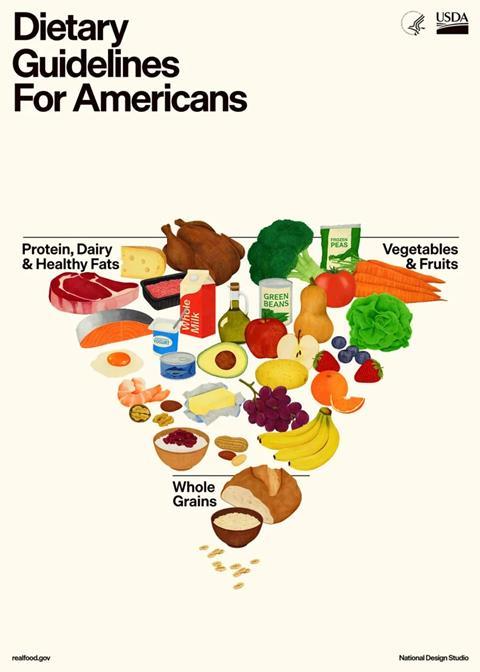
To emphasise his focus on “real food”, RFK has updated the visuals that accompany the recommendations, inverting the traditional food pyramid to put animal proteins and full-fat dairy at the top.
While there is a cursory nod to plant-based proteins and fats, this visual pyramid is dominated by hunks of meat.
Americans should consume protein “at every meal” according to Kennedy, with the health department doubling the recommended daily intake from 0.8g per kilo of body weight to 1.6g.
This ignores the fact that the average American already gets more than the previous recommended amount of protein – with population data showing consumption at around 1.2g-1.4g per kg of body weight. For context, the UK recommends 0.75g per kg of body weight.
A meaty issue
Most of this protein is being consumed via meat (almost 25% of which is processed) and animal products – indeed, meat consumption in the US has nearly doubled in the last century. The average American now eats more than three times the global average, according to the UN‘s Food & Agricultural Organization.
This is a massive health problem: a strong body of scientific evidence links excess meat consumption, particularly red and processed meat, with heart disease, stroke, diabetes, obesity, colorectal cancers, and earlier death.
This means the new US guidelines – which will inform, for example, how 4.8 billion school lunches are designed – now contradict a wealth of scientific studies on diets and disease.
Having such a laser-focus on protein also diverts attention from the positive changes people can make: increasing fibre intake, plant diversity, and overall healthy eating. This is neither new nor rocket science. There is a growing body of evidence showing people with diets rich in fruit, vegetables, and plant-based proteins, such as those found in beans, pulses and plant oils, have better health outcomes on almost every measure.
Also missing from the document is any mention of sustainability. Failing to link diet with the imperative of tackling climate change and nature loss leaves America out of step with the rest of the world. Nine out of 10 countries which have updated their dietary guidelines since 2019 have incorporated planetary and human health, according to the UN’s food agency.
Study after study shows there is no way we can stay within planetary boundaries without changing what we eat and how our food is produced. Livestock agriculture accounts for between 11% and 20% of all global greenhouse emissions and nearly a third of the potent planet-warming gas methane.
The most comprehensive study of the global food system, the Eat-Lancet 2025 study, made clear that human and planetary health are intimately connected. It found more moderate meat consumption would significantly lessen emissions, while also preventing 40,000 deaths a day globally.
A big year in UK food
2026 is set to be a big year for food in the UK. The government is currently working towards a national food strategy, as well as further developments for the 10-year health plan for the NHS.
Unhealthy diets are already a major drag on the UK, with an estimated cost to us of £268bn a year in healthcare costs and reduced economic activity, according to the Food, Farming & Countryside Commission.
What has happened in the US is a stark reminder of the need for the UK to develop its plans based on expert-led scientific research.
As we work towards the UK’s food strategy, we must not lose sight of the UK government’s goals to build a “healthier, more affordable, sustainable, and resilient food system”.
Ali Morpeth is a public health nutritionist and co-founder of Planeatry Alliance










No comments yet