




If you had a two-metre-long aquatic dinosaur, a silent, whiskered behemoth so adapted to life in the murky depths that it has not evolved since the mid-Jurassic – would you keep it in your pond?
Yes. Obviously yes. Wild horses couldn’t tear me away – give me the dinosaur.
What about 150?
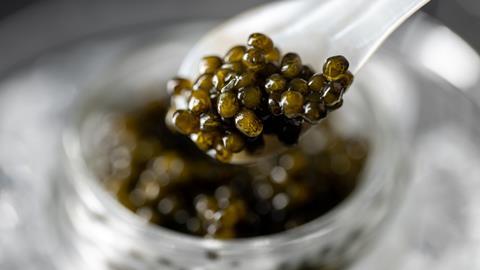
That’s the life of a sturgeon farmer – like Yorkshire’s own Mark Addey of the Sturgeon Sanctuary. Seeking £500k to launch back into the caviar trade, he recently told The Grocer of his vision for an enterprise that would act as the UK’s first-ever sturgeon sanctuary, rehoming giant fish that have outgrown their owners’ ponds, and harvesting eggs worth thousands of pounds per kilo.
Aiming for a farm of 150 fully mature female fish, and tens of thousands of juveniles, Addey would step back into his role as one of very few caviar farmers in the UK if successful in the raise.
A niche market
Obviously, it’s a niche market. And a decade ago, Addey was the first to introduce no-kill harvesting techniques to the UK – making a premium product even more rarefied.
But ironically, he explained, there simply isn’t the money in caviar to be able to sustain solely no-kill farming. Man cannot live on caviar alone – and Addey subsequently has plans to trade in rehoming sturgeon and selling ornamental breeds of the fish.
If he did not, it would be a matter of the fishes’ survival instead: it is far more economical to slaughter the gentle giants than to live-harvest.
The dilemma has come because cheap Chinese imports – like in almost any market you care to name – have driven the price of caviar down. The country’s share of the global trade has exploded over the past decade-and-a-half, rising from around 14% in 2012 to 43% of the global total in 2024, as sanctions cut into Russian trade following its invasion of Ukraine.
Chinese caviar is backed by the state, with a single producer developed by its agriculture ministry, Kaluga Queen, producing 35% of global harvests in 2024.
These competitors can offer prices as much as £700 cheaper per kilo – and many UK buyers no longer seem to value the ‘ethically produced’ label favoured by some European no-kill farms, according to Addey.
For a so-called nation of animal lovers, it seems tough luck that this softness doesn’t extend to fish.
Rather, it’s a shame that even those who can afford caviar – a delicacy but, objectively, a frippery – would choose to save money rather than lives, no matter how unusual.
It’s not as if caviar buyers have the same (slippery) route of argument as those still selling battery-farmed eggs – that it is necessary to make a nutritious product accessible to the poorest in society.
So when you next buy a tin of caviar… Sorry. If you ever buy a tin of caviar, check the label. You might just save a dinosaur’s life.


No comments yet