





The co-founders of Ben & Jerry’s have called on The Magnum Ice Cream Company (TMICC) to release the brand from its ownership, as a dispute over the “erosion” of Ben & Jerry’s progressive voice boils over.
“We feel compelled to speak out,” wrote Ben Cohen and Jerry Greenfield in open letters to investors and the TMICC board – published as TMICC CEO Peter ter Kulve took to the stage in London to convince investors to back the company ahead of its IPO in November.
Cohen and Greenfield claimed the brand’s autonomy to pursue social campaigning – “guaranteed” under its 2000 acquisition agreement – had been limited by Unilever. The pair left Ben & Jerry’s following the sale, but entered talks to buy back the brand in early 2025, according to Bloomberg reports.
“For several years now the voice of Ben & Jerry’s has been silenced by Unilever, particularly when the brand has tried to speak out about social justice and unjust wars,” they said.
“That is not the Ben & Jerry’s we founded, or the one that we envisioned when we agreed to join Unilever 25 years ago.
“We no longer believe that Ben & Jerry’s belongs under the umbrella of a corporate entity that fails to support its founding mission, and which is reducing the company’s value by undercutting one of the critical reasons why customers love and support the brand.”
Despite the letter’s publication being timed to coincide with TMICC’s pre-IPO presentation to potential investors, Cohen and Greenfield said their purpose was not “antagonistic” but rather ”genuine concern” for the company they founded.
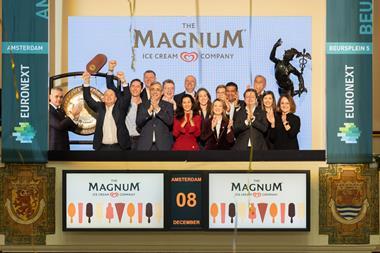
While Magnum will shortly be independent from Unilever – and completed its internal separation internally in July – the conglomerate will remain one of TMICC’s largest shareholders, and will likely have “significant influence” over Magnum’s governance and choice of executive team.
In July, Ben & Jerry’s social mission board – an entity set up to protect the company’s independence of thought following the 2000 merger – entered into a bitter spat with Unilever over the removal of its former CEO, Dave Stever, and sued it for breaching its merger agreement.
In court filings, the company said Unilever’s removal of Stever was an attempt to clamp down on its political views, and violated the agreed process for replacing the company’s top executive because it had not properly consulted the board.
Ter Kulve said in late August that he was “comfortable” about the court case, because the “contracts are clear”.
“We have a governance dispute with this board, not the Ben & Jerry’s company – because that is us, TMICC – but with the board around the nature of the social mission, that they should by contract be progressive but nonpartisan.”
The legal dispute was only the latest escalation in a long-running feud between Ben & Jerry’s independent board and Unilever: in July, Unilever reportedly cut millions in funding to Palestinian nonprofits; in May, the board had called the destruction of Gaza a genocide.
Cohen and Greenfield said: “We believe decisions made by Unilever which affected Ben & Jerry’s advocacy cannot be separated from Magnum – including on issues such as Gaza, indigenous rights, the Trump administration and DEI.
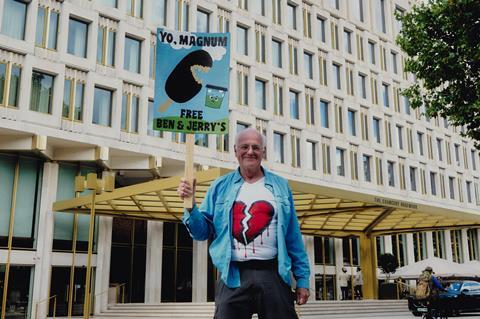
“We intend to campaign for an independent Ben and Jerry’s, owned by values-aligned investors, and plan to mobilise a group of concerned stakeholders and supporters to strongly encourage Magnum to rethink the inclusion of the brand in its future.”
A TMICC spokeswoman said: “Ben & Jerry’s is a proud part of The Magnum Ice Cream Company and is not for sale. We remain committed to Ben & Jerry’s unique three-part mission – product, economic and social – and look forward to building on its success as an iconic, much-loved business.”








No comments yet