





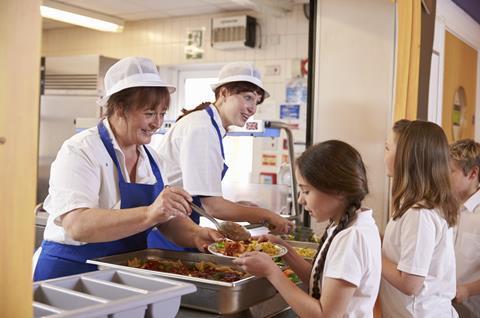
Deep-fried food and fruit juice will be banned from school menus, the government has announced, in “once-in-a-generation changes” to school food standards.
Under the updated framework, which was published by the Department for Education today (14 September), all meals must contain or be served with at least one portion of fruit or vegetables, while fibre and wholegrains will be increased.
Sweet desserts will be reduced to twice a week in secondary schools and once a week in primary schools, and must be served alongside a portion of fruit.
Processed meats such as ham, sausages and chicken nuggets can only be served once a week and must be accompanied by a side of vegetables or fruit.
Fruit juice will no longer be permitted on school menus, in a move British Soft Drinks Association director general Andy Bagnall has described as “counterproductive”.
“A 150ml portion of fruit juice counts towards 5 a day as part of a balanced diet, and provides vitamins and other nutrients,” he said. “With 17% of children deficient in vitamin C and 12% deficient in folate, removing an accessible source of these nutrients risks making it harder for some children to achieve a healthier diet.
“We hope the government will closely monitor children’s nutritional status and be prepared to put juice back on the menu if vitamin C and folate intakes fall further.”
The updated standards are due to come into effect from September 2027, subject to final parliamentary approval. While the changes have been widely supported by the school food sector, fears around funding and monitoring continue to be raised.
The government said the changes would be funded with existing money for schools.
Association of School and College Leaders general secretary Pepe Di’Iasio said the current funding rate for free school meals was “not enough to cover costs”.
“Many schools have to divert money from teaching and learning in order to afford this vital provision,” he said.
Last year, the government increased the rates for free school meals by 3p (or 1.16%) to £2.61. Prior to this, free school meal funding had increased by just 12% since 2013.
A survey by industry body The School Food People found 78.3% of caterers believed a figure between £3 and £3.20 was more realistic for a two-course lunch.
Brad Pearce, national chair of The School Food People, said that as the standards roll out, “it is vital that we protect the strength and sustainability of the school food sector that will be responsible for delivering them”.
He said this would involve “realistic funding, a practical and fully supported implementation plan, investment in the workforce and kitchens, and sufficient time for caterers and suppliers to adapt and reformulate products where necessary”.
He added that a close eye must be kept on meal uptake. “New revised mandatory school food standards, while very much welcome, can only actually improve children’s diets if pupils continue to choose school meals,” Pearce said.
Until now, there has been no formal national enforcement mechanism to penalise schools that breach standards. However, the government has confirmed that schools will be required to publish menus and food policies online, and nominate a school food governor, while monitoring arrangements will be developed alongside the Food Standards Agency.





No comments yet