





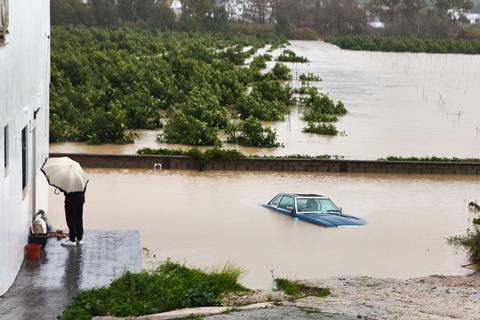
The UK’s winter supplies of key fruit and veg items could be hit after floods “devastated” farms in Spain and Morocco.
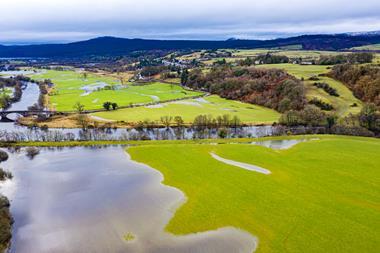
Extensive rainfall caused by Storm Kristin last month, exacerbated by the impact of Storm Marta over the past week, have led to catastrophic crop losses for growers in the two countries – which supply significant proportions of the UK’s fruit and veg in winter.
Up to 40,000 hectares of farmland had been hit by the storms, said the Spanish Association of Agri-food Cooperatives this week, with damage – centred on Andalusia – estimated to have cost the sector at least €35m.
Strawberry producing association Freshuelva said it expected exports to be down 50% year on year, with the storms “affecting both crops and production and handling infrastructure”.
Meanwhile, Spanish farming union Coordinadora de Organizaciones de Agricultores y Ganaderos (COAG) reported an “unprecedented emergency situation” in Andalusia, with “thousands of hectares flooded and greenhouse structures destroyed”.
Avocados, citrus, herbaceous plants and winter crops (such as brassicas and cabbages), plus a variety of other vegetables and cut flowers have been badly hit.
And as much as 80% of the region’s olive crop had also been destroyed, COAG said – leading to a “growing employment crisis” in the key olive oil producing region and across the wider horticulture sector.
Alongside widespread waterlogging, even undamaged crops were also now at risk of further losses due to disease, it warned.
Most regions in Spain saw at least double their typical rainfall in January, said Expana weather and crop researcher James Tyler.
Morocco production hit hard
The situation is equally dire in both Morocco and Portugal, with North African media reporting more than 140,000 people had been evacuated due to flooding in northern Morocco, which has received an average of more than 140% more rainfall than it usually would at this time of the year, Tyler added.
Up to 30% of the country’s berry farms were flooded, with significant damage to greenhouse structures too, said Amine Bennani, director of Phyto Loukkos, the Moroccan Association of Soft Fruit Producers.
“We’re also suffering from an absence of workers due to the evacuations,” Bennani told The Grocer. “The production is low now and will be at the same level for two or three weeks.”
Alongside strawberries, a raft of other key Moroccan crops currently in development may also be impacted by these wet conditions, said Expana’s Tyler, including artichokes, carob, cumin, melon, peas, peppers, spring onions and tomatoes.
“Flooding could also directly damage trees in orchards and groves, such as almonds, apricots, figs, olives, plums, and pomegranates,” he warned. “Notably, Moroccan spring onions have historically been vulnerable to heavy rainfall in January and February, as saturated soils can stunt growth and increase the risk of rot. ”
Analysis of HMRC data by the thinktank the Energy and Climate Intelligence Unit shows that Morocco and Spain are “two of the most important sources of fresh produce for the UK at this time of year”.
Thc countries supplied 58% of the UK’s tomatoes last January, 72% of its cucumbers, 57% of its strawberries and raspberries and 75% of its sweet peppers.
“The recent storms demonstrate the exposure of our food supplies to extreme Weather, made worse by climate change,” said ECIU land, food and farming analyst Tom Lancaster.
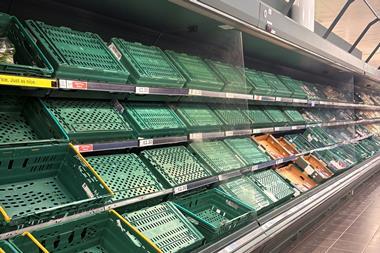
“It’s too early to say if this will disrupt supplies for British shoppers, but many will remember the impact of similarly extreme weather in early 2023, that left British shelves empty of tomatoes, cucumbers and peppers,” he added.





No comments yet