




Marks & Spencer has been urged to stop sourcing “factory-farmed salmon” in the latest campaign from activist group Project Slingshot.
The eight-week campaign includes a satirical film starring Chris Packham, more than 5,000 London Underground adverts and an email campaign, inviting members of the public to email M&S chief executive Stuart Machin.
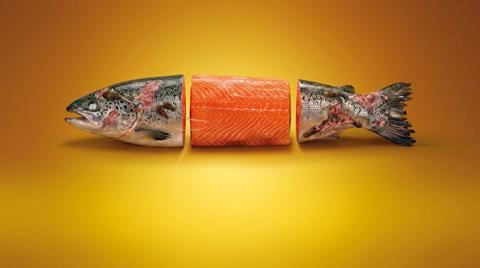
The video shows Packham enjoying ”the perfect picnic” with a salmon meal. However, it comes with “chemical condiments” and a colour chart. The ad is designed to draw attention to sea lice, chemical treatments and feed used to turn flesh pink.
The activist group has also pressed M&S to create a timetable outlining when it would implement potential changes.
The campaign comes as M&S and Scottish Sea Farms – the exclusive supplier of M&S farmed salmon – have celebrated 20 years working together.
Packham has called on M&S “to use its influence to help end factory-farmed salmon”.
“Confining them in sea cages exposes them to excessive levels of parasites, a range of diseases and practices that cause extreme suffering,” he added. “And the damage doesn’t stay inside the farm – their waste and toxic chemicals destroy marine life and this, plus frequent escapes, put Scotland’s endangered wild salmon at risk.”
The Grocer understands that salmon is not grey when wild or farmed due to the cartenoids from their diet and that chemicals are not used on the salmon meat.
The campaign is the third undertaken by Project Slingshot this year, following those targeting CO2 stunning of pigs and fast-growing chicken breeds.
Project Slingshot also took issue with M&S’ ‘Lochmuir’ brand, which the group’s co-founder, Naomi Hallum, said used a “loch that doesn’t exist” to tell a story of “care and pristine Scottish waters”.
However, The Grocer understands that M&S has not used the brand for some time – on its website, as of 6 October, no ‘Lochmuir’ products can be seen.
Responding to the campaign, an M&S spokesperson said the supermarket’s farms “uphold the highest standards of welfare”. The Grocer understands that the phrase factory
”We only work with select farms that we know and trust and they are independently monitored,” they added.
An SSF spokesperson added that the business was “committed to farming responsibly with the highest standards in the industry for fish health [and] welfare”.
”To meet the demand of one of the UK’s most popular fish, we need to farm salmon, and we do that responsibly in conditions that replicate their natural environment as closely as possible,” they added. ”That means deep, cold sea lochs and seas with fast-flowing, well-oxygenated waters and strong currents.”
SSF fish are situated in their natural environment in pens made up of 98.5% water and 1.5% fish - the lowest stocking densities in the industry, The Grocer understands.
Questions over financing
Industry body Salmon Scotland said the claims made by Project Slingshot presented “a distorted picture and come amid growing concerns about overseas ‘dark money’ funding campaigns against the sector”.
It said the campaign was “not an independent assessment of Scottish salmon farming” but was, rather, an initiative “from a vegan-led activist group” that has “already targeted the pig and chicken sectors and is backed by substantial US funding”.

“These activists do not speak for the thousands of people whose livelihoods depend on Scottish salmon, or the millions of consumers who choose the UK’s most popular fish,” the organisation added.
However, Project Slingshot hit back at the claims made by the salmon industry body, with Hallum saying “when an industry’s response to evidence about its own practices is to talk about who is asking the questions, that tells you something”.
“Our leadership team includes vegans and non-vegans,” she added. “What unites us is a belief that the public deserves honesty about how their food is produced.”
Hallum added the group was open about its funding, saying £150k had originated from public donations, with the rest coming from charities including the Karuna Foundation and Coefficient Giving.
She also pointed to the apparent hypocrisy in Salmon Scotland’s comments, “given that most of Scotland’s salmon industry is itself owned by overseas companies”.






No comments yet