



Several big names have yet to sign up to Wrap’s new scheme, citing the failure of the first Plastics Pact, intangible goals and increased costs
The food industry, or at least elements of it, announced the founding partners for the second phase of its war on plastic packaging last week.
With 55 signatories, including retailers, suppliers and academics, the UK Packaging Pact’s initial lineup was announced as the UK Plastics Pact came to an end. The first pact achieved mixed results, albeit with some big gains in stripping plastic from supermarket shelves.
But as The Grocer revealed, the new agreement now faces a battle to win backing, with many of the UK’s biggest companies notably absent.
A number of companies that helped spearhead the previous pact, including Coca-Cola, Unilever and a raft of supermarkets, are missing. Tesco added its name at the last minute.
So can the new pact overcome the apparent divide?
Helen Bird, head of material systems transformation at Wrap – orchestrator of both pacts – claims the atmosphere at last week’s launch event suggested it can. “To have some of the biggest retailers and manufacturers already signed up is really encouraging and we’re pretty happy at this point,” she says.
“We’re really proud of what we’ve achieved with the Plastics Pact. Now, for the UK Packaging Pact, we are looking at a complete system overhaul.”
Wrap also notes it will not be until April that the new pact has its hard launch.
“We are going to be announcing the full list when we launch,” adds Bird. “The first 55 have signed, but there are many who have given verbal backing. For many of them it’s going through their governance process.”
20 big-name Pact I members who have yet to sign Pact II
Retailers:
- Sainsbury’s
- Morrisons
- Aldi
- M&S
- Waitrose
- Spar UK
- Boots
Brands/suppliers:
- Birds Eye (Nomad Foods)
- Britvic
- Coca-Cola Europacific Partners
- Colgate
- Danone
- General Mills
- Kimberly-Clark
- Mars Wrigley
- McCain
- PepsiCo
- Procter & Gamble
- Reckitt
- Unilever
Yet the most worrying sign for Wrap is not so much a lack of signatories as criticism of the pact from leading food industry sources. Multiple companies who told The Grocer of their concerns cited the cost of joining and doubts over the need for a new commitment amid increasing regulatory costs.
“I don’t know how many signatories there were in the last pact but it was in the hundreds,” says one source. “It would have been a very serious revenue stream for Wrap and so they are in a difficult spot.
“They had to come up with some kind of successor to keep that revenue stream but that’s different from whether we actually need the pact.
“Our view, which I know is shared by others, is it’s simply not worth the money Wrap is asking. The fees have gone up by astronomical levels. We are talking 30% to 40%.
“You are immediately questioning the value. The fact the previous pact did not hit its targets makes us question it even more.”
Bird doesn’t recognise the claims of astronomical sign-up fees. “That doesn’t fit with the feedback I’ve had,” she says. “We have a system, and rightly so, that the biggest producers and retailers pay the largest costs, so we can ensure we have the smaller businesses and innovators in the room.
“The feedback that we’ve had is that the pact is very much a mechanism to counter future costs. But I do understand that companies are being hit by higher costs and have to think about which initiatives they are involved in,” Bird adds.
Pact apathy
Costs aside, questions are being asked over whether there is as much need now for a pact as there was in 2018, when the first one launched, with Blue Planet fever at its height.
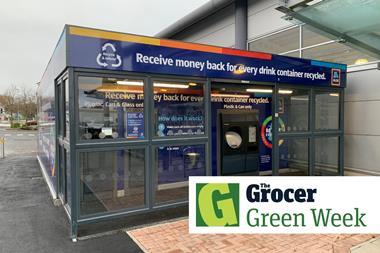
There have since been major developments, with the arrival this year of extended producer responsibility and DRS due to launch across the UK in 2027.
One supplier questions whether the new pact may be obsolete in “the world of EPR”.
Defra and Pack UK – which were in attendance at Tobacco Dock for Wrap’s event last week – have already pledged to hand over management of EPR to an industry-led producer-run organisation (PRO).
Some sources argue there is the a risk of duplication between EPR, which is geared towards shifting the industry away from hard to recycle plastic using taxation, and the pact.

Again, Bird disputes this. “The regulations for EPR are not going to be enough to drive the outcomes we are looking to achieve.
“Industry and government have told us it’s helpful for the pact to be the place where industry can convene and tell government which policies it wants, and where market failures can be addressed by regulatory measures.”
But when it comes to DRS, the potential for conflict is even more apparent. A source claims Wrap and the Plastics Pact have been “apathetic at best” in supporting the flagship scheme.
Welsh support
With the Welsh government and Westminster split over the best way forward for DRS, Wrap appears to lean towards the Welsh solution, which includes proposals for a mandatory shift towards reuse, as opposed to a scheme dependent on a large network of reverse vending machines in stores.
“In Wales, they are seeing this as an opportunity for a move to reuse and we do agree that returning products to store is problematic,” says Bird.
It comes after nine supermarkets – all members of the Plastics Pact – issued a joint statement in July promising to work together on a co-ordinated rollout of a reusable packaging model “at scale” by 2030.
Among them, Aldi, Morrisons, Sainsbury’s , Co-op and Waitrose are missing from the new pact’s founding signatories. Tesco, which has signed up, recently urged ministers to come up with new regulation to set a level playing field on reuse.
Bird says DRS does not go far enough to enable this shift. “We are thinking about the whole system and how these policies [EPR and DRS] come together.
“There are potential opportunities to look at DRS and reuse, which is why the Welsh government has been consulting on its plans. DRS is there to solve the litter issue and Wrap wants to make sure that happens.”
Despite the ambition, the Packaging Pact does not share the measurable targets of its predecessor, which has been cited by critics as another reason not to sign up.
The new pact instead has four broader 10-year goals: optimising packaging, scaling reuse and refill, supporting infrastructure investment, and harmonising data.
Wrap says this shift followed “feedback from members”, and that despite the lack of targets, the pact will include a major emphasis on quantitative evidence to show progress.
“We will hold feet to the fire and report on progress.
“The original Plastics Pact has helped shape government policy and there are fingerprints all over the regulations that are currently being rolled out.
“That impact should not be underestimated.”
Neither though, should the challenge of getting more sign-up in time for the launch in April. Wrap will be hoping to by then have a much longer list of signatories, whose support is essential if it is to have any hope of making a difference.






No comments yet