


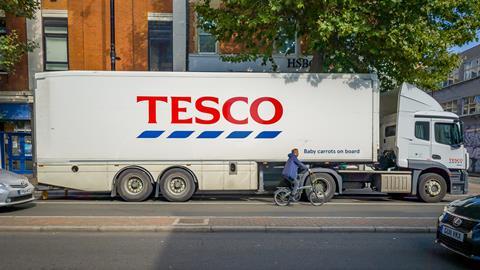
It has been billed as one of the most incredible pieces of collaboration in food industry history, and it could prove a game-changer on wheels for the future of food redistribution.
A new ’mission control’ set up to allow supermarkets and suppliers to integrate supply chains, so they can co-operate on routes for surplus food, is allowing trucks from traditionally bitter rivals to literally share the load in getting thousands of tonnes more food to charities.
The Grocer revealed last week that Sainsbury’s, Tesco and Marks & Spencer were already signed up to the rollout of Alliance Food Sourcing’s scheme, with plans for it to expand across all major supermarkets by next summer.
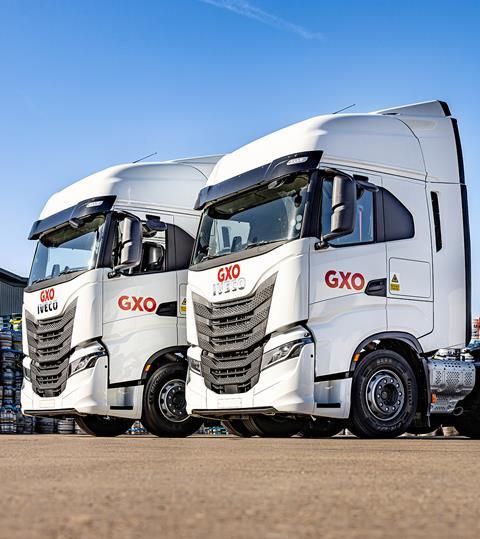
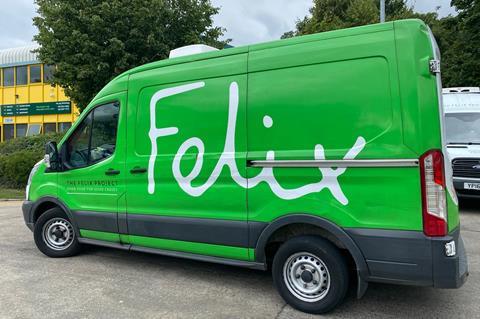
We also revealed in April that Sainsbury’s, working with logistics expert GXO, had become the first retailer to take part in a trial of the new platform. The supermarket is delivering fruit & veg that would otherwise be wasted from suppliers to food distribution charities FareShare and The Felix Project, which recently merged under the Felix banner.
Matt Clarke, a tech leader in food supply chains and former MD and partner at BCG, has been spearheading the new initiative as a volunteer for AFS, which was set up by food industry bosses in November 2024 on one-year anniversary of the King’s Coronation Food Project.
“We started looking at this project about a year ago and thinking about the problem,” says Clarke. “A big challenge was inventory all over the country that could be from donations, from manufacturers, from large supermarkets like Asda or Tesco or from small surplus stores on the high street.
“We needed to understand where that inventory was, so we could get it into the supply chain and to end users as quickly as possible.
“The second big challenge was logistics management.”
‘Bus stop schedule’
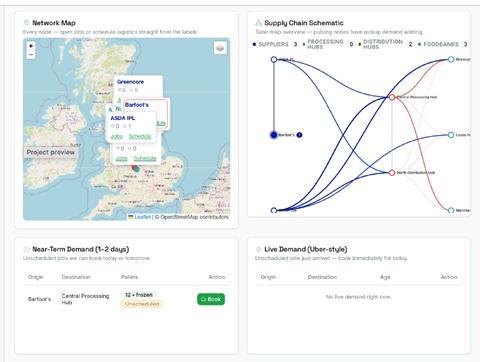
The trial has worked using two basic set-ups. One is what Clarke describes as a “bus stop schedule” where logistics providers give their routine routes.
The other is where a retailer or manufacturer “just wants to pitch in and help”, which he compares to an “Uber service”.
“They can effectively dial in the night before and ask where they can send a truck.”
The trial is already transforming the way supermarkets and other food players tackle surplus.
“Take someone like Tesco, who have a highly sophisticated planning system,” says Clarke. “They manage their logistics as tightly as possible, but they will have space. It might be just a lane or half a lane. They know the capacity they have and we can just plug that into the system.”
A mostly volunteer team working with industry partners has used AI, spreadsheets and even WhatsApp messaging to create a schedule that allows retailers to dip in and out of this “mission control”. Day by day it is being developed to become easier and more sophisticated.
SpaceX thinking
“We didn’t want to have to use big tech that would cost partners or the charities millions, but we’re at a point where AI is really helping us to massively accelerate what would have previously been a high-cost heavy-tech solution,” says Clarke.
“We’ve applied AI full-stream into this and used a kind of SpaceX thinking to build something quickly and see what works.”
“We’ve created a hybrid team that has come together to rapidly prototype a system.
“Even wandering around the Felix depot in Poplar the other week, we were hearing stories about how the food supply chain is still very reactive at the moment. We’re getting food, it’s going off,” Clarke adds.
“But the team are doing some really innovative stuff” to address that.
“We can apply the AI innovation capability to get product out really quickly. We can use it for meal planning. We can use it to quickly know what products are in and what inventory we can turn that into. There is all sorts of stuff we can do.”
AFS director Nicky Robinson says the results have been extraordinary.
“Before the platform, charities often had to manage transport needs manually, at short notice and with limited resources, while opportunities to use spare capacity were considered individually rather than across a wider network,” she says.
“The technology creates a shared, real-time view of the options available across multiple logistics providers, allowing Felix to compare different routes and offers at once and identify the most efficient way to move food.”
“It goes beyond making better use of lorries and could potentially transform even more than this through the real time visibility and matching up of all the offers coming in from the industry.”
Early results show the scale of the opportunity. Trials with Sainsbury’s, GXO, Gist and Greencore are already on track to move 5,300 tonnes of food, save 42,885 road miles and 62.9 tonnes of CO2, and generate £170,000 in savings over six months. Over 12 months, the AFS expects the platform to have the potential to save Felix £500,000 in logistics costs, alongside 120,000 road miles and 180 tonnes of carbon emissions.
Once rolled out more widely, it believes if could amount to a £1m saving in transport costs for Felix in its first full year.
“This is why we are calling on the industry to get involved to fulfil and achieve beyond this potential,” says Robinson.
“We have tangible proof now of how the model can work in practice,” and an ambition to “open up a wider conversation about what could be achieved if more of the food and logistics industry took part.”
Sustainability potential
Food redistribution must not be the end of the matter, says Clarke. The initiative is also providing invaluable data on carbon use road miles too, which could add a sustainability function. “We’ve not set out to tackle sustainability as such, but we know there is valuable data.” Over time it can be used to help manage empty legs of journeys with sustainability in mind, he says.
“Many of the industry’s systems are green screen, old school and don’t use the data that’s flowing within them.”
The new technology means that “at any time you should be able to click a button to produce a more or less shareholder-friendly report on pallets moved, miles travelled, the cost, CO2 emissions. All of his being auto-generated thanks to the system we’re building.”
Felix director of food innovation Richard Smith says the huge spikes in transportation and fuel costs since the conflict began in Iran in February show how valuable the project could be.
“Transportation costs Felix millions of pounds a year, and since the conflict in Iran these have risen substantially,” he says.
“To know this new tech could save so much money is phenomenal.”
The government has called on the food industry to triple the amount of food surplus reaching charities and the truck collaboration, the volunteers and companies involved hope, is a clearer sign that things are heading in the right direction.





No comments yet