







Volume sales of rice – the world’s most widely consumed grain – are surging as Brits travel increasingly far and wide on their culinary adventures. So what’s cooking? And what’ll be the next big thing? We’ve polled 1,000 shoppers to find out this and much more…
1. More than two-thirds of Brits say they’re adventurous with food
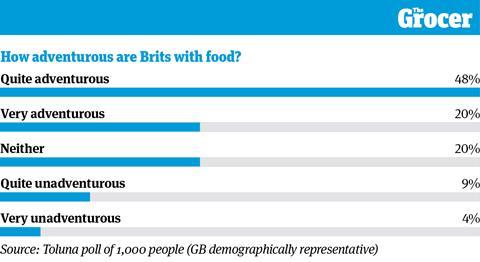
It’s time to lay the outdated stereotype about Brits only eating food that’s beige, bland and overboiled to rest, once and for all. Our research reveals that more than two-thirds (68%) of Brits describe themselves as adventurous when it comes to trying foods from around the world. And, as we explore in later charts, rice is playing a key role in those culinary explorations.
“Growing culinary curiosity is a really interesting opportunity for retailers,” says Eszter Somogyi, director for Europe, Middle East and Africa at USA Rice. “The key is making exploration accessible. Shoppers may be interested in trying something new, but they need to know what to buy, how to cook it and what to serve it with.”
2. Most shoppers say UK food culture is becoming more varied
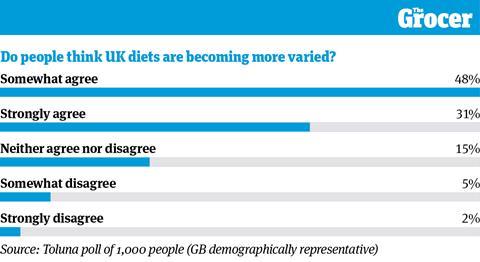
Brits’ culinary horizons are continuing to expand. When we asked our survey if they thought UK diets are becoming more varied, 79% of people agreed that they were. “Shoppers are becoming more curious about specific cuisines and regional specialities,” says Somogyi, pointing to the 65% of people who told us they think broad descriptions like “Chinese” or “Indian” do not do the diversity of these cuisines justice. “This doesn’t mean established cuisines such as Chinese are losing relevance, rather that consumers are more interested in exploring the breadth and regional diversity within them.” Two-thirds (67%) of people told us that they would like to explore more regional dishes from popular world cuisines.
3. Younger people are most likely to want to try new cuisines
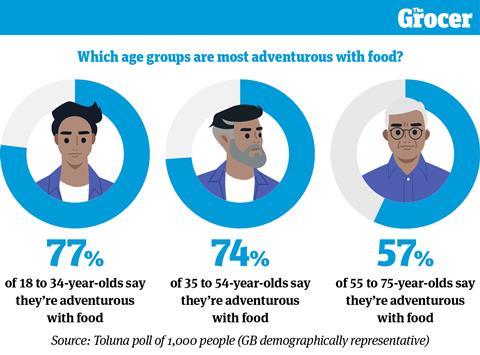
The younger you are, the more adventurous you’re likely to be. But that doesn’t mean older people are closed to new experiences: 78% of people aged 18 to 34 say they’re adventurous, versus 74% of 35 to 54-year-olds and 57% of over 55s. “For retailers, the opportunity is to meet younger shoppers where their appetite for discovery is strongest,” says Somogyi, noting also that 77% of younger people would like retailers to stock more rice varieties to help satisfy their culinary curiosity. “Retailers can respond by connecting rice with the trends and cuisines that are already capturing younger consumers’ attention, while using digital content to demonstrate how easy it is to recreate these dishes at home.”
4. Seventy-six per cent of Brits eat rice at least once every week
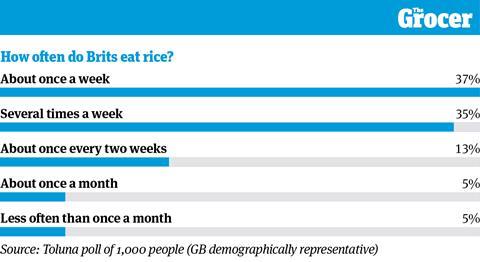
Brits’ growing appetite for meals inspired by far-flung cuisines is driving strong growth for rice. As we revealed in our 2025 Top Products report, volume sales of rice through the supermarkets surged by 4.1% last year, significantly outgrowing alternatives like noodles, pasta and potatoes [NIQ 52 w/e 8 September 2025]. Our latest research shows just how embedded rice has become in UK diets.
“With 76% of people eating it at least once a week, and 35% eating it several times a week, rice is clearly an everyday staple rather than an occasional ingredient,” says Somogyi. “The opportunity isn’t to persuade people to buy rice – it’s to increase the repertoire of ways they use it.”
5. Most people agree that rice goes with almost anything
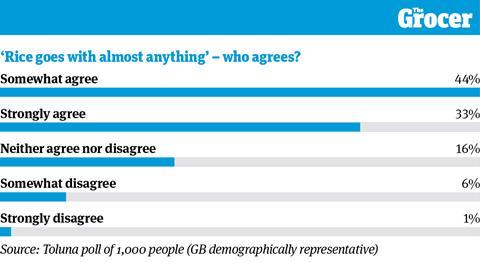
Rice is prized for its versatility. More than three-quarters (77%) of people agree that rice goes with almost anything. While curry is the dish most people (72%) say they regularly cook with rice, chilli (45%), stir-fries (44%), fried rice (42%), risotto (24%) and rice bowls (24%) are also regularly on the menu. It’s also significant that two-thirds (64%) of people would like to see the supermarkets stock a greater variety of rice, says Somogyi. “This suggests consumers are ready to explore beyond the familiar,” she says. “That is particularly relevant for USA Rice, given the range of US-grown rice varieties available, from long and medium grain to short grain and wild rice, each with different qualities and applications.”
6. Eighty one per cent say that rice is useful for quick meals
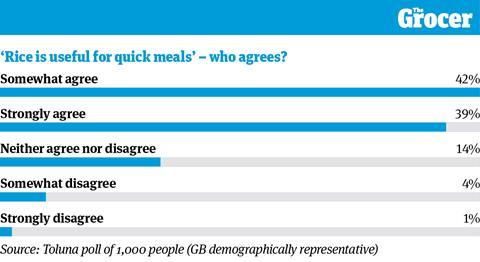
Convenience is another quality people say they value in rice. Eighty-one per cent of the people we polled agree with the statement that rice is a useful base for quick mid-week meals. This reinforces our earlier point about rice’s versatility (see Chart 5). “Consumers aren’t turning to rice for one specific meal or cuisine – they see it as an ingredient that can work across different occasions, from quick and budget-friendly midweek dinners and comfort food to more adventurous cooking,” says Somogyi. Rice also scores highly when it comes to health, with 61% of people agreeing that it is healthier than alternatives such as pasta or potatoes, rising to 75% of 18 to 34-year-olds.
7. Most Brits go on social media for food inspiration…
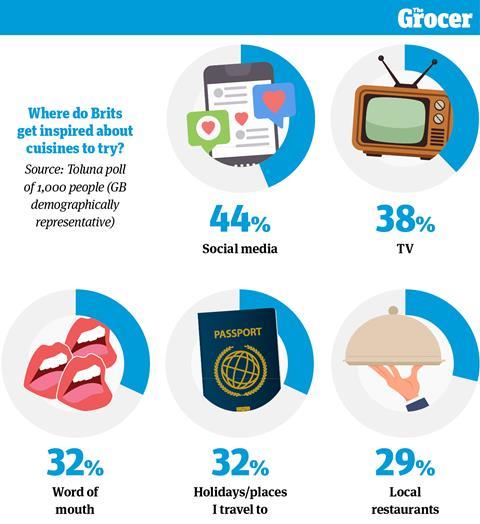
We’ve established that Brits are becoming more adventurous when it comes to their food choices and that rice is playing a crucial role in helping to satisfy growing demand for world cuisines. But where do Brits go for inspiration?
When we asked our panel to pick their top three sources of culinary inspiration, social media came out top with 44% of the vote. TV (38%) and word of mouth (32%) came second and third. Holidays (32%) and restaurants (29%) also play an important role. Social media is a key focus for USA Rice’s marketing. “Our Instagram channel showcases everything from educational content, recipe inspiration for a variety of cooking levels through to insight into what makes US-grown rice different,” says Somogyi, adding that content featuring ambassador chefs Jeremy Pang and William Chilila has helped it showcase the role its products can play in Asian and Afro-Caribbean recipes, respectively. “Social media is an important part of how we demonstrate the versatility of USA Rice.”
8. … but where people get inspired depends on how old they are
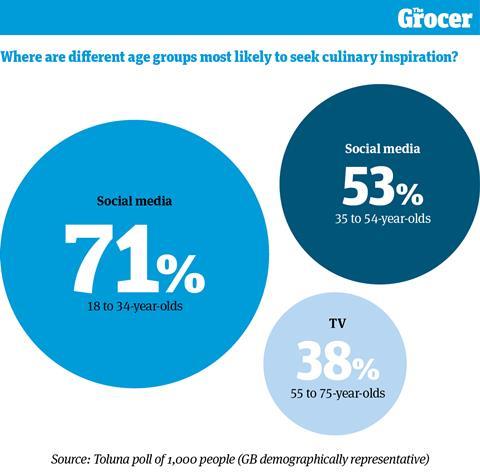
There are also big differences between where different age groups go for inspiration for what to eat and cook. Seventy-one per cent of people aged 18 to 34 say social media is where they get their culinary ideas from (the most cited source), compared with 24% of people aged 55 to 75. “For retailers, there’s a huge opportunity to turn inspiration into action,” says Somogyi. “Short-form recipe content, simple cooking demonstrations and serving suggestions can help shoppers move from seeing dishes online to understanding how they can recreate it at home.” Older people, meanwhile, are most likely to turn on the telly to get their culinary creativity flowing.
9. More than a third of Brits have ‘discovered’ Japanese recently
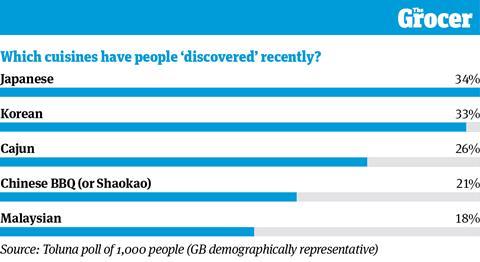
The UK food scene is going Japanese. For proof, just look at the steady stream of matcha, sushi and miso products landing on supermarket shelves. Further evidence lies in the fact Japanese is the cuisine most people (34%) say they’ve tried for the first time recently.
“Consumers are moving beyond traditional definitions of world food,” says Somogyi. “While Japanese and Korean cuisines are already being explored by significant numbers, future interest extends to Malaysian, Filipino and Chinese barbecue.” A third (33%) of the people we polled said they’d tried Korean for the first time, making it a close second, followed by Cajun (26%), Chinese BBQ (21%) and Malaysian (18%).
10. Malaysian & Shaokao are set to be the next big thing
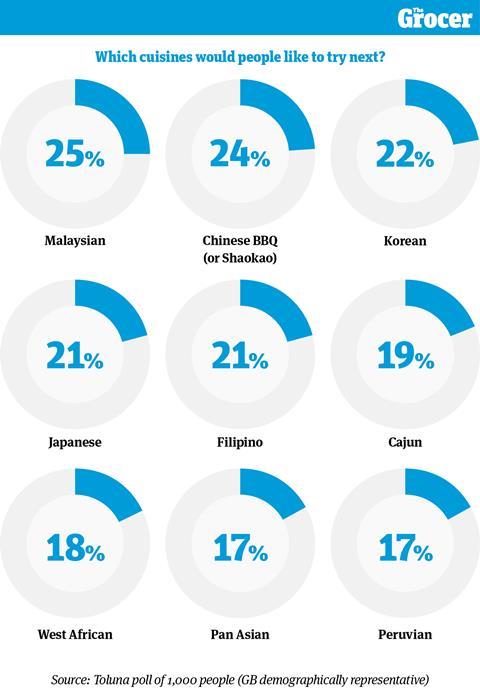
Far Eastern influences on the food scene look set to grow. Malaysian (25%) and Chinese BBQ (24%) are the cuisines most people say they’d like to try next, followed by Korean (22%) and Japanese (21%), despite the fact a third of people have recently tried Japanese and Korean for the first time (see Chart 9). Filipino (21%), Cajun (19%) and west African (18%) are also on people’s radars.
This spells good news for the rice category. “Long grain rice is a key component in many Chinese dishes, so there’s an opportunity to use a familiar ingredient to help consumers explore both well-loved dishes and new regional specialities,” says Somogyi. “There is also an opportunity to look beyond Asian cuisines, with Cajun and west African offering consumers another route into regional food discovery.”

Research for this story was conducted by Toluna
Downloads
10Charts Rice
PDF, Size 1.1 mb











No comments yet