





Political turmoil and industry infighting have plagued the road to the UK’s deposit return scheme. With the October 2027 launch looming, packaging and labelling reforms can’t wait
The clock is ticking loudly for producers ahead of the UK’s first deposit return scheme (DRS). After years of industry infighting and political fallouts, the landmark strategy appears on course to go ahead from October 2027 – even if it’s not yet clear, thanks to a furious bust-up over glass in Wales, whether the whole of the UK will be on board.
However, the question increasingly being asked is not whether DRS is coming, but whether the drinks sector, retailers and wholesalers are ready.
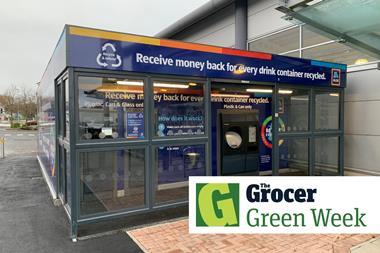
Exchange for Change, the not-for-profit industry body that was unveiled only in January this year, has the unenviable task of making sure things go to plan. And while the enormous task of installing reverse vending machines (RVMs) across supermarkets has captured the most headlines, ensuring the right packaging changes are made is just as vital.
Twenty-five billion single-use containers are sold across the UK each year, of which an estimated 6.5 billion end up going to waste. The vast majority will need to undergo a transition that involves much more than just a new label.
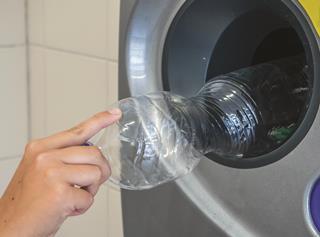
All single-use drinks containers made wholly or mainly from PET plastic, aluminium or steel, with a capacity of 150ml to three litres, will be included. DRS will operate by introducing a 20p deposit on in-scope containers, which will be refunded when they are returned to retail collection points in supermarkets, convenience stores and other return points.
Producers have until September next year to complete their operation rollout. Given the intricacies involved, it’s a frighteningly short timeline.
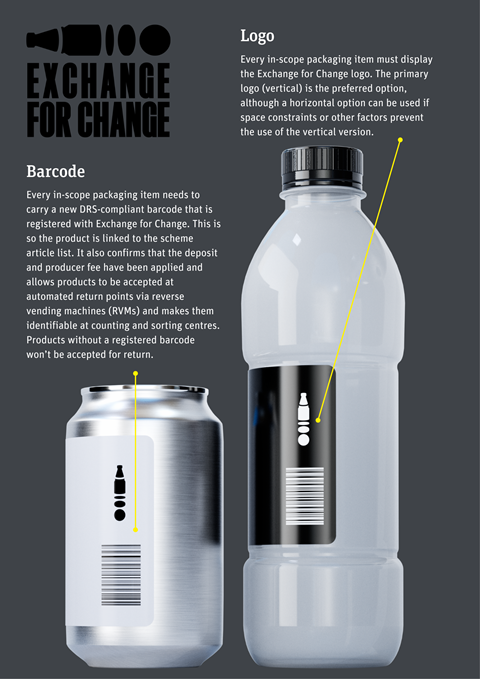
When DRS goes live, all in-scope drinks containers will need to have a new Global Trade Item Number (GTIN) – a unique identification number that will make the products distinguishable from “legacy stock” when it comes to point of sale, invoices, registration and retailer RVMs. Packaging must also feature the new Exchange for Change deposit logo so that consumers, retailers and enforcement bodies can identify products that are in scope.
The administrator has published a list of the types of barcodes that will be accepted. And just in case getting their heads around approved varieties known as EAN-13, EAN-8, UPC-A and UPC-E wasn’t hard enough, producers will also have to squeeze in all existing mandatory content such as allergen warnings, nutritional information, country of origin and other recycling information such as OPRL labels.
Exchange for Change has indicated that a vertical ladder format is preferred for barcodes and that the barcode should sit on the main label rather than a neck label of a container. It should be least 8mm from the base on aluminium or steel cans, never appear on the top or bottom, and remain readable on both cylindrical and non-cylindrical containers. Producers then need to decide if now is the time to take the plunge and use the DRS transition to move into the world of QR/2D codes, which are being rolled out across major retailers.
Suffice to say, it’s a daunting process and is proving to be a major headache. But there’s little respite – only producers who put fewer than 5,000 units a year on the market are set to be exempt from the process. And even that’s on a per-SKU basis, meaning some will need to carry out the work for some of their higher-selling products, but not for others.
“My sense is that the biggest challenge initially around DRS was things like RVMs and getting them in place,” says Iain Walker, industry engagement director at GS1 UK. “I think everyone sees it and is focused on it.
“I’m much less sure that they’re focused on the labelling points. But for DRS to function, the label and packaging overhaul is absolutely at the heart of whether the scheme will succeed. What we’re saying is that these labels, these digital labels, now carry a financial value because they have money inside them. The industry is not just tracking packaging, it’s tracking money.”
A source at one leading drinks supplier says that making sure they’re ready for October 2027 is posing a “massive challenge”, for which strong leadership by the government’s Deposit Management Organisation will be vital.
By law, there is no “transition” or grace period for the industry, which will in theory be required to bring in the new labelling requirements from day one. However, it’s widely anticipated that a period of up to six months will be given to enable the industry to get old stock out of the system.
“The label and packaging overhaul is at the heart of whether DRS will succeed”
“We recognise the complexity of the UK drinks supply chain and the work that will be required in the transition to DRS-compliant products,” says an Exchange for Change spokesman. “Earlier this year we published material specifications and logo and regulatory requirements to allow producers to plan effectively.”
They added that Exchange for Change has worked with the industry to “develop a proposal for consideration by the regulators that would provide a transition period to cover the dispatch and sell-through of products”. The body is now in discussion with the regulators in England, Scotland and Northern Ireland about the proposal.
From the wholesale perspective, Food & Drink Wholesale UK (FWD) CEO James Bielby is confident regulators “will adopt a pragmatic approach and work with industry to avoid wholesalers or end users having to destroy or write off stock after target transition dates have passed”.
GS1’s Walker says there is “definitely work to do” to ensure the industry is ready. “Everyone wants to make this work but, for me, this change isn’t just about a label, it’s about changing thousands of products across a complex supply chain without disrupting the customer experience.
“It’s doable, but it needs to be clear about who’s doing what and when. Even with a grace period, the practical risk will be operational: mixed stock, unclear invoicing and poor cut-over discipline are more likely to create problems than the standard itself.”
Learnings from Ireland
Hopes for a smooth handover have been raised by the success of DRS in the Republic of Ireland, which in March reached the milestone of 2.5 billion drinks packages returned in just over two years from its launch.
“It went incredibly well,” says Walker. “But they did do a lot of work on the preparation. The take-up was incredibly quick. There was almost no gap between DRS starting and the return rates going up to 70%-80%.
“My sense is that [in the UK] we’re just not hearing enough about it. The big companies are agitating for more information and clarity on timings. The smallest companies are out of scope. I don’t know if we have enough intelligence on the middle group.”
One of the biggest concerns is how the packaging transition will be managed across the wholesale sector, especially with the October launch threatening disruption in the key summer and Christmas periods.

“The industry is not just tracking packaging, it’s tracking money”
“We cannot afford to get to 30 September and suddenly find we haven’t got any stock” is how one supplier puts it bluntly. “Likewise, if the sun shines in September we want to ensure we’ve got enough stock in the system, so it’s vital there’s not a hard changeover on day one.”
However, Samantha Walker, DRS project lead at CCEP, is confident the right groundwork is being carried out. “The transition to DRS-compliant packaging is a complex undertaking,” she says. “Having engaged closely with Exchange for Change on the challenges around the packaging changes, we welcome the proposals that they’ve put to regulators on introducing a transition period and look forward to further updates.”
The Wales dilemma
Yet if England, Northern Ireland and Scotland are facing challenges, it’s nothing compared with the sheer chaos that’s been raging in Wales over its version of DRS – which is threatening to rip apart the chances of an interoperable scheme launching across the UK in 14 months’ time.
And once again it’s packaging issues that lie at the heart. Unlike the other nations, Wales is insisting glass will be in scope, although with a transitional period of its own that will mean no deposit applies to glass containers until 2031.
Drinks bodies have labelled the decision a “recipe for disaster” that could see a mass withdrawal of products from shelves and might result in industrial-scale cross-border fraud.
While the Welsh government has said glass containers will not need deposits or new labelling when its scheme kicks off, drinks bodies claim that’s disingenuous, because stock will have to be labelled either as ‘Not for sale in Wales’ or ‘For sale in Wales only’ to avoid environmental taxes applicable in the rest of the UK under extended producer responsibility (EPR) rules.
“Having a zero-rated deposit and no mandatory scheme labelling for glass between 2027-2031 offers no practical transition window for the industry,” says Miles Beale, CEO of the Wine & Spirit Trade Association. “The [Welsh] scheme as planned will in fact undermine funding for glass collection, as identical containers will need to be differentiated from those subject to EPR in the rest of the UK from October 2027.”
Further labelling changes could be on the horizon in Wales, too, with the country the first to trial a major deposit-and-reuse model that would create even more packaging and tracking requirements.
Either way, the history of DRS suggests there are several twists in the tale yet to come, both in Wales and the rest of the UK. In the process there will be many important changes to the billions of containers produced here annually. Perhaps most importantly, for consumers and industry alike, they will in future contain not only drinks, but money too.
DRS D-Day: three of the biggest challenges
With just 14 months to go until the UK’s first deposit return scheme comes into effect, there are still big questions that need answering if retailers, producers and the administrator are to be ready for the change. Here are the big three:
1. The fees producers will be charged
The first big challenge expected over the coming weeks will involve crucial details about the cost to producers involved in the scheme.
In June, DRS passed a crucial step ahead of the October 2027 launch when it revealed the handling fees for retailers. At manual return points they will receive 3p per container, while automated reverse vending machines (RVMs) will use a tiered model: 5p per container for up to 225,000 items annually, and then 1.3p for every subsequent item.
Producers will pay a separate per-unit fee for every in-scope container placed on the market, based on real operational data. While not viewed to be as much of a stumbling block as the retailer fees, there is still potential for controversy and concern.
2. The software specs for RVMs
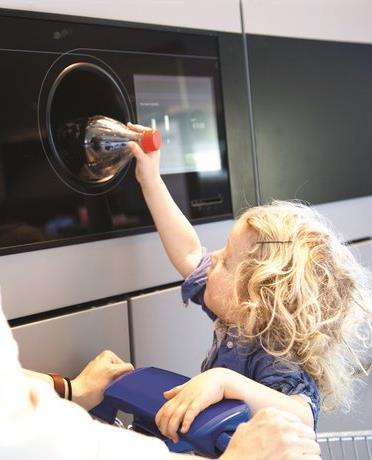
Exchange for Change published minimum hardware specifications for certified RVMs in February. Approved RVMs must meet mandatory standards for security, reliability and container recognition for PET plastic and metal cans.
However, further details on the software and programming requirements are yet to be revealed, meaning it’s a race against time to get the right machines out to stores and working in time for launch.
3. The beneficiaries of cash grants
Exchange for Change is making £60m in grant funding available for up to 10,000 small, independent retailers to meet the cost of installing RVMs in England, Northern Ireland and Scotland. Grants of £6,000 per site will be offered, funded three months after the installation of an RVM.
But further details on exactly which businesses qualify, how they apply and how they get hold of the money are yet to be revealed.
Information including eligibility criteria and application processes for exemptions, full terms and conditions of the grant scheme, and supporting guidance for retailers ahead of registration are all expected in the coming weeks – but it leaves little time for small businesses to get themselves up to speed.





No comments yet