




Retail robots are moving from warehouses to shop floors. Can they co-exist with shoppers and staff – and how will they affect the jobs market?
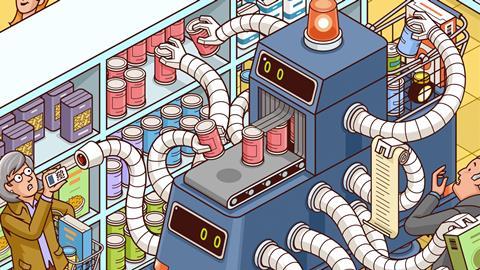
At just over two metres tall, Tesco’s Tally robot looms above shoppers as it stalks the aisles scanning shelves for the placement, price and availability of stock. It quietly whirs along, emitting only the odd electronic chirrup when someone gets too close. It can be an unnerving sight. As one shopper at the trial store observed: “Nobody went within five feet of it.”
Having grown to dominate the increasingly automated backrooms, warehouses and distribution centres of supermarkets, robots are now popping up on the shop floor, rubbing shoulders with shoppers and store staff. Their arrival raises important questions about how humans and bots can co-exist in harmony.
How should robots behave and function to ensure they don’t clog the aisles and put people off? What impact might they have on the livelihoods of store staff? And what does the future of retail robots hold?
“Physical AI only works when it delivers on its core function and integrates seamlessly into human spaces,” says Jeff Gee, chief design officer at Simbe. “A retail store is a dynamic environment, with conditions that can change throughout the day.”
That’s a far more complicated environment to navigate than the expansive warehouses with clear and predictable pathways in which they have mostly found themselves so far. Simbe’s Tally robot is tall, but also slim, can turn in a tight space and place itself in a 150,000 sq ft store within a two-inch margin.
Crucially, it “is built to move through stores comfortably, predictably and unobtrusively” Gee adds, “pausing to give people space and using soft, friendly sounds to communicate its presence to anyone nearby”.
Robots’ ability to avoid blocking aisles and getting in the way of shoppers is “one of the fundamental challenges we have spent more than a decade solving” says Michel Spruijt, Brain Corp’s international president.
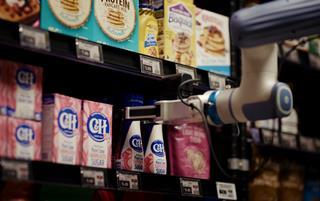
Brain Corp’s robots, which number 50,000 globally after deployments grew year on year by 68%, use sensors and cameras to understand their surroundings and navigate around obstacles.
“We are also developing more advanced semantic understanding so robots can increasingly distinguish between different kinds of objects and situations, for example recognising that a shopping cart is a temporary obstruction rather than treating everything simply as geometry,” Spruijt explains.
“Operating reliably around the public is very different from making a robot work in a controlled demonstration,” he adds. “It isn’t enough to put sensors on a machine and send it into a store. The autonomy system has to make sense of that information, understand the environment and enable the robot to operate safely.”
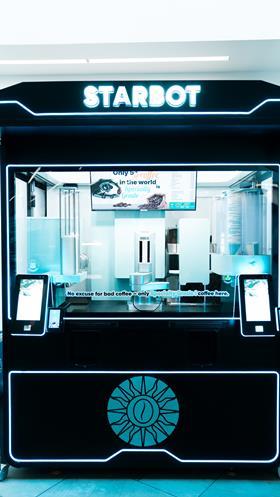
Bot barista
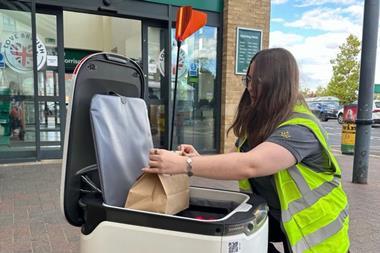
Billed as “a coffee shop shrunk into a kiosk”, Starbot features a six-axis arm preparing Specialty Grade 1 coffee with nobody behind the counter. “The robotic arm earns the first look.
The hygiene, consistency and quality of the coffee earn the second visit,” the company says. With the first unit installed at City St George’s University, the company is now developing bubble tea and frozen dessert serving versions.
It’s one thing to ensure the robots don’t run amok. It’s another to make shoppers feel at ease alongside them.
“For many people, their expectations of robots have been shaped more by science fiction than by everyday experience,” says Spruijt. There will be as many shoppers seeing a robot in store and thinking Terminator as there are those that bring to mind Johnny 5 [the robot that comes to life in the 1980s Short Circuit films].
“Trust is a big part of that. People tend to be much more comfortable with technology when its purpose and behaviour are clear and predictable. A floor-cleaning or inventory-scanning robot isn’t trying to pretend to be a person: it has a recognisable job to do, and people fairly quickly understand how to interact around it.”
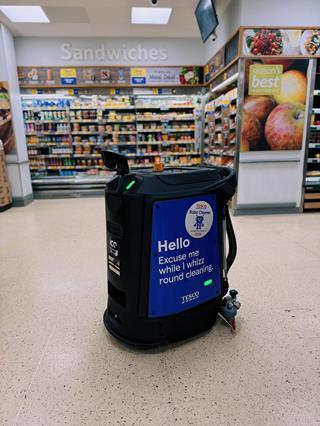
But friendly vibes go a long way, too. Some of the Tally robots feature occasionally blinking eyes on their digital screens. Tesco’s example displays a greeting and an introduction to its in-store function.
US regional supermarket chain Stop & Shop has rolled out hundreds of Badger Technologies robots to its stores. The robots softly ping like a hospital monitor as they roam the aisles and have been named Marty (short for Mobile Autonomous Robot Technology).
But the bots have gained fame thanks to a store associate at the initial trial shop who went to a craft store and bought a pair of stick-on googly eyes for the machine, which they all now feature, along with a stick-on smile. Marty has proved so popular they now do school visits and have a line of cuddly toys.
Robo Pierre White
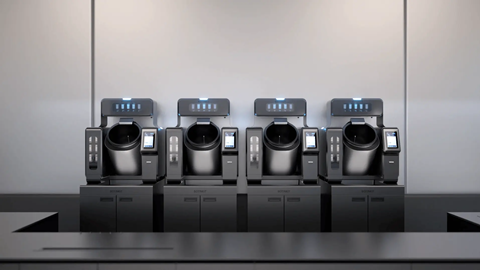
Botinkit’s robot can cook more than 10,000 stir-fry and pan-fry recipes covering in excess of 30 cuisines. Is it a threat to entry-level kitchen jobs? “On the contrary,” the company says. “Jobs are at risk because the economic model for most restaurants and QSR is under pressure. If the robots can help to make the model more sustainable, more jobs are protected, not less.”
Crowded aisles
Supermarket aisles are already high traffic routes. Growth in online grocery means shoppers must already dodge staff pickers and their cages, as well as other shoppers, retail media displays and abandoned trolleys. March research commissioned by Robinsons Fruit Shoot found crowded aisles ranked as the fourth-biggest bugbear of shoppers; the second was people blocking the aisles. Add robots – no matter how cute – to the melee and consumers will surely be turned off.
“One of the interesting things about human-robot interaction is how quickly expectations can change once people understand what the robot is there to do,” says Spruijt.
“Anyone presenting robotics as an instant labour cost solution is overselling it”
Several supermarket bots carry messaging that explains their purpose. But what if that purpose might annoy customers? Shoppers might be less patient with bots like the one trialled by Iceland late last year whose main function was to display advertising and promotions from a digital screen. Or one rolled out by Del Monte and Bear Robotics to several US stores that called out customer messages including: “Hey, you! Yes, you… grab a Del Monte banana before I eat them all!”
In the UK at least, retail robots are something of a novelty. And that often means the initial caution of shoppers quickly gives way to curiosity.
“For many people, this is their first time experiencing a robot in a public space,” Gee says, “so shoppers seeing Tally often stop to watch, ask questions or take a selfie. Children in particular are Tally’s biggest fans.”
A sign of a successful deployment, Spruijt adds, is that robots “stop being remarkable” and become “another piece of equipment in the environment. From our perspective, that’s a good outcome. The goal isn’t for the robot itself to be the attraction,” he says.
However benign they become in the minds of consumers, store workers will remain concerned about the potential for the bots to take their jobs. But their fears are unfounded, claims Roman Tsiuba, CEO and co-founder of robot coffee station Starbot.
“I do not think retail robots win by being cheaper than a human employee in the short term,” he says. “The capital expenditure is real, maintenance is real and anyone presenting robotics as an instant labour cost solution is overselling it.”
The business case for robots emerges when they’re deployed “in places where people cannot or will not easily work” or, as in the case of Starbot’s robot coffee counters, “sites where the demand has not yet been proven enough to justify a fully staffed counter”, Tsiuba adds.
Roast in the machine
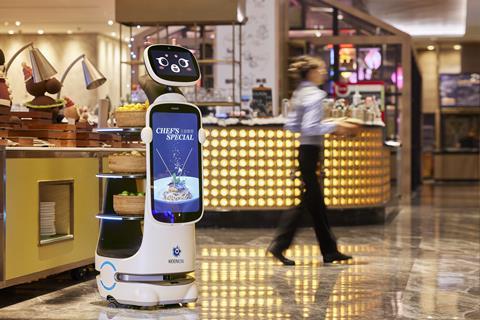
Keenon Robotics’ Dinerbot T10 “makes every moment fun”. So claims its maker, which holds a 40% share of the global food delivery robotic market. There is an array of ears and antlers to choose from, as well as customisable expressions, voices and faces.
Moving around restaurants at one metre per second, the robot can take orders, carry dishes to customers at their tables and display specials on its screen.
Most robotics firms claim that their bots aren’t designed to replace roles, but rather remove the most menial, dull and laborious elements of it. Most retailers rolling out cleaning robots, for example, do so “specifically to work alongside their existing cleaning teams rather than replace them,” says Julie Kitchener, chief communications officer at Industrial Cleaning Equipment, which is behind the rollout of autonomous cleaning robots across 600 Tesco Express stores.
“The most successful deployments are not the ones that remove people from the process,” Kitchener says. “They are the ones that use automation to take care of repetitive, time-consuming floor cleaning tasks while allowing employees to do the things people are genuinely better at: customer service, problem-solving, attention to detail and creating great in-store experiences.” As Kitchener puts it: “Labour savings are part of the calculation, but they are rarely the whole story.”
However, she is realistic that this will result in changes to roles. That could have impacts on who is employed, particularly at entry level.
“I do not think it is honest to pretend that automation does not change the shape of entry-level work. It does, and anyone in this industry who says otherwise is not being completely straightforward,” she adds.
“They’re coming for everyone’s jobs. The train has already left the station and we’re all on board”
Unions are taking a pragmatic view. “Technological change doesn’t necessarily have to be a bad thing, but it needs to be implemented properly to make sure that everyone benefits from it,” says Usdaw.
“What can happen is that the same hours of labour are filled with the more complicated work that the digital systems cannot yet cope with, meaning a larger mental toll for the worker,” says a union spokesperson.
Retail robots are already expanding their capabilities. Brain Corp’s Project Brawn is in its early stages but involves a robot that can not only navigate and scan the store but pick up and move products, unpack cases and pick online orders.
“Over time, a robot could not only understand that something needs attention on the shelf, but potentially take physical action to address it,” Spruijt says. Such advances have led some to suspect supermarkets will employ more robots than people in future.
“By 2045, there will be virtually nothing a human can do that a machine cannot do better for a tiny fraction of the cost,” predicts Adam Dorr of non-profit research group RethinkX. “Humans simply will not be able to compete. They’re coming for everyone’s jobs. The train has already left the station and we’re all on board. Nothing can stop the disruption of labour.”
Others are more optimistic. As Kitchener puts it: “The future isn’t robots versus people. It’s robots and people working together.” Time will tell what those googly eyes have in mind.


No comments yet