






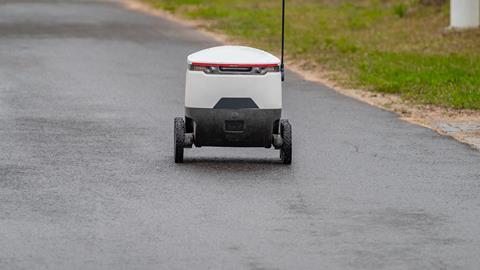
What sort of heartless misery-guts could possibly have a problem with the loveable little pavement-roaming robots that have been popping up around the UK, diligently ferrying groceries from stores to doors? You’d surely have to be some sort of puppy-kicking, bug-squishing, cat-in-wheely-bin-putting monster to be in any way anti the cute courier critters, right?
Well, a new campaign from charity Living Streets wants them exiled immediately. “Pavements are for people and should remain that way,” it states. The robots – from companies like Starship, Delivers.AI, Cartken – are putting “millions of disabled and vulnerable pedestrians” at risk, it claims.
Luddite ‘stop the bots’ curmudgeons? Or do they have a point?
Delivery robots arrive across the UK
PDDs – personal delivery devices or P. DeeDees (as opponents haven’t yet started calling them) – arrived in the UK in early 2018, initially fulfilling orders from a handful of Co-op stores in Milton Keynes. But they’ve since been rolled out to Sheffield, Leeds, Barnsley, Sunderland, Reading, Bristol, Cambridge and elsewhere, ferrying orders from a range of retailers as well as takeaway delivery companies Just Eat and Uber Eats.
The robots use AI – and human remote-control back-up – to navigate pedestrian walkways to deliver goods. They pootle about at less than 4mph, stopping if they encounter a person or pooch, and cross the road at proper crossings.
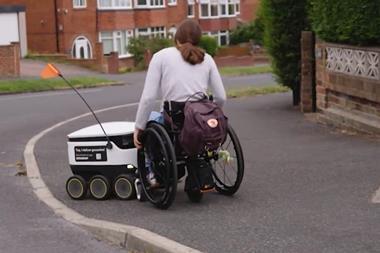
So what’s the problem? According to the charity, they are low-profile, unpredictable, not consistently detectable by cane or guide dog, and too wide for prams or mobility scooters to easily pass. A bit of a nightmare for disabled and vulnerable pedestrians, and as some videos prove, a bit of a nuisance for everyone else too.
It’s not even like there are many of them. The biggest PDD player – Starship Technologies – has just 3,000 autonomous robots, operating across around 300 locations in eight countries. Hardly a scourge. And besides, Starship says 25% of its regular UK customers in the UK report they are disabled or live with someone who has a disability – so the bots can be a help, not just a hindrance.
The big tech play book
But now is exactly the right time for Living Streets to put their foot down.
The rise of PDDs is a line taken straight from the big tech play book. Expand rapidly with a shiny customer proposition before regulators can catch up and society get a handle on whether it’s genuinely a net positive or not. The platform/gig economy, social media, dockless share bikes and most recently AI have all trodden this well-worn path, and governments trying to rein it in face a far steeper uphill battle than if guardrails had been put in place early doors.
At present, there is no statutory definition of a PDD anywhere in UK law. Starship Technologies, to its credit (or at least for investor comfort), has been seeking to amend this, last year calling for a “clearer regulatory landscape” in the UK for its PDDs, which currently operate in what it describes as “a grey area”.
Having seen this sort of thing before, the charity makes a fair point, arguing that PDD firms’ focus on the ambiguous legislation “is not accidental” – and has been done “in the knowledge that it is harder to remove a technology that is already on the streets than to resist one that has not yet arrived”.
As the government looks to bring forward a consultation on micromobility regulation, it’s only right that pedestrians have some input into what we share the pavements with, before it’s too late (Starship has previously stated it needs more than 10,000 new robots to meet demand).
PDDs are undoubtedly impressive tech, providing a solid service to people in the towns they have popped up in, and will surely be an essential mode of grocery delivery in the years to come. But at the same time, Living Streets’ campaigning isn’t just hammy technophobia – it’s the only sound response to any private capital-backed encroachment on public space.
It’s not about bots or not. It’s about putting people first.











No comments yet