



Battle-weary Hain Celestial slimmed down even further last week as it agreed to sell its international division to private equity firm Aurelius for $323m (£240m). Once the deal completes, the US-headquartered group will be left to focus solely on North America with its remaining portfolio of tea, yoghurt and babyfood brands.
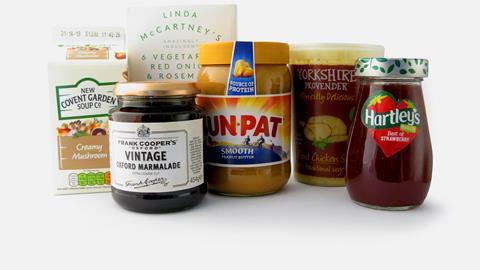
Hain International comprises a stable of well-known brands such as Ella’s Kitchen, Linda McCartney’s and New Covent Garden Soup. Much of the division’s $668m (£499m) revenues are generated in the UK, alongside a sizeable own-label milk alternatives business in Germany and Austria.
Proceeds from the deal will allow Hain to trim its $558m debt pile, but Aurelius will have its work cut out in turning around the fortunes of the international portfolio.
Brands in decline
Despite serious struggles at the US parent, the European division is no basket case, though it has been starved of resources as Hain Celestial failed to make headway with a wider recovery plan launched in 2023. The US group has racked up losses of more than $1bn in the past four financial years (to 30 June 2026) and turnover has consistently declined.
Amid the turmoil, former CEO Wendy Davidson fell on her sword in 2025, and new boss Alison Lewis has struggled to stabilise the ship since taking control.
Unsurprisingly, with attention diverted elsewhere, the European business has seen steady growth disintegrate into declines, with organic sales 4% lower and adjusted EBITDA down 27% to $63m in the latest financial year.
The situation hasn’t been helped by market leader Ella’s Kitchen being hit by a Panorama investigation, changing government and NHS advice on weaning age for babies and increased own-label competition.
Linda McCartney’s has also suffered in a tricky plant-based market and spreads brands Hartley’s, Robertson’s and Sun-Pat have lost ground to nimble challengers. Even chilled soup, which was in growth in 2025, has soured, with reversals at New Covent Garden and Yorkshire Provender. Cully & Sully remains the only brand moving in the right direction.
“The transaction highlights the continued interest of private equity investors in well-established consumer brands that may not have received sufficient strategic focus, or investment, within larger corporate groups,” says Richard Naish, partner and head of corporate at law firm Walker Morris.
“Whilst Hain’s international division includes a number of well-known and trusted brands, its performance has been constrained by competing priorities within the wider business,” he adds. “Carve-outs of portfolios like this in the food and drink sector are often driven by the opportunity to provide clearer strategic direction by an owner focused solely on their success and a willingness to invest in NPD, distribution and operational efficiencies.”
Munich-headquartered Aurelius specialises in carving out neglected or troubled companies and transforming operations by steering the business towards its true potential. That’s the theory, at least. The firm has a reputation among some critics as an asset stripper, not helped by its high-profile ownership of The Body Shop in 2024. The much-loved ethical beauty retailer ended up in administration just six weeks after being bought by Aurelius.
No risk, no return
Investing in struggling businesses obviously comes with risk, but Aurelius has completed more than 300 transactions since its foundation in 2005 and has a good track record of strong returns.
Dealmakers in the City reckon the firm has a clear positive strategy for Hain International.
Day-to day operations will remain in safe hands, as well-respected CEO Wolfgang Goldenitsch looks set to continue his stewardship of the division under the new owners. Goldenitsch joined the group in 2015 when Hain acquired the plant-based drinks business he ran in Germany and Austria, and he stepped up as head of international in 2019. That familiarity should steady nerves among most of Hain’s 1,500 workers across seven factories in the UK, Germany and Austria.
Aurelius differentiates itself from other PE firms through its dedicated WaterRise team, an internal consulting arm focused on driving improvements at portfolio companies. The team has grown from just four specialists in 2005 to a global army of 200 today.
“WaterRise will drill down with laser-like focus on where it can push efficiencies and take out cost at Hain, whether that is in manufacturing, procurement or labour,” a consultant source says. “There are many different levers to pull such as retendering with suppliers, improving terms with retail customers or SKU reduction. It will dig into the detail in a way the previous owner ignored and take action very quickly to really improve margins.”
Aurelius set out its vision for Hain International when announcing the carve-out last week. It aims to build on the leading market positions of the division’s brands, accelerate product innovation, expand scaled private label partnerships and optimise operational efficiencies across the manufacturing base and supply chain.
“Aurelius will likely aim to take complexity out of SKUs, ramp up brand support and drive volumes,” one City source close to the deal says.
“Because Hain in the US has been such a disaster, the UK has been bled dry with no money for brands or capex. International is a good, cash-generative business, and the new owner can now use that cash to drive improvement.”
Robert Lawson, managing partner at Food Strategy Associates, which worked with Aurelius on the deal, agrees the chaos of the Hain parent company over the past decade hasn’t given the business a stable base to develop.
He also points out Hain’s European assets are “a rather mixed bag”, operating in ambient, chilled and frozen across a variety of diverse categories and in branded and own label.
“Aurelius will no doubt consider portfolio options, but fundamentally what they have acquired is a business with excellent market positions, strong commercial plans and plenty of scope for improvement,” Lawson says.
Dealmakers expect Aurelius to spend time reviewing the business before deciding its next move. “Aurelius will figure out what brands and parts can be sold relatively quickly for good value within the next 12 months and what to hold on to and improve in the hope of a better future return,” one City source says.
“The individual assets and categories still hold plenty of appeal for potential trade buyers. There are good options for Ella’s, the growing chilled soup portfolio, the sweet spreads business and in plant-based.”

No comments yet