




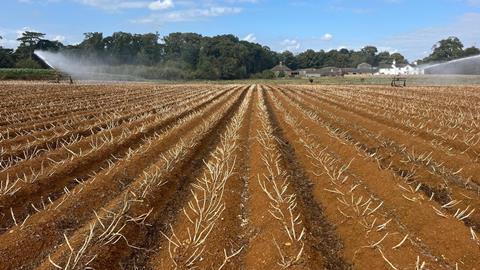
The hottest summer on record has created a host of challenges for growers, farmers, suppliers and retailers. Drought has cut supplies of core vegetable lines, accelerated harvests, reduced milk yields and is likely to lead to shortages on shelf and further increases in production costs.
These pressures come on top of already high input costs, driven by conflict in the Middle East, as well as last week’s latest blow to the industry: that many farmers would not be receiving government support under the Sustainable Farming Incentive scheme, after the second application window closed within six hours.
It would be hard to disagree with NFU president Tom Bradshaw, who says it has been “the hardest summer for British farming in a generation”.
However, it is being made much harder by retailers – who often boast about their desire to “back British” – refusing to help cover additional costs.
One industry source told The Grocer that retailers had “simply batted off” any requests for cost price increases over the past few months, operating on the assumption that prices were “bound to go back down again, which we all know never really seems to happen, does it?”.
Another grower said some crops were costing up to 12% more to produce than normal, largely due to soaring diesel prices. But instead of being supported by their retailers, some suppliers were threatened with being delisted if they continued to push for higher prices.
At the same time, a survey of 40 suppliers by retail consultancy The Retail Mind revealed that while more than 85% of suppliers had passed some inflationary costs on to retailers this year, only one in five had been able to recover their costs in full.
For an industry facing one of its toughest periods in years, that is simply unsustainable. It is also unacceptable.
When is investment not investment?
Of course, supermarkets are under pressure to keep costs down for consumers, and with households already feeling the pinch it is understandable that they are trying to keep food bills down however possible. But putting more pressure on growers who already are struggling to turn a profit is deeply short-sighted, especially if – as they claim – they want to keep a healthy supply of British fruit & vegetables on shelf.
There is a growing disconnect between the rhetoric and the reality. Behind closed doors, some suppliers say retailers are making investment increasingly difficult, while publicly supermarkets continue to “invest” in and support British farming. Just this week, for example, Asda signed a 10-year supply deal with Len Wright Salads.
But this announcement, made to much fanfare, contains deep ironies. Yes, long-term commitments such as this are undoubtedly welcome. But the deal itself is not exactly groundbreaking, despite what some headlines suggest.
Asda had already worked with Len Wright Salads for 35 years and the grower had already invested in establishing a site to be used specifically for supplying Asda. Renewing the partnership should be seen as the minimum expected of a retailer serious about supporting British agriculture, not an extraordinary act of investment. Had Asda decided not to renew the partnership, that would have been more of a news story.
Instead, rather than going through a lengthy recontracting process, Asda has decided to continue working with a long-term, loyal and reliable supplier. Hardly front page news.
Asda is not the first to proudly make public announcements of its ongoing “investment” and “commitment” in British growers. Since Aldi fanfared its £750m partnership with apple supplier AC Goatham & Son in 2024, all the major mults have sought to publicise similar deals.
This is not to say these long-term commitments aren’t vitally important for growers and suppliers. Far from it. A long-term commitment gives them confidence and certainty over future demand, as well as making them a more attractive investment opportunity to lenders should they want to expand or future-proof their farms.
But the supermarkets should be careful about calling this investment. These partnerships are taking on none of the risk that growers must shoulder – if the crop fails then they will simply shop elsewhere. And as this summer has shown, if production costs go up there are no guarantees supermarkets will support growers and share that burden.
These long-term contracts should be the baseline, not the gold standard. If retailers genuinely want to support British agriculture, they should put their money where their mouths are and start paying prices that reflect the reality of production. Otherwise, they risk taking British growers for granted and, eventually, may well find there is nothing left.







No comments yet