



The instinctive response to the Food Foundation’s Broken Plate report is to focus on consumers: their choices, cooking skills, budgeting and personal responsibility. That all matters, but it is not where the real power sits.
The report reads less as a commentary on how people shop, and more as an audit of how the food system is designed. It shows that healthy food is too expensive, too poorly promoted, too inconsistently available for millions of households. The issue is not simply consumer behaviour. It is the commercial environment in which those behaviours are shaped.
The report’s findings are stark. Households with children in the lowest-income fifth would need to spend 85% of their disposable income on food to afford the government’s recommended healthy diet. Healthier foods remain significantly more expensive per calorie than less healthy alternatives, and the affordability gap is now the widest it has been in more than a decade.
At The Bread and Butter Thing, our own member data reinforces this picture. When affordable fresh food is made available, people buy it, cook it and eat it. The issue is not a lack of demand for healthy food. It is that too many households are priced out of it.
The problems of price and access
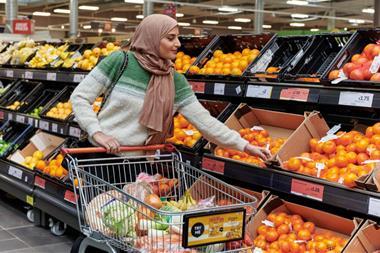
In the poorest communities, price and access become the same problem. The Food Foundation reports that fast food outlets now make up more than one in three places to buy food in the most deprived neighbourhoods, where people often rely on smaller convenience formats that carry less fresh produce and charge more for it. This is no criticism of those retailers, who work within tough commercial realities, but it makes the point plainly: where fresh food is hardest to reach, it is also the most expensive. Fixing that is not on those shopkeepers alone. It needs incentives, from government but delivered through the wholesalers and symbol groups that supply them, to make stocking affordable fresh food viable where there is currently little commercial reason for it.
All of this should prompt an important question. If the healthier option is the one with the higher unit price, weaker promotion, less prominent placement and less reliable availability, are we really making healthy choices accessible?
Many of the forces driving food affordability sit beyond retailers’ direct control, from climate pressures and supply chain disruption to rising production costs. Within those constraints, however, the decisions retailers and suppliers do control, including pricing, ranging, promotions, pack sizes and merchandising, still play a major role in shaping what shoppers see as normal, affordable and good value. We know many retailers and suppliers are already working hard to widen access, and we see that work first-hand through our partnerships. Even so, category management has become one of the most powerful public health levers in the country.
For retailers, the first challenge is affordability and own label is perhaps the biggest opportunity. Healthy options should not sit as premium or niche ranges. Fruit & vegetables, pulses, wholegrains, healthier dairy and quality proteins need to be embedded across entry price, mid-tier and family value ranges. The key question for category teams is simple: where is the healthy default, and can a household on a tight budget afford it?
Promotions matter just as much. Multibuys, price cuts and meal deals do not just drive volume, they define what shoppers understand as value. While those mechanics keep favouring less healthy products, healthier choices stay fragile. The same firepower needs to go the other way. We cannot keep telling families to eat more fruit & vegetables while giving those products a fraction of the marketing given to food we are meant to eat occasionally. Healthy categories do not need more moralising. They need better ad creative, better placement and proper investment.
For suppliers, reformulation is necessary but not enough. A product that is marginally lower in sugar or salt but still premium priced, poorly distributed or marketed as a niche lifestyle choice will not shift the dial. The challenge is mainstreaming: designing from the price point backwards, building fibre, vegetables, beans and lower sugar into everyday products without making them feel like a compromise, and treating health as part of the core product brief rather than a specialist claim.
The future of category strategy
The future of category strategy has to bring together affordability, health, sustainability and resilience. That means closer long-term relationships with growers, smarter use of specifications so good food is not wasted for cosmetic reasons, and better routes for surplus and secondary-grade produce so it reaches people rather than waste streams.
This is where redistribution plays a role. Fresh produce and protein, often the most price-sensitive categories, are also the most likely to generate surplus further up the chain. At The Bread and Butter Thing, we redistribute that surplus through community food clubs reaching 100,000 members, working with retailers and manufacturers who increasingly see it as a route for good food to be used well. Done at scale, redistribution moves more product up the food hierarchy, cuts waste cost and reaches shoppers who would otherwise be priced out entirely – without discounting core ranges. It is not a substitute for getting category strategy right, but it is an immediate, cost-effective bridge that can be built into how a business runs, rather than bolted on as an afterthought.
Government clearly has a role, through mandatory reporting on healthier sales, nutrient profiling, fiscal incentives and clearer regulation. But most businesses already know what the right thing to do is, and should not need to wait for regulation to do it. Many are already taking meaningful steps, treating health not as a corporate responsibility side project but as a mainstream growth, trust and resilience issue. Those that move first will be best placed to build all three.
The Broken Plate report should not leave the food industry asking why consumers do not make better choices.
It should leave retailers and suppliers asking a harder question. What choices is the food system making for them?
Vic Harper is CEO at The Bread and Butter Thing




No comments yet