




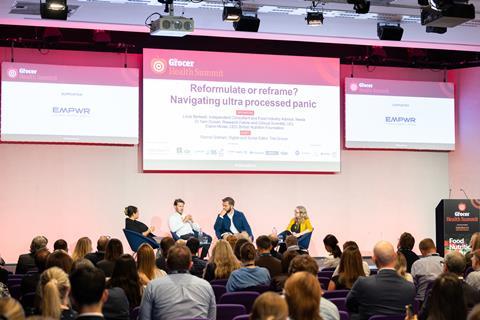
At The Grocer Health Summit earlier this month, one panel spent much of its session debating what the food industry should actually do about ultra-processed food. It’s a fast-moving area: just days before, Tesco had announced an extension of its ban on certain ingredients and additives.
The panellists agreed on much, particularly the need to look beyond individual products and consider the wider food system. But there wasn’t enough time to explore what comes next.
So we asked those experts to look ahead. What will the UK’s convenience food look like in five or 10 years’ time, and what needs to change to get us there?
Change the incentives
“We won’t see UPF disappear, nor should complete eradication necessarily be the aim.
“Food businesses work in isolation to make their products healthier, and growing consumer interest may encourage manufacturers to remove markers of ultra-processing, sometimes at a premium, ahead of improving the quality of the whole product (nutrients, energy density, portion size, sensory characteristics). But public health requires businesses to work collectively: removing markers alone still leaves the wider food environment largely unchanged, including the availability and promotion of HFSS discretionary foods.
“Such changes in convenience food alone are unlikely to close existing health inequalities. Whole-product reformulation is needed over marginal single-nutrient or single-ingredient changes that create a health halo, but food businesses are constrained by financial incentives and tight margins. Therefore, shifting diets towards healthy dietary guidance will require financial incentives that make fruit and vegetable sales more attractive, alongside policies that disincentivise discretionary HFSS sales.
“Independent governance is key in changing those incentives and facilitating whole-product and food environment shifts. This is where the Nova classification is more useful upstream for research, policy and regulation, than as shopping advice. The impact of rising GLP-1 use on consumer food choice may be a helpful support in driving large-scale product change (e.g. whole-of-food reformulation) that is healthier, convenient, and aligned with dietary guidance.”
Sam Dicken is a research fellow at the UCL Department of Behavioural Science and Health
Keep nutrition at the centre
“The UPF debate is encouraging a valuable conversation about how food is made. But we mustn’t lose sight of the progress achieved through nutrient-led reformulation, or the need to keep it moving.
“At the British Nutrition Foundation, we strongly support the principles behind the proposed use of the 2018 nutrient profiling model. Limiting free sugars, alongside further salt and saturated fat reduction and encouraging fibre, fruit and vegetables, remains important. HFSS regulations, mandatory health reporting and potentially healthier sales targets could help accelerate improvements to everyday food.
“In the future, processing is likely to become a bigger point of difference, with more interest in shorter ingredient lists and less-processed products. But we should be wary of creating a two-tier market, where premium options are available to those who can afford them while cheaper convenience ranges change much more slowly.
“Convenience isn’t going away. Time pressures, cost and varying cooking confidence will continue to shape what people buy. The opportunity is to improve nutritional quality while retaining that practicality.
“Consumers also need clarity. We shouldn’t expect shoppers to navigate competing technical definitions, and the industry needs to be transparent about the benefits and trade-offs of processing, including preservation and fortification, while being clear about what makes a food ultra-processed.”
Elaine Hindal is CEO at the British Nutrition Foundation
More technology, not less
“Like any conversation about health, there’s plenty worth taking seriously in the UPF debate. It could help shift diets at scale. But I don’t think the future is fresh food on one side and processed food on the other. Nova has its uses in research and policy, but expecting consumers to use it to plan their weekly shop is another matter.
“In future I think we could see more technology rather than less, and manufacturers making smarter use of processing more broadly. Freezing already makes fruit and vegetables easier to keep and reduces waste. As climate volatility makes supply less predictable, longer shelf life could become more important. Alternative proteins may offer ways to reduce the environmental impact of food production, while controlled-environment growing could help improve food security. But these will need to reach supermarket shelves at prices people can afford.
“Consumer demand is ever-changing, influenced by the cost of living, the cycle of trends, social media and, of course, GLP-1s. The long-term effects of the drugs remain to be seen.
“Right now, I’d rather see the industry focus on making a healthier overall diet easier to afford and a weekly shop easier to put together. Any conversation about processing should start with what we’re trying to achieve.”
Louis Bedwell is an independent consultant and food industry advisor








No comments yet