






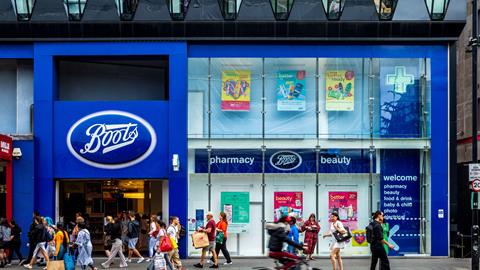
Since 2021, barely a year has passed without reports about Boots being put up for sale. Now the latest months-long saga has ended, with news last week that Sycamore Parters – Boots owner since August 2025 – is selling to the Canadian branch of the Weston family.
The $8.9bn deal finally puts pay to any remaining City hopes of a Boots IPO, the route Sycamore was initially reported to be exploring in April.
While the Weston family in the UK control ABF and Fortnum & Mason, Boots’ new owners are a separate branch, with a distinct corporate structure. So, who are they? And what will they do with Boots?
Based in Canada, this Weston family owns Loblaws, the country’s biggest supermarket, with a 17% share, according to the US Department of Agriculture’s Retail Foods Annual Report for 2025. In the UK, this is the same Weston name that owned Selfridges for 18 years, before selling the department store group in a £4bn deal with Thailand’s Central Group in 2021.
Shoppers Drug Mart
Perhaps the best clue to Boots’ future lies in Loblaw Companies subsidiary Shoppers Drug Mart, Canada’s largest pharmacy and health & beauty retailer.
According to Bruce Winder, a retail analyst covering Canada and the US, the similarities are hard to ignore. “Both have number one-market share and both have expanded beauty & health care services to grow above and beyond prescriptions.”
Both have also been pursuing similar avenues for growth. Boots has introduced more than 100 new beauty brands since 2023, added ‘Wellness Zones’ and ‘Trending on Social’ bays to stores, and developed its NHS partnership, offering walk-in consultations and prescriptions without a GP appointment since 2024. SDM has benefited from a “enhancement of prestige beauty products and a beauty shop within SDM” plus the “addition of health care services” under Loblaw’s stewardship, says Winder.
Boots Advantage Card has more than 17 million active members, the runner-up only to Tesco Clubcard and Sainsbury’s Nectar in the rankings of the UK’s most popular loyalty schemes. SDM has amalgamated its loyalty scheme with Loblaw’s to form PC Optimum, the “Canadian powerhouse” of loyalty programmes.

Josh Holmes, head of research at Retail Economics, says: “The Westons bring substantial retail experience, and their ownership of SDM makes them a particularly good fit. They understand the economics of pharmacy-led retailing and the importance of getting the balance right between healthcare, beauty and convenience.”
Richard Hyman, a retail analyst of 40 years, sees opportunities for talent-pooling. “SDM is a successful, well-run business, and I think there’ll be a lot of learnings from it and maybe some crossover of people too.”
Strategic thinkers
However, Hyman believes it would be a mistake to imagine the similarities with SDM were “top of mind” in the Westons’ decision. “They are more strategic thinkers than that”, he tells The Grocer. More likely, the retail-savvy family simply sees long-term opportunity in a business that could do better with more love.
Hyman has argued in an in-depth article that despite “lots of positive talk about Boots’ recent performance” it has “seriously lagged behind” AS Watson-owned Superdrug and Savers in growth. “Over the past 10 years its sales growth has been pedestrian: just under 10%. Meanwhile Superdrug has managed 42% while Savers has virtually doubled,” he says.
Boots has closed over 300 stores since 2023, leaving about 1,800. While an unwieldy estate may have necessitated this, Hyman also notes “you cannot disinvest and not see the consequences in performance”, especially in pharmacy, which made up about 30% of Boots’ revenue in 2025, down from 39% in 2021.
For its $8.9bn, the Westons get Boots’ retail operations in the UK and Ireland, Boots Opticians, its No7 Beauty Company and its Thailand and franchised businesses, along with its assumed debt. Boots will transfer to Wittington Investments, Limited, the Canadian Westons’ holding company (differentiated from the UK Westons’ holding company, Wittington Investments Limited, by a gramatically nonsensical comma). Wittington Canada’s chairman Galen Weston will become chairman of Boots.
“Deals like this are rarely just about current performance,” says Debbie Jackson, head of private equity at Walker Morris. ”The focus is often on where the business can be taken next.”
GlobalData retail analyst Charlotte Chilcott agrees: “Boots is a strong, profitable business with genuine headroom for growth under the right stewardship… The Weston family brings a proven track record of enhancing retail businesses through investment and long-term ownership”.
Willingness to invest
Away from its flagship urban and city centre branches, Boots has many neglected stores spread in smaller towns across the country, even after the closures.
Chilcott says the new owners should “focus on refurbishing the full store estate and… reinvesting in the pharmacy and health side of the business, which has been deprioritised relative to beauty expansion.
“The Westons have proven they can position health expertise as a competitive differentiator through SDM. Applying this model to Boots, investing in more trained health advisors and enhanced clinical services, will support revenue growth whilst maintaining its growing beauty proposition”. Revamping smaller stores will also “lift the brand image across the entire portfolio”.
As to the Westons’ willingness, Chilcott says the family is “not hesitant to invest in its store estate”.
“Loblaw has committed roughly $2bn (CAD) a year to its stores and supply chain since 2023, with around 1,800 store renovations and 250 new or relocated stores.”
A formalised $10bn capital plan to 2030 also suggests the Westons are ”well-placed” to fund the refurbishment of Boots’ remaining unmodernised stores.
Holmes also sees “considerable potential to develop Boots’ own-brand portfolio, particularly No7, through greater product innovation and potentially wider international distribution”.
“The Advantage Card is another significant asset, particularly as AI changes how consumers discover and choose products,” he adds. “In an AI-driven world, those direct customer relationships will become even more valuable.”
Boots has an excellent new CEO in Alex Baldock, who started in September, and is sure to have had “quite a few intensive conversations” with the new owners as they each “make sure that they’re on the same page”, says Hyman.
End of uncertainty
After what Hyman calls “many years of mixed ownership”, there seem to be a lot of pros for Boots in this latest change of hands. Are there any potential cons?
Chilcott notes that although health & beauty is expected to be one of the UK fastest-growing sectors over the next five years, it is still “forecast to grow at less than half the rate of Canada’s out to 2030”. That makes return on renovations harder to achieve than with SDM, which potentially reduces incentive to move quickly on refurbishments. It means “modernisation is likely to be phased over several years”.
That said, “as the biggest stores have been prioritised, the bulk of the remaining work is a programme of smaller, and likely less costly refits”, Chilcott says.
Holmes expects investment to be “selective” alongside potential “further closures as the new owners review the estate”.
But he sums up consensus with his view that “overall this is a positive development for Boots”.
Hyman says: “I think if I worked for Boots, I’d see this as a really good moment, a moment of relief and optimism that there is going to be genuine positivity in the business.”








No comments yet