


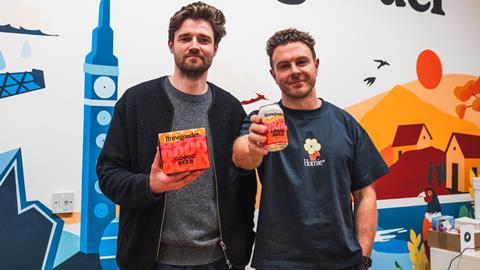
Brewgooder’s founders James Hughes and Alan Mahon on pandemic pivots, their Gaza support collaboration and going beyond craft
Brewgooder’s founders met in auspicious circumstances. In 2017, James Hughes left a job at Trustpilot and moved back to Glasgow, having scraped together just enough money for a flat in the city where he grew up. He recalls coming home one morning to discover his housemate had thrown an impromptu soirée. And there – sprawled on the chaise lounge in his boxers – was a twenty-something Alan Mahon.
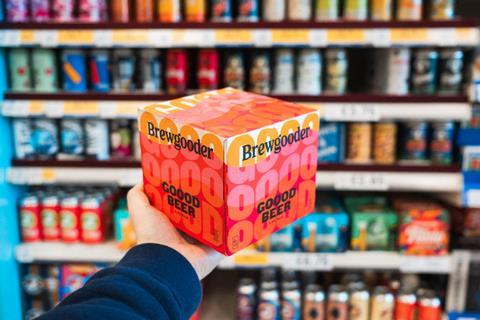
Despite appearances, Mahon was at this stage already an entrepreneur, having launched version one of Brewgooder: a beer brand that donated 100% of its profits to clean water projects. The idea came from his own experience becoming ill from drinking unsafe water while volunteering in Nepal.
“It was my first experience of unfairness in the world,” he says. “When I came home sick, not only did I have a prescription in a week, I was able to just continue with my life, applying for grad jobs and whatever.” Meanwhile “there were children [in Nepal] who wouldn’t have even made it to their fifth birthday”.
Having failed to land a job in international development, Mahon started working at the Edinburgh-based homeless charity and café Social Bite, and drinking in some of the city’s best beer bars. But while the first batch of Brewgooder’s Clean Water Lager was made at BrewDog, the business was never about jumping on the craft beer bandwagon, Mahon insists.
“I didn’t think the world needed another craft beer brand,” he says. “There was already enough of that around. I thought the opportunity was – could you take the social part of beer and combine it with the philanthropic things I was doing and had been brought up to do. But it could have been anything. It was just that 25-year-old me f***ing loved beer.”
Within three months of the first cans rolling off the line, the beer brand had funded its inaugural project via The Brewgooder Foundation – a 10,000-litre water tower providing safe drinking water to the community of Chiluzi, Malawi.
But it was the chance encounter with Hughes that opened Mahon’s eyes to what else a social impact beer company could achieve. “James had a more evolved vision than even I had,” he says. “His intuition of what Brewgooder is transcends the fact he wasn’t there at the kitchen table when I made it up.”
Hughes takes up the story: “It was evident to me that Alan’s motivation for wanting to set up Brewgooder was less about a specific passion or affinity to clean water projects, but about the values of equality, dignity and community that were driving him.”
The business may have never reached that full potential were it not for the pandemic. In late 2019, Brewgooder was planning its biggest project yet – enlisting over 250 breweries globally to launch a collaboration beer on World Water Day in March 2020.
Names: Alan Mahon and James Hughes
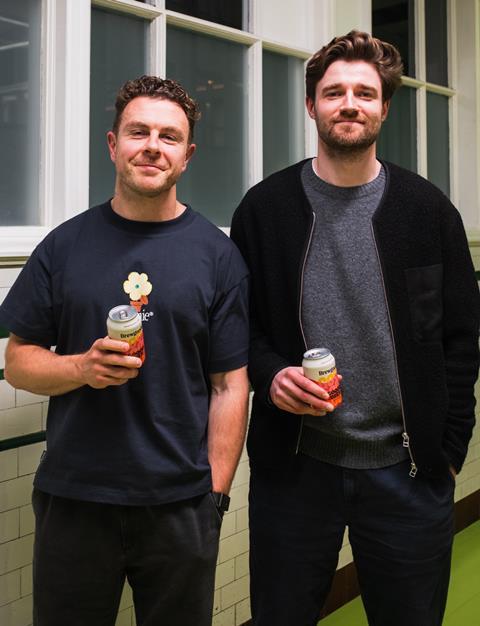
Born: Glasgow (JH); Belfast (AM)
Live: Glasgow (JH); Belfast (AM)
Family: Partner Sarah and two-year-old daughter (JH); Mum, two much older sisters (AM)
Potted CVs: Left uni to work at startups in Glasgow & London, plus a short stint as brand manager at Tennent’s Lager, then Brewgooder (JH); Led fundraising and events for Social Bite, before and during Brewgooder (AM)
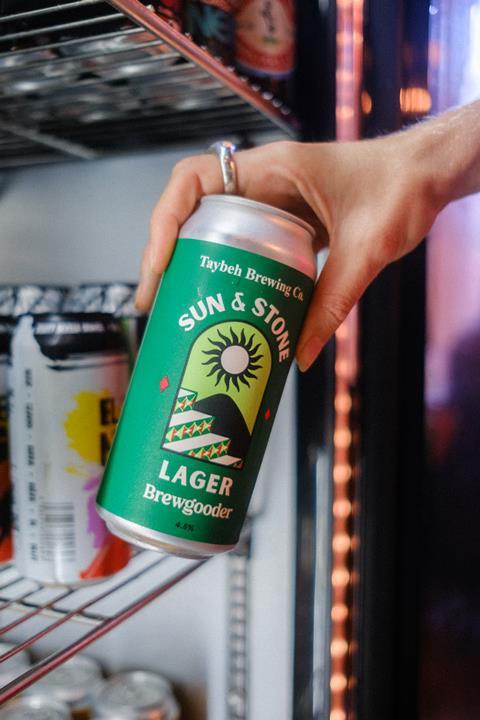
Career highlight: Collaborating with Taybeh Brewing Co to launch Sun & Stone Lager last year (both)
Business icon: Naval Ravikant, AngelList CEO (JH); Yvon Chouinard, Patagonia founder (AM)
Business motto: Only the paranoid survive (JH); Hope is dope (AM)
Book currently reading: The Creative Act by Rick Rubin (JH); Meditations by Marcus Aurelius (AM)
Favourite film: Hook, for the nostalgia (JH); A Serious Man (AM)
Charity you’re most proud to have worked with: Fairtrade, Refuweegee, CBV (JH); Tiny Changes (AM)
Dream collab/partnership: Glastonbury has always felt like it would be a good fit (JH); Minor Figures, because Affogato Oat Stout would be lit (AM)
“The self-declared funding target was something like £300k-400k,” says Mahon. “It was going to be amazing. And then Boris Johnson called last orders at the pub and told everyone to go home.
“James phoned me and said: ‘If we’re going down, we’re going down swinging. Wouldn’t it be cool if we could set the website up to allow people to buy a four-pack of beer for an NHS worker on the frontline?’
“We called it #OneOnUs and it was just the best response we could think of, and also proof we could evolve in a direction that was much more about empowerment, opportunity, activism and using the brand to do good things.”
Another impact of the pandemic was a shift in Brewgooder’s fundraising model. With no profits to speak of, the brand instead pledged £10 for every hectolitre of beer sold to The Brewgooder Foundation.
More Big Interviews:
-
Scott Davies: the builder‑turned‑beekeeper disrupting the UK honey market
-
UK MD Michael Fletcher on how Spar is creating a ‘functional family’
-
Alex Brittain: Proper Snacks CEO betting big on fibremaxxing
Independent trustees including B Lab head of marketing Kate Orme and ex-Toms Shoes MD Helen Thompson now sit on its board and – alongside Mahon and Hughes – are responsible for deciding where funds are best directed.
The duo cite the likes of Tony’s Chocolonely, Patagonia and Ben & Jerry’s as brands that have inspired them. “I make the most comparisons with our model and that of Ben & Jerry’s, which has gone on an inverse journey to us,” says Hughes. “It started out in Vermont funding things on its doorstep but has since expanded to not just local projects but international ones.”
Mahon agrees: “We’d love to be the Ben & Jerry’s of beer. Obviously there are challenges with that brand right now, but it had a remarkable 30-plus years of growing and doing the right thing whilst doing it.”
To date, The Brewgooder Foundation has supported more than 100 projects and donated over £300k in grants to everyone from Glasgow-based Refuweegee to mental health charity Tiny Changes. It also funds an annual brewing scholarship for BAME students at Edinburgh’s Heriot-Watt University.
“The lack of diversity in craft beer was always one of the biggest turn-offs for me,” says Hughes. “We do what we can, but we’d love to do more.”
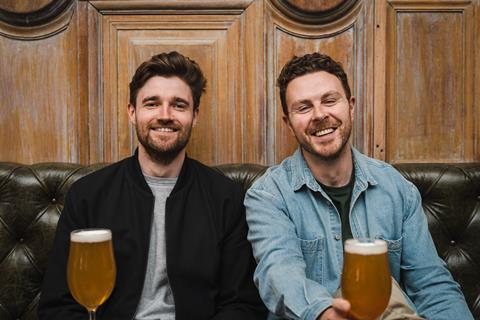
Palestinian collab
However, the project Brewgooder’s founders are most proud of was its collaboration last year with Palestinian microbrewery Taybeh Brewing Co, based in the occupied West Bank and unable to export its beers.
Brewgooder flew brewmaster Madees Khoury to the UK to produce Sun & Stone lager. The beer rolled into 1,600 Co-op stores in September, with a commitment to donate £20k to support the Disasters Emergency Committee in Gaza.
Hughes admits the “hostility” of discussions around Palestine was flagged as a concern internally, but says supporting humanitarian aid in the conflict-torn region was ultimately “the sword we would die on”.
“I asked myself, if Alan and I had to look each other in the eye in five to 10 years and say we witnessed what was unfolding and hadn’t taken any steps to do anything… could we genuinely be proud of that? And the answer was categorically no.”
While Taybeh “showed a lot of gratitude” to Brewgooder for its support, “at times it felt like it was the other way around”, Mahon adds. “I was grateful to them for trusting us to do it.”
Despite the publicity generated by Sun & Stone, the two founders know Brewgooder’s social impact mission is best served by selling more beer. Last year – having turned over a modest £3m in sales – the brewery unveiled a new-look core range featuring two fruit beers and a 3.3% abv pale ale.
The refresh is part aimed at wooing younger drinkers with whom Brewgooder’s mission resonates. “The craft beer scene that we were lumped into probably wasn’t our natural home,” says Mahon. “Our [target] market is younger than the average craft drinker, so that’s led us to look at what that consumer is actually drinking.
“The realisation that this consumer is different and wants a different profile of drink is what we hope will propel the company forward.”
Future success will therefore hinge on whether Gen Z believes that beer – like chocolate, clothing or ice cream – can be a force for good.
No comments yet