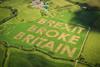
BREXIT BROKE BRITAIN_LBD-009

Source: Save British Farming/Led By Donkeys

Save British Farming marked the referendum’s anniversary by denouncing the impact of Brexit on the farming sector with a special ‘installation’

Keir Starmer’s flagship EU reset lacks a “clear strategy”, while its economic benefits are overstated, a damning new report by the Commons Business and Trade Committee has warned.

Published to coincide with the tenth anniversary of the Brexit referendum vote on Tuesday – and within hours of Starmer’s dramatic resignation on Monday – the committee warned the government had failed to articulate a clear long-term vision for UK-EU relations, leaving businesses and European partners alike uncertain about the ultimate destination of its much-vaunted reset.

The committee’s ‘UK-EU relations, a decade on’ report pointed to a growing “rhetoric-reality gap” at the heart of the government’s EU strategy. It noted that ministers had repeatedly highlighted the economic damage caused by Brexit and the potential benefits of the reset, despite experts suggesting the benefits would be relatively modest and the current dynamic alignment strategy could pose even more difficulties than Brexit itself.

Even in an “optimistic” scenario, the wider reset would only add 0.5% to the UK’s GDP by 2040, the committee said, citing figures calculated by thinktank UK in a Changing Europe. This was “significantly less than the purported 4%-8% UK GDP reduction from Brexit”, the committee pointed out.

The EU SPS deal

The planned sanitary and phytosanitary (SPS) deal with the bloc was highlighted as a key example of this mindset.

MPs on the cross-party committee noted that while efforts to reduce friction in agrifood trade had been broadly welcomed, initial optimism had increasingly given way to concerns over the extent of the dynamic alignment with EU law likely to be required of UK food and drink businesses – echoing recent warnings from the Fresh Produce Consortium, NFU, FDF and BRC.

They additionally spoke of the frustration of industry and EU member states over the “lack of a clear strategy beyond the planned EU summit” on 22 July – the date of which was confirmed by the PM last week, and promptly postponed in the wake of his resignation yesterday.

The committee said it had heard “time and again” that European partners remained unclear about the UK’s ultimate objectives.

“Yet there is still no strategic case for the reset, regulatory roadmap or any accompanying policy documents which set out the UK’s end goal,” it concluded.

Ministers needed to provide “greater transparency and guidance” on the “potential impacts on affected businesses” under the SPS deal, the committee urged. Clarity was also required on the future implications of EU legislation for UK businesses under the deal.

It comes as the Fresh Produce Consortium told The Grocer last month that the deal would increase cost and complexity for the importers who bring 50% of the UK’s fruit and veg supplies from outside the EU, rather than lessen it.

“Business decisions are being made now which risk falling foul of the deal’s eventual requirements,” the committee warned, while calling for a “detailed and comprehensive” SPS agreement implementation plan.

“This plan should set out how it will provide support for businesses to ensure compliance with SPS requirements,” the report said.

Speaking after the publication of the report, and following a Brexit anniversary event held by the UK Trade Policy Observatory on Monday, committee chair Liam Byrne MP said the economic damage done by Brexit would not simply be reversed by the government’s current reset plans, despite the government’s claims.

The “gap between political rhetoric and economic reality” had “led to all sorts of political consequences, one of which is the rise of populism and left us going through prime ministers faster than Italy”, he added.

“This is a national strategy moment, and we need a much bolder vision based on the world we’re in, that includes better co-operation with Europe.”

Ten years on, “there’s still no agreed post-Brexit vision”, added UKTPO founding director and University of Sussex emeritus professor L Alan Winters.

“Until this materialises, policy is going to continue to be rather chaotic. And while I am a fan of returning to the EU eventually, we have to address issues like energy, skills and investment at home first.”

It comes as campaign groups Save British Farming and Led By Donkeys today teamed up to mark the referendum’s anniversary by creating an installation on a Wiltshire field with crops cut to spell out ‘Brexit Broke Britain’.

“Ten years ago, farmers were promised a Brexit dividend,” said Save British Farming founder Liz Webster, whose farm hosted the installation.

“Instead, we have experienced a decade of disruption. We have lost the benefits of frictionless trade with our largest market, faced growing competition from imports, and watched Britain become increasingly dependent on food produced elsewhere,” she added.

“Brexit doesn’t just make imported food more expensive. It makes British food more expensive too,” Webster said.

“Farmers pay more for feed, fertiliser, packaging, machinery and energy, while consumers face higher prices at the checkout. Consumers pay more and farmers earn less. That is the Brexit food trap.”

The “only way” to ensure Britain could secure affordable food supplies “in an increasingly unstable world” was to rebuild a closer economic relationship with Europe, she urged.