


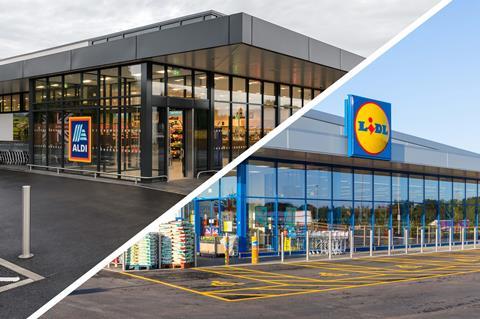
Lidl is nearly level with Aldi in the race for UK retail space despite having fewer stores, exclusive data shows.
Aldi has a UK retail footprint of 13,662,000 sq ft, while Lidl has 13,610,000 sq ft, just 52,000 sq ft less, according to figures from retail location data firm Geolytix.
The figures reflect Lidl’s preference for slightly larger stores, of up to 26,500 sq ft, while Aldi’s specified upper limit is 20,000 sq ft. They also reflect Lidl creeping up on Aldi in store numbers.
Across the UK, Lidl has close to as many stores, at 1,059 versus 1,085, thanks partly to Aldi’s lack of presence in Northern Ireland, where Lidl NI has 44.
Even excluding Northern Ireland, the gap in store numbers has closed marginally in recent years. At the end of 2021, Aldi had about 9% more stores, at around 960 vs Lidl GB’s 880. Aldi now has 6.9% more, at 1,085 versus Lidl GB’s 1,015, according to Geolytix’s data, relating to quarter two of 2026.
Geolytix store number and location data is published quarterly and used by retailers in planning where to open or close, as well by the Competition & Markets Authority to support investigations.
Its more detailed data also capturing stores size is not included in the published figures. Geolytix product manager Louise Cross said the sizing data used modelling and estimation “from a number of sources: planning permission, VOA, news articles, fascia and satellite”.
Aldi said it had 1,088 stores as of this week, while Lidl GB put its number at about 1,020.
The numbers also underline Aldi’s higher sales density. Its UK grocery market share is 10.8%, while Lidl’s is 8.8% [Worlpanel 12 w/e 12 July 2026]. At the same time, Lidl’s share is on the rise, up from 8.3% a year ago while Aldi’s has slipped from 11%.
Neither discounter provided a comment on Geolytix’s data.
Both plan to open about 40 stores throughout 2026, with Aldi usually weighting openings toward the end of the calendar year.
Aldi last week won permission for a new store in Lincolnshire after a four-year battle with Lidl, in a case highlighting how they are increasingly likely to come up against each other as they chase long-term goals of having 1,500 UK stores each. Both had submitted bids to open stores in Horncastle, but planners decided two discount supermarkets would be too harmful to the town centre.
Unlike other major UK supermarkets, the two discounters can legally have restrictive clauses in property deals to prevent competitors from opening nearby. A CMA consultation on extending the rules to cover Aldi and Lidl closed in April. The restrictions, designed to protect choice for consumers, already apply to Tesco, Sainsbury’s, Asda, Morrisons, Co-op, M&S and Waitrose.




No comments yet