Drone_1.19.1

Source: Compassion in World Farming

The increase in the fishing of the species threatened stocks and could impact wider seafood supply chains, the NGO warned

The boom in Atlantic bluefin tuna farming in European waters threatens to derail the fish species’ recent recovery, and could also affect global food security, a new report by Compassion in World Farming has warned.

Driven by demand from Japan – where the fish is used in its premium sushi and sashimi markets – the volume of farmed tuna in the Mediterranean rose 19-fold from 2023 to 2024, revealed CIWF’s report Atlantic Bluefin Tuna: Caught, Caged and Under Threat, published this week.

The number of licensed Atlantic bluefin tuna farms in the region also jumped significantly, from just 13 farms in 2006 to 123 by this year, the animal welfare charity added – placing stocks, which had been slowly recovering since the species was classified as endangered in 2011 – under renewed threat.

CIWF said the industry’s spread needed to be curtailed, with footage also released by the group alleging instances of “appalling welfare conditions in a Mediterranean tuna farm”, showing the animals in close confinement, constantly swimming around cages, and suffering from skin erosion, fin injuries and eye loss.

This reinforced “strong scientific evidence” that the animal welfare impacts were severe, and the species was totally unsuitable for farming, the NGO said.

It added there was also a lack of “transparent, comparable data across the whole supply chain” into the impact of the farms on fish stocks, which obscured the true scale of the industry’s expansion, and that more than €64m in public subsidies has supported tuna farming over recent decades.

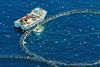
Captured live at a crucial point in their reproductive season, wild Atlantic bluefin tuna are typically dragged in large nets to farms where they are fattened and confined in sea cages.

CIWF said these methods put “unique pressure on wild populations”. Their need to swim continuously just to breathe – over long distances in the wild – also “causes them exceptional distress in confinement”.

The report additionally revealed that one farmed tuna producing just 200kg of meat could consume up to 3,000kg of wild-caught fish – the equivalent of up to 33,000 sardines, or 166,000 anchovies.

And beyond the sustainability concerns of feeding carnivorous species in farms, this system threatened marine life and vulnerable, low-income coastal communities in Sub-Saharan Africa and North Africa, which depend on these smaller feed fish for food and livelihoods, it added.

As a result, the NGO is calling for an “immediate”, international moratorium on new or expanded Atlantic bluefin tuna farms.

An urgent assessment of the species’ conservation status, improvements to industry transparency and monitoring, and animal welfare assessments were also required before new farm permits were granted, it urged. And any subsidies should be redirected to sustainable low-trophic aquaculture.

“Atlantic bluefin tuna are incredible underwater giants. In the wild, they can swim 260 kilometres every day – so it is completely cruel and unnatural to confine them in sea cages,” said report author and senior advisor at CIWF Dr Elena Lara.

“This destructive and unsustainable industry takes wild tuna from our oceans to fatten them on huge quantities of wild-caught fish – mainly to supply luxury sushi and sashimi markets.

“For too long, governments have failed to regulate a sector which is driving environmental harm and severe animal suffering. They must act now to stop tuna farming and commit to keeping tuna wild.

“So soon after the species recovered from endangered status, we cannot afford to repeat the mistakes of the past.”