




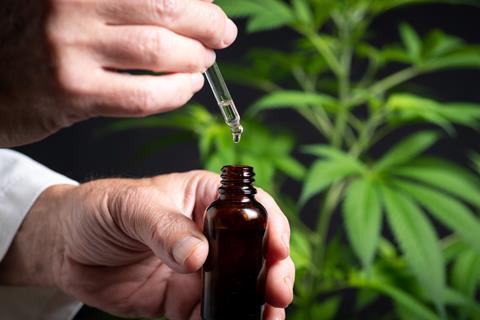
Just a handful of the 12,000 CBD products under review by the FSA are likely to be approved before responsibility switches to the EU – throwing the future of these products into doubt.
Thousands of applications for CBD food and drink products are in “limbo” amid uncertainty over the government’s SPS re-alignment negotiations with the EU, The Grocer can reveal.
Legal experts said it was looking increasingly likely that suppliers may have to launch fresh applications into Europe, with the Food Standards Agency set to hand over responsibility for novel food authorisations as a result of the regulatory reset.
The agency has admitted that bar a few “frontrunners” in the queue, it is set to hand over jurisdiction on decision-making in regard to CBD products to the EU.
However, leading CBD companies told The Grocer they were hopeful that the FSA would be able to secure an exemption that would allow them to go on selling their products.
CBD food businesses have been operating in a legal grey zone since the EU and UK determined that CBD was considered a novel food in January 2019, meaning products required authorisation before they could be sold legally.
However, the FSA introduced a transitional “grace” period in 2020 allowing manufacturers with a GB novel food application pending to sell their products in England subject to a credible application being submitted.
There are currently 12,000-plus products on the list linked to novel food applications. And the FSA wrote to manufacturers this week explaining that an EU market authorisation will be required when the SPS agreement comes into place, .
While the EU has accepted there will be a “limited number” of exceptions to the rules, the FSA said which products were included would depend on the outcome of negotiations.
No grace period
Experts pointed out that the EU has no such equivalent grace period as the UK.
The Grocer understands the FSA wrote to all CBD novel food applicants in March to inform them what the change could mean for their business and advise on “actions they may wish to consider”.
Last month it also held a roundtable with the CBD industry to discuss concerns from the industry.
The FSA has told industry sources that while it will continue to work on products with applications that are ”very near the end of the process” and “particularly those on which we have already consulted publicly”, the SPS negotiations mean others are “unlikely to progress through the queue”.
It said it meant that only a handful of “CBD frontrunners” were likely to make it through the process in England, before the EU takes over.
Even then experts warned that unless an exception was agreed, the authorisations would “fall away” when the SPS agreement came into effect, which is expected in mid-2027.
Adding to the doubts is the EU’s food safety watchdog, which has recommended that EU countries adopt a much stricter recommended limit for intake of CBD than the FSA’s recommended levels.
Last summer, the FSA encouraged businesses to meet a CBD provisional acceptable daily intake (ADI) of 10mg per day of CBD.
The European Food Safety Authority has proposed a daily intake level of 2mg. In 2022 an EFSA panel identified what it called significant data gaps in the safety of CBD as a novel food, including concerns focused on potential adverse effects on the liver, gastrointestinal tract, endocrine, nervous and reproductive systems.
While EU member states have largely adopted a tolerant approach towards CBD, no products have been officially approved despite more than 200 applications. Countries including Italy have recently introduced restrictions.
France is introducing restrictions on CBD edibles, after deciding on a strict interpretation of EFSA’s health advice.
Legal ‘uncertainty’
A source told The Grocer the legal uncertainty facing the CBD industry was affecting a huge number of products.
“There are literally thousands of CBD applications in the UK and they are just in limbo with companies wondering if the whole thing is going to go up in smoke. Will they have to start all over again?”
Katrina Anderson, a regulatory lawyer at Mills & Reeve, said: “The latest developments in the SPS negotiations seem to suggest that any agreement with the UK will effectively mean that GB novel food authorisations will no longer be an acceptable basis to sell in the UK, creating further uncertainty.
“Unless the UK negotiate an exemption specifically for CBD, businesses will have to apply for an EU CBD novel foods authorisation which would be a lengthy and costly process.
“There is no equivalent EU grace period to allow products to remain on the market while the application is being processed and it is not clear whether the FSA would extend existing grace period in England and Wales pending an EU application.”
However, Eoin Keenan, co-founder and CEO at CBD drink product Goodrays, said he was positive about the outcome of the discussions for CBD products.
“The SPS agreement is a generally positive long-term move for UK food and drink brands as it will make trading with the EU significantly easier,” he said.
“We’ve been a part of the SPS stakeholder roundtables, which have been productive but the details of the agreement are still a long way off as it’s such early days.
“With regards to CBD, the UK and the EU are both headed toward full market authorisation, just on different timelines. The UK expects full market authorisation this year and the EU expects it next year, so they are generally aligned on the same principles and intentions.
“The EU has also accepted that the SPS agreement will have ‘exceptions’ allowing the UK to keep the same regulations in place in certain sectors, which most EU countries already have in place.
“Since the UK leads the EU in its CBD process, it prioritises this as a key sector, given the significant time and energy invested over the last six years.
“I think it is highly unlikely that the EU and UK will fail to reach an agreement while simultaneously agreeing on and implementing all the details of SPS before the EU has time to fully market-authorise CBD.”






No comments yet