




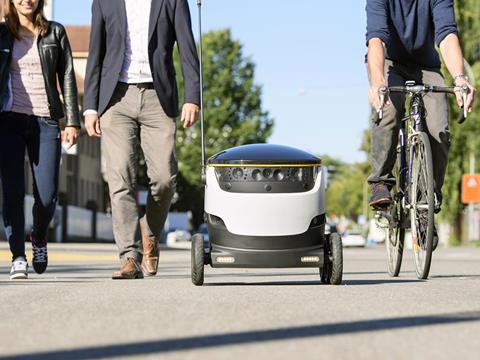
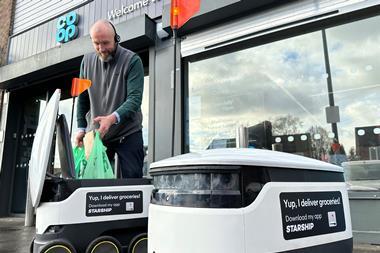
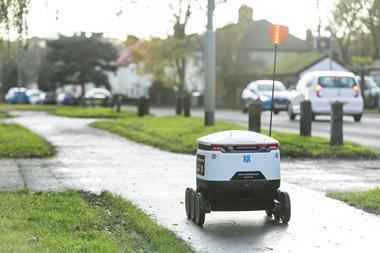
A new campaign is calling on the government not to legalise the pavement-roaming robots that are delivering groceries in several UK towns.
The ‘Pavement Overload’ campaign from charity Living Streets claims the robots – like those from Starship Technologies that deliver food for Co-op, Just Eat and Uber Eats – are putting “millions of disabled and vulnerable pedestrians” at risk.
“Britain’s pavements are already under significant pressure. For blind and partially sighted people, for wheelchair users, for older pedestrians, and for anyone who depends on a mobility aid, the pavement is the only safe route available to them,” said Living Streets CEO Catherine Woodhead.
“Delivery robots add to existing pavement congestion, present navigation hazards that are not reliably detectable by white cane or guide dog and occupy space that accessible design and decades of campaigning have worked hard to protect.”
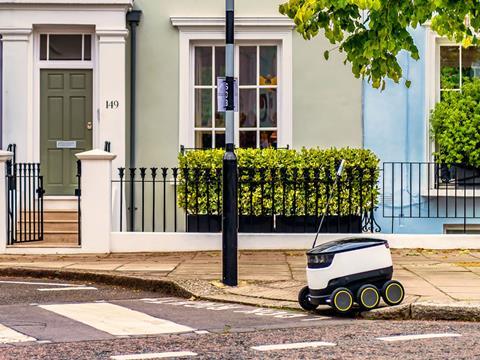
The campaign comes as the government looks to bring forward a consultation on micromobility regulation. At present, there is no statutory definition of a personal delivery device (PDD) anywhere in UK law. This is something robotic delivery company Starship Technologies has been seeking to amend, last year calling for a “clearer regulatory landscape” in the UK for its PDDs, which operate in what it called “a grey area”.
The Living Streets campaign – arguing that “our pavements are not for sale” – calls on the government to ensure any PDD laws are “designed with pedestrian safety and accessibility as baseline requirements, not as afterthoughts” and to “seriously reconsider the benefits of pavement robot technology, and the significant disbenefits”.
“Pavements are for people and should remain that way,” it states.
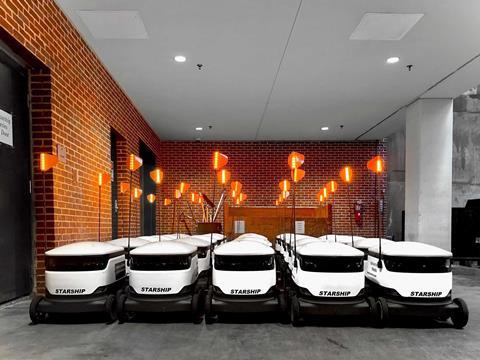
Lisa Johnson, Starship VP of global public affairs, told The Grocer that the company “completely understand concerns around robots sharing pavements with disabled residents”.
”That’s why we work closely with the disabled community and charities on inclusive design and making sure lived experience is reflected in how robots develop,” she added. “For example, a sight loss charity helped design the LED flag, another local group helped us with the positioning of robots at traffic light crossings, and we’ve tested robot behaviours with guide dogs,” she said.
According to Starship, 25% of its regular customers in the UK report they are disabled or live with someone who has a disability. “So it’s about sharing space well but also providing an accessible service,” Johnson said.
Johnson added that the company provided further huge social value, with around half of Starship’s UK customers saying they would have driven to the shop if robot delivery wasn’t available, ”so there’s a tangible impact on reducing short car journeys”.
“And kids love the robots, especially when the robots sing. For their parents, robot delivery can be a real post-school time saver,” she said.
Campaigners say that the fact food-delivery PDDs – which through Starship, Delivers.AI, Cartken and other robotics providers are in operation in Sheffield, Leeds, Barnsley, Milton Keynes, Sunderland, Reading, Bristol and Cambridge – have been deployed despite the legal grey area “is not accidental” and has been done “in the knowledge that it is harder to remove a technology that is already on the streets than to resist one that has not yet arrived”.
The campaign claims that in Sheffield, a Starship Technologies robot hub was installed at a local scout hut without notification to residents, ward councillors, or council transport and planning officers. “The council’s electoral manager discovered the operation by accident while conducting access checks at the building, a designated polling station,” it said.
Sheffield City Council subsequently opened a formal planning enforcement investigation.
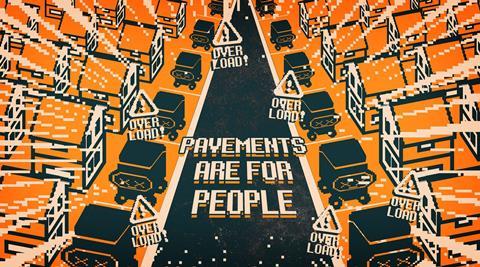
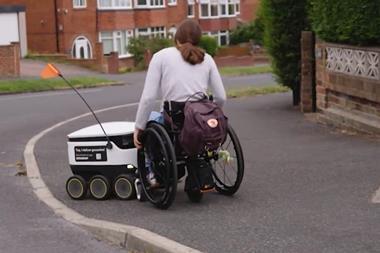
“Delivery robots are programmed to stay on the pavement, so when there is no room for someone who is disabled to move around the robot and vice versa a blockage is created,” Woodhead said. “This is especially dangerous when they may be a wheelchair user with no dropped kerb nearby or a blind person with a guide dog trained not to take them onto the road.”
There have been several incidents involving delivery robots colliding with humans. In 2022, Starship Technologies told The Grocer it was investigating an incident in which one of its bots reportedly “hit and pushed” a toddler in Milton Keynes.
In 2023, The Grocer exclusively revealed a Starship employee was given “additional training” after taking remote manual control of a 35kg bot and “charging it into” a pedestrian. The victim said the robot charged into their foot, broke the cat sensor on their front lawn, then “started charging at me, comes at me full speed, going back and forth, trying to run me over”.
Campaigners cite other incidents from other robot delivery tech firms, like a robot crashing into a man using a mobility scooter in Los Angeles and a robot almost running into a dog in Bristol.
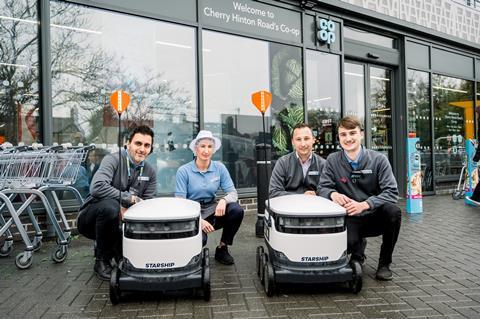
A 2025 report by Prysm Global, commissioned by Starship, estimates that expansion of the total fleet of PDDs UK-wide could see a £125m uplift in grocery spending, with underserved “delivery deserts” seeing the greatest uplift.
Their local manufacture and maintenance would require 555 new high-skilled jobs by 2035, and almost £11m in cumulative wages, the report states.
Several retailers and food delivery apps have partnered with delivery robot companies in recent years. Late last year, Uber partnered with Starship to offer customers autonomous food deliveries in the UK, Europe and US. The partnership began in Leeds before rolling out to Sheffield. The robots will be delivering Uber Eats orders in multiple European regions this year and in the US by 2027.
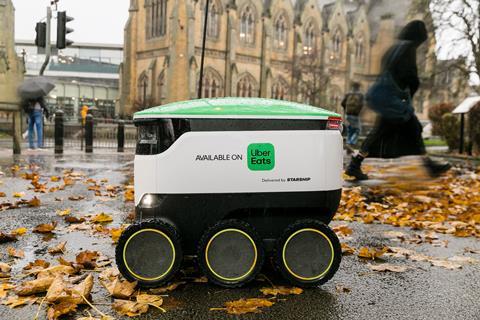
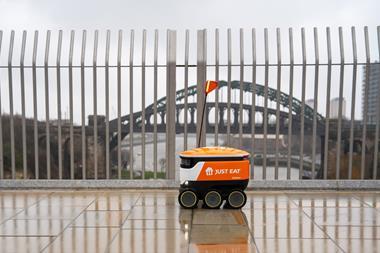
In February, Just Eat and Starship launched a joint hot takeaway delivery service in Sunderland enabling customers using the Just Eat app to select an option to have their meal delivered by Starship’s autonomous robots. The companies said they planned to expand the service to other towns and cities “in line with demand”.
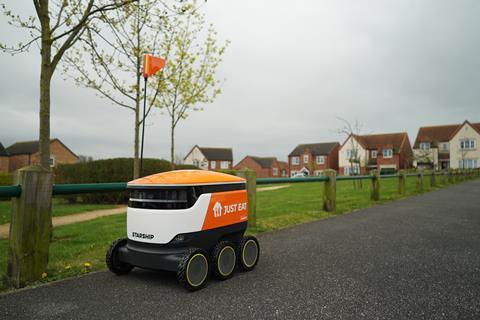
Starship alone has more than 2,700 robots operating across 270 locations around the world. Founded in 2014, the firm’s robots have been serving UK customers since 2018, and have completed almost 10 million deliveries to date.






No comments yet