





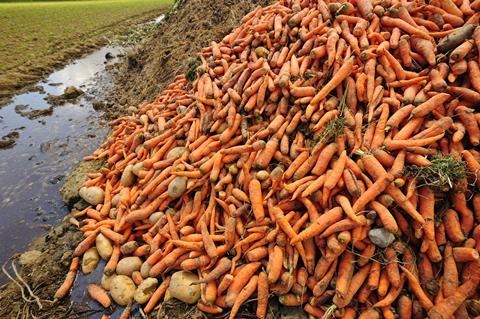
The amount of fresh surplus food rescued and redistributed by the UK’s biggest food charity crashed by 39% this year after a government fund to help growers pay the costs of transport ran out, a new report reveals.
Felix, which came together in a merger with FareShare last year, claims the huge fall shows that temporary government fixes to the food surpus farm crisis do not work.
It is urgently calling on the government to create fresh financial incentives that will allow it to turn the tide on the “mountains” of food being wasted, sent to landfill, or going to anaerobic digestion, instead of feeding those suffering from food poverty.
A report published by the charity this week, called the Redistribution Revolution, charts how the withdrawal of government funding saw a massive fall in food going to charities on the front line.
“We’ve seen what happens when the economics change,” it says. “When the government’s Farm Gate scheme made donation cost-neutral for growers, more than 14,000 tonnes of fresh produce reached communities.
“When the funding ended, the fresh produce Felix redistributed fell by 39%. Short-term grants can unlock food, but only lasting change keeps it flowing.”
After years of campaigning by charities the government made £15m available across England last year in its Farm Gate scheme, although as The Grocer revealed at the time only £13.6m of that was actually awarded.
It came after The Grocer’s Waste Not Want Not Campaign saw Michael Gove award £15m to help subsidise the transport costs of redistributing surplus, which instead of becoming ongoing funding saw instead only temporary interventions.
In May, in one of Keir Starmer’s final acts as PM, the government announced a major new commitment to triple the volume of surplus food made available for redistribution, as part of a national programme to tackle food waste and food poverty.
Then in July, the UK’s food redistribution sector reached an historic agreement to collaborate and share resources after the seven main redistribution organisations signed a “covenant”, which will look to turn their separate organisations into a joined-up network, sharing data, resources and strategy.
However, in its new report Felix warns that “mountains” of unnecessary food waste is still being produced because of stop-start funding and a perverse set of financial incentives which make it cheaper for companies to send food to landfill than to food banks.
To mark the new report nearly 1,000 charities and community organisations have signed a joint letter to the government calling on it to introduce corporation tax incentives to make it more attractive for food businesses to redistribute surplus food.
Felix says that at a time when 12% of UK households are experiencing food insecurity, over one billion meals-worth of high quality food go to waste in the UK supply chain every year, enough to feed every child in the UK for a month.
The signatories, including homeless shelters, pantries, community kitchens and breakfast clubs, have backed Felix’s call for tax incentives.
They claim the UK tax code makes it cheaper for businesses to waste surplus food than to donate it to people in need.
The report says: “The businesses we work with want to donate. But giving food away means extra sorting, packing and transport, while sending it to animal feed or anaerobic digestion can earn money or cost less.
“So redistribution happens where companies go out of their way to make it happen, not because the system rewards it.”
The UK now redistributes just 0.7% of its surplus through charities compared to France which redistributes twice that share, and the USA more than four times.
As well as tax change the report calls for redistribution to be built into Food Nation 2040, a new phase of the government’s Food Strategy, being spearheaded by the IGD.
It is also calling for the government to revive long-delayed plans for mandatory reporting of surplus food, so government, industry and charities can see where the food is.
Felix said the government had made its priorities clear and that it wants to support local communities and help people suffering from the cost of living crisis in every postcode.
“We know anyone involved in growing and producing food would much rather see any surplus food they have ending up on people’s plates, but sadly this is not always the most financially viable route. That is why it is so important the Treasury look at our proposal,” said Felix CEO Charlotte Hill.
”We have already had so much incredible support from the government – in May former PM Keir Starmer announced the National Programme to Redistribute Surplus Food, which aims to triple the amount of food redistributed in the UK over the next 10 years.
”As a sector we have come together to try make this happen, but it is important the government makes changes to help us achieve our ambitions. I am delighted to see so many organisations supporting this ask, which we all feel confident could unlock more food and help us all deliver greater impact to communities across the UK.”






No comments yet