



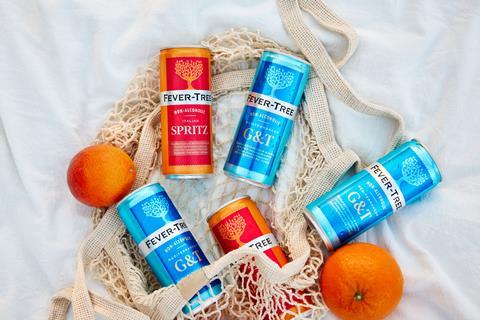
Fever-Tree is planning to expand its portfolio of adult soft drinks and non-alcoholic cocktails in response to growing demand from consumers and retailers.
Having debuted its first non-alcoholic cocktails in the UK earlier this summer, Fever-Tree was now looking to grow distribution of the SKUs as well as develop further new products, CEO Tim Warrillow said.
“It has taken us all of it by surprise quite how quickly they have found their customer base and quite how fast they’re rotating,” he told The Grocer. “They are in our top five SKUs for rate of sale and they’re only been out there for a couple of months.
“They’re currently in Waitrose and 300 Sainsbury’s stores, which as you can imagine is something we’re now looking to roll out much more widely.”
Retailer requests were also shaping the supplier’s NPD pipeline, Warrillow admitted.
“There’s no question that people are elevating their people entertaining and dining in at home,” he said. “And that is something the retailers are looking to us to help support them with.
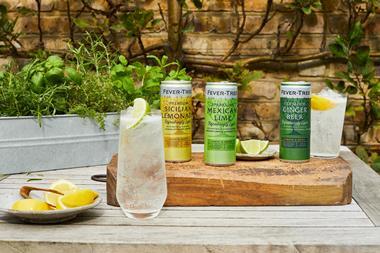
“We are looking at other non-alcoholic products to build our portfolio, as well as other formats across our soft drinks for the convenience channels and other parts of store where those products are more commonly sold.”
Gin’s long-term decline
Non-tonic products now make up 45% of Fever-Tree’s sales globally, and 30% in the UK – where they have grown grown at a CAGR of 13% over the past three years.
The long-term decline in gin consumption, as well as reduced footfall in pubs and bars, has also given added impetus to NPD efforts. Fever-Tree’s UK revenues fell by 6% in the first half of 2025, driven primarily by declines in the on-trade.
“Gin has been declining from this wonderful peak – although the data suggests volume declines are starting to slow,” Warrillow said. “But on top of that the on-trade has been suffering from a tsunami of taxes and costs that has unfortunately resulted in higher prices to customers, and therefore lower footfall in general.
“The Fever-Tree brand remains as strong as ever – our market share in the on-trade is twice that of our nearest competitor – but the trade is just being less frequently visited and spend is down. Conversely, in the off-trade we are seeing a benefit as people take their drinking and dining back home.”
Proft dip downplayed
Elsewhere, Fever-Tree sought to downplay the significance of a 15% decline in its profits before tax in the first half of 2025, pointing to £4.1m in exceptional items resulting from its new partnership with Molson Coors in the US.
On an adjusted basis, its profits before tax and earnings per share were both up, with the latter ahead of analysts forecasts, it pointed out.
Molson Coors bought an 8.5% stake in Fever-Tree in January as part of a deal to produce, distribute and sell the carbonated drinks brand in North America. Following the deal, the supplier wound down its local bottling arrangement and it is currently making its drinks in the UK, meaning they are subject to US tariffs of 10%.
The impact of US tariffs on profits amounted to “a few million pounds”, but this was shared between Fever-Tree and Molson Coors, Warrillow said.
“We’re working very hard with them to get on-shoring going and 2027 is when we are planning to start producing in the US,” he said. “So hopefully by then, tariffs will no longer impact us.”
While profits had taken a short-term hit, Fever-Tree was set to benefit from the increased scale and distribution of Molson Coors in the US, Warrillow added.
“They service about 500,000 distribution points across the US,” he said. “Currently, we’re in 40,000 or so of each in the on and off trade, so 80,000 out of the 500,000 pool. So the opportunity ahead in terms of their reach is huge.”



No comments yet