





A group of senior executives from major UK food suppliers and retailers has claimed the industry has responded to the climate crisis by resorting to “quick-fix crisis management” to present the “illusion of resilience”.
In a damning new intervention, the group has warned short-term thinking in food industry boardrooms is leading to higher prices in shops and shortages of healthy food options.
It has accused companies of stepping away from the action needed to create strategic long-term solutions to the climate challenge, with disastrous consequences for the supply chain and consumers.
The accusation comes from the same group of whistleblowers who rocked the industry in April last year with a memo warning the sector was heading for an economic disaster bigger than the pandemic. It claimed companies’ resilience planning was based on “wishful thinking” and “false reassurances” to investors.
The group includes around 20 executives from major UK producers, manufacturers and retailers, as well as the British arms of global firms.
They warn that the content of a suppressed government report on the risks to the food chain of climate change is now coming to fruition.
Last week foreign secretary Ed Miliband presented to foreign leaders the contents of a report by the UK’s intelligence chiefs. It claimed the El Niño posed a critical threat to nations’ defences, after the report’s originally planned October release was controversially suppressed by former prime minister Keir Starmer.
The report found the collapse of natural systems around the world would lead to conflict, migration and food shortages in the UK and elsewhere.
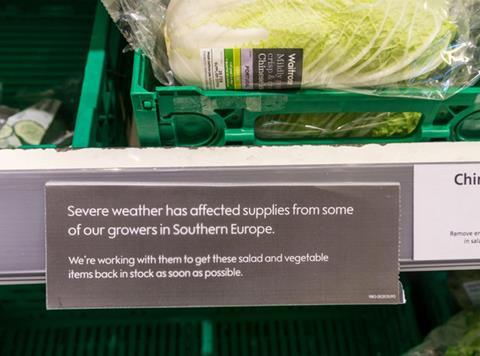
The insider group pointed to significant crop failures this year, with farmers also suffering across several key European and global sourcing regions.
“The intense pressures caused by climate change, biodiversity loss and soil degradation are now real,” the document warned.
“They are generating material reductions in yield, quality and reliability of supply.”
The whistleblowers warned that the current corporate response to the threat would push up prices for consumers seeking healthy food options.
They claimed companies were moving away from investing in more resilient and local food systems with “short-term ‘fixes’ to switch sourcing to alternate regions and ingredients… taking priority”.
The memo states: “There will be growing disruption unless we seriously act to reduce environmental impacts, ensure farmers can access long-term and reliable income, and take much bigger adaptation steps ourselves… We cannot sacrifice actual resilience for the illusion of resilience in the short-term, or we will undermine the overall financial sustainability of our sector.”
Food company boards are “hyper-focused” on “unrealistic” expectations from investors on short-term growth, the group goes on to say.
It says senior executive remuneration packages and key performance indicators are still tied to short-term financial targets, which themselves are disconnected from environmental targets and work against the futureproofing that is needed.
“This creates a huge structural pressure focusing boards’ minds on commercial competition instead of the long-term, pre-competitive work necessary to advance the key issues that will make food healthy, affordable and reliable into the future.
“All of this is further amplified through siloes by sector and country, and a ‘head down’ mentality by suppliers who are under pressure and don’t have capacity to focus on shifting the system.”
Part of the criticism accuses food bosses of “consistently lobbying against necessary regulations” or staying silent.
“We’ve seen that the DRS scheme [sic] and EPR regulations which enjoy popular and expert support have been continually attacked by our industry for over a decade to delay them.
“The popularity of these policies meant they survived lobbying but have carried a huge expense for businesses who are now having to make changes at short notice.”
It adds that increasing competition within a faltering food system that relies on more complex and fragile supply chains should be of major concern to investors and renews calls for them to do more to hold companies to account.
“We need our investors to challenge us and hold us accountable to the risks we are disclosing.
“This will enable us to work towards a more secure food system which is in the interests of our companies, our investors, our government, the communities we source from, and our customers.”
The memo was co-ordinated by Inside Track, a non-profit organisation that enables anonymous networks of senior executives to expose social and environmental impacts of their industries.
Ana Cuddeford, head of investor engagement at Inside Track, said: “Food companies are opting for short-term tactical fixes rather than investing in mitigation and resilience.
“Our insiders tell us that boards are neither asking the right questions to understand the risk the industry is facing nor allocating the time, energy or budget to materially reduce that risk.”
Tim Lang, professor emeritus of food policy at City St George’s, University of London, added: “The UK food system might be super-efficient in some respects, yet it’s also damaging ecosystems on which it depends.
“Worse, the costs of diet-related ill-health and social divisions are rising. The post World War II model of intensification and pursuit of output is fraying.
“This latest Insider briefing confirms that picture. We are entering a new era. But it’s one that policymakers have not yet grasped. “The enormity cannot be resolved by a label here or there, or putting the burden on consumer choice. A new framework for food is required. But will it be agreed before events force change? That’s the big question recognised by the insiders here.”







No comments yet