






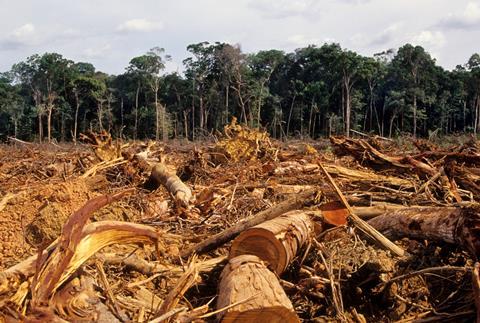
Major food and drink businesses including Nestlé, Mars Wrigley, Ferrero and Tony’s Chocolonely have urged the EU to reverse its planned delay to Deforestation Regulation by another year.
European Commissioner Jessika Roswall announced a second one-year delay to the rollout of the EUDR a fortnight ago, citing “IT issues”. The law was due to come into effect at the end of the year for large businesses and in June 2026 for SMEs.
In an open letter sent to Roswall last week, the businesses, alongside NGOs including the Rainforest Alliance warned the delay “puts at risk the preservation of forests worldwide, will accelerate climate change impacts, and undermines trust in Europe’s regulatory commitments”.
“The company signatories to this letter, together with their value chain partners – including smallholder farmers – have been actively preparing and investing in compliance with the current provisions of the EUDR, which we have consistently supported,” they added.
“These efforts have been made in good faith that the European legislative framework and timeline were reliable. We remain on track to achieve full compliance with the EUDR obligations by 31 December 2025.”
Instead of further delaying the rollout of EUDR, the Commission was urged to “adopt a pragmatic approach” and establish “a defined timeline (grace period) of not more than six months”, during which controls would be reviewed and fines suspended for failing to meet EUDR’s standards.
Read more: What’s behind the latest delay to the EU’s flagship Deforestation Regulation?
Failure to comply with the regulation – which calls on extensive proof products are deforestation-free – brings a maximum fine stretching to at least 4% of a company’s total annual EU turnover, plus a ban on doing business with EU member states. The likes of Mondelez and Lavazza this year warned the regulation should be delayed.
However, the proposed delay put at risk the preservation of forests worldwide, while also accelerating climate change impacts, and “undermines trust in Europe’s regulatory commitments”, the letter read.
“We deeply regret that a technical IT issue risks jeopardising the EUDR’s core objectives and entry into force, three months before the implementation deadline for companies,” it added. “This approach would introduce considerable uncertainty and stakeholder disengagement and result in additional compliance expenses for businesses, contrary to the intended simplification.”
It comes as Roswall was said to be weighing up changes to the EUDR this week that could ultimately see a watered-down version of the law still come into force.
On Thursday, she had hinted in a meeting of the centre-right Renew Europe grouping of MEPs in Brussels that she could “reopen and tweak” the regulation, reported EU news outet Euractiv.
“Roswall says we need to simplify the legislation,” a Renew MEP present at the meeting told the website. Relief for micro and small enterprises was said to be “under consideration”.
Elsewhere, the US was this week demanding the EU water down parts of its green legislation, including calling on it to scrap requirements for non-EU companies to provide “climate transition plans”, reported the Financial Times on Wednesday.
The move was part of a “wider bid by Washington to push countries, financial institutions and businesses to roll back their climate change policies”, the FT said.
A US government paper described EU corporate due diligence rules – which came into force last year and require companies operating in the bloc to identify any social or environmental harms – as a “serious and unwarranted regulatory over-reach” that “imposes significant economic and regulatory burdens on US companies”.






No comments yet