





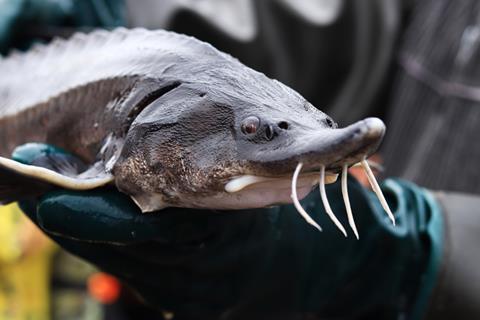
‘Fish whisperer’ Mark Addey has launched a £500k raise to set up the UK’s first sturgeon sanctuary – both a home for monster fish and a rare centre for caviar production in the UK.
Addey was the first to bring no-kill caviar harvesting techniques to the UK at a previous business based in Bridlington, just outside Leeds. Supplying to Aldi, KC Caviar used a patented process to massage eggs from around 450 adult female sturgeon – dinosaur-like fish that date from the mid-Jurassic and grow up to several metres long.
KC Caviar wound down at the start of the pandemic after around five years of production as a series of health issues put Addey out of action.
Now back in the game, Addey – known as “the Crocodile Hunter [Steve Irwin] of sturgeon” – has begun the hunt for funding to combine a rehoming programme for ornamental sturgeon with true UK-only caviar farming.
“I just seemed the obvious person to do it. I have the contacts, I have the knowledge. And I’m just searching for funding,” he said.
“If the money was in place, I could do it tomorrow.”
Though sturgeon are less popular as ornamental fish than koi carp, millions are kept as pets in the UK, according to Addey. New venture The Sturgeon Sanctuary would be home to up to 150 adult females, and many thousands of juveniles.
“There’s no donkey sanctuary or dogs’ home for sturgeon – there’s never a pond large enough. They just go from pond to pond, Facebook group to Facebook group. You wouldn’t want your dog passed around Facebook for the rest of its life,” Addey told The Grocer.
Adult females typically produce around two kilos of eggs per season, which can happen as often as once a year, giving Addey a maximum capacity of around 200kg-300kg of caviar a year, which he would sell to supermarkets rather than individual buyers.
“They take it and repackage to their own standards – it’s a job lot, and you sell it all in one go. You don’t have to chase around with samples,” he said.
With so many fertile females, it would be “silly” not to produce caviar, said Addey – though he added the business would not be viable on caviar alone, as cheaper Chinese imports keep prices down and make no-kill production economically unviable.
China’s share of the global caviar trade has exploded from around 14% in 2012, to $43m of the $228m market, aided in part by the western trade blockade on Russia and a growing taste for luxury goods in China. Harvesting caviar from wild sturgeon has been illegal internationally since 2006.
“No matter what industry you’re in, you’re in direct competition with China,” said Addey.
As well as producing caviar, selling feed and breeding young sturgeon, Addey will embark on an experimental breeding programme to produce colourful, patterned sturgeon. Sturgeon are far more resistant to disease than koi, requiring significantly less medicine and treatment – and Addey said he believed there were strong commercial prospects for any venture that succeeded in breeding brightly coloured sturgeon.
“If the sturgeon was as pretty as a koi, the koi industry would be finished,” he added.
Despite Addey’s status as one of the UK’s top sturgeon experts, he himself has little taste for caviar.
“It’s strange but nice tasting, like creamy nuts with an aftertaste of grapefruit – but it’s just not appetising to me,” he said.
“I’m a Yorkshire guy – I just like my Sunday dinners and spag bol on a Thursday.”







No comments yet