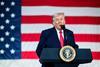
UK food and drink exporters are facing further tariff uncertainty after US president Donald Trump reacted to the US Supreme Court decision to strike out his ‘Liberation Day’ tariffs with a new 15% levy.
Trump reacted angrily to the court’s decision on Friday, describing the ruling – which found he had exceeded his presidential powers in imposing the package of reciprocal tariffs last April – as “ridiculous” and “nonsensical”.
The Supreme Court decision saw six justices (including three conservatives, two of whom were appointed by Trump) vote in favour of it, with three voting against, and rendered a slew of global import tariffs imposed last year, including the baseline 10% paid by most UK food and drink exporters, as unlawful.
But by Friday evening, Trump had introduced a new, temporary 10% global tariff under the US Trade Act of 1974 – for a period of 150 days, to replace the ‘Liberation Day’ package.
Trump then quickly hiked the levy to 15% on Saturday, as the act allows for, with the White House saying tariffs “will continue to be a critical tool in president Trump’s toolbox for protecting American businesses and workers, reshoring domestic production, lowering costs, and raising wages”.
Extending the new tariff regime past the initial 150 days will require congressional approval.
The UK government is yet to comment substantively on Trump’s latest move, which will effectively increase the cost of doing business with the US by five percentage points for most UK food and drink exporters. However, it has already led to calls from some businesses for a refund on the costs imposed during the previous tariff regime.
And the British Chambers of Commerce (BCC) warned the total tariff cost for the 40,000 UK companies exporting goods to the US could rise by as much as £3bn.
The status of the UK’s Economic Prosperity Deal – agreed with the US last May in the wake of the ‘Liberation Day’ levies – also remains unresolved.
Read more: Trump’s ‘Liberation Day’ tariffs thrown out by US Supreme Court
It comes as the Supreme Court judgment acknowledged that striking down the ‘Liberation Day’ tariffs “could generate uncertainty regarding various trade agreements” – according to testimony from Trump loyalist justice Brett Kavanaugh, who voted against the court decision.
“The United States may be required to refund billions of dollars to importers who paid the tariffs [under the International Emergency Economic Powers Act], even though some importers may have already passed on costs to consumers or others,” Kavanaugh added in his argument.
Reacting to the new 15% levies, William Bain, head of trade policy at the BCC, said UK exporters would be “dismayed at this latest turn of events”.
“We had feared that the President’s Plan B response could be worse for British businesses and so it is proving,” he added. “This will be bad for trade, bad for US consumers and businesses and weaken global economic growth. Businesses on both sides of the Atlantic need a period of clarity and certainty. Higher tariffs are not the way to achieve that.”
Bain said “the one ray of light” in this new scenario is that extending thew 15% tariff will need to be approved by Congress after 150 days. ”It is now vital that the government and business continue dialogue with their US counterparts to retain the UK’s competitive advantage and reduce tariffs as far as possible.”
A spokesperson for the UK Department for Business & Trade Told The Grocer on Friday that the court decision was “a matter for the US to determine but we will continue to support UK businesses as further details are announced”.
“The UK enjoys the lowest reciprocal tariffs globally, and under any scenario we expect our privileged trading position with the US to continue,” they added.
“We will work with the administration to understand how the ruling will affect tariffs for the UK and the rest of the world.”
DBT also stressed the Friday ruling would “not impact the majority of trade under our deal with the US, including preferential sectoral tariffs on steel, pharmaceuticals and autos”.


No comments yet