






Dubai-style chocolate was the category’s hottest craze this past year. Lindt, Ombar, Iceland and M&S were just a few of the names to tap the trend through launches. But they weren’t enough to prevent a decline in category volumes: 11.4 million fewer kilos of chocolate have gone through tills.
“It’s been a turbulent year for the chocolate industry and, more importantly, cocoa farmers,” says Nicola Matthews, Tony’s Chocolonely UK marketing head. “Cocoa prices used to be around $1k to $3k per tonne. By the end of 2024 they’d rocketed to $12k, causing shelf prices to go up and people to buy less chocolate.”
The price shocks were chiefly due to extreme weather conditions in Ghana and Ivory Coast, the world’s biggest cocoa producers. And with climate change making weather patterns in west Africa and elsewhere increasingly erratic, the volatility persists. Global cocoa prices stood at around $6k per tonne in November.
Against this tumultuous backdrop, the big brands have performed surprisingly well. Sixteen of the top 30 have shifted more kilos in the past year. Many of those in decline in terms of weight sold have still managed to shift more units by diversifying ranges and shrinking packs to hit lower price points.
“Consumers are shopping in different ways,” says Lauren George, Mars external communications manager. “Some have traded up to bigger pack formats that offer better value, and some are driven by unit price. We’ve supported customers by offering different price points and ensuring value for money.”
Her final claim is a matter for debate. Social media has been awash with posts calling out brands and retailers for shrinkflation in the past year. For example, Mars Celebrations tubs have shrunk from 550g to 500g, while its non-deal price has remained at £6.
Wrapped assortment tubs from Cadbury Roses, Cadbury Heroes and Quality Street have also shrunk in recent months with no corresponding cuts in price. At the time of writing, Morrisons was selling 550g tubs of Quality Street for a non-deal price of £7. The same time last year, it was selling 600g for £6.
Similarly, Toblerone sharing bars have shrunk from 360g to 340g with no corresponding fall in price.
Not that all shoppers seem bothered by shrinkflation. Toblerone has grown 11.3% in value and 10.1% in volumes – the strongest volume gain in the top 30. Cadbury Heroes has grown 9.3% in value and 4.9% in volume, and Mars Celebrations has grown share with 7.9% value growth on volumes down just 0.4%.
Seasonal sharing formats may be particularly vulnerable to shrinkflation because people are less concerned about getting a bang for their buck on special occasions. “Shoppers are more price sensitive day to day,” says George at Mars. “But they’re still looking to treat themselves and others on special occasions.”
Of course, events like Christmas and Easter are crucial for chocolate, but brands are also widening the repertoire of seasonal sales events they’re looking to cash in on. Increasingly, they’re promoting chocolate as a gift for everyone from romantic interests at Valentine’s Day to teachers at the end of the school term.
Mondelez, owner of Cadbury and Toblerone, claims its investment in seasonal events is paying off. “We’re winning share across seasonal and gifting occasions as shoppers continue to indulge in seasonal moments, particularly at Christmas and Easter as well as Father’s Day,” says trade communications manager Susan Nash.
“Mondelez won 1.1ppts share in Easter and 2.3ppts share at Father’s Day with key brands including Cadbury Mini Eggs and Cadbury Creme Egg growing value share.”
These brands’ performances support the belief that shoppers are less price sensitive during seasonal events. Cadbury Creme Egg has seen the steepest rise in average price per kilo in the top 30 – but it’s achieved value growth of 22.4% on volumes up 2.2%. Mini Eggs’ average price rise was third steepest, yet it’s grown 27.1% in value and 7.9% in volume.
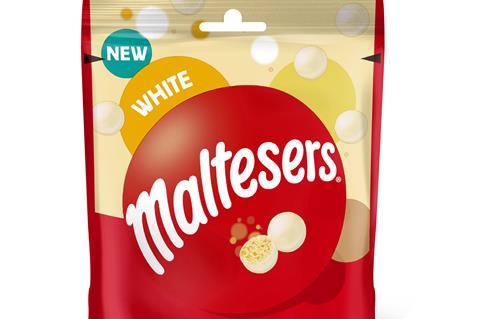
Outside festive occasions, Mondelez is looking to new products to drive growth. “Innovation is an integral part of our approach,” says Nash.
She points to the March launch of Cadbury Dairy Milk Biscoff and May’s White Dipped Cadbury Twirl as highlights from the past year. “Consumers are interested in discovering new and innovative chocolate flavours as well as limited-editions, which drive footfall in store.”
A fight for shelf space
Despite the aforementioned innovations, Dairy Milk and Twirl are in volume decline – by six million kilos and 1.4 million kilos respectively. That’s partly because the biggest brands are having to fight harder with challengers for shelf space.
Ritter Sport, for example, claims to have achieved 29 consecutive quarters of growth fuelled by distribution gains at Tesco, Sainsbury’s, Asda, Morrisons, Waitrose, Ocado and Booker.
“While many legacy brands have struggled to maintain momentum and much of the block chocolate segment continues to face declining penetration and volume, 2025 has been a period of real success for us,” says Ritter’s UK MD Benedict Daniels.
“The key driver of performance has been the evolving consumer mindset. Today’s shopper is more value-conscious than ever. That’s not to say they are price-led, but they are discerning about what constitutes genuine value.”
Tony’s is playing a similar tune. “Many brands have raised prices, shrunk bars and taken cocoa solids out to offset additional costs, and consumers are feeling that at the shelves. We’re completely bucking that trend,” says Matthews. Tony’s 2.7% volume loss is due chiefly to the April recalls of Easter eggs and tablets, she adds.
Despite the mounting pressure on cocoa prices, Matthews is upbeat about the outlook for Tony’s. “Cocoa yields are down 30% and farmers are growing less because of climate change,” she says. “But because our whole mission is to end exploitation in cocoa by paying a fair price and partnering with farmers, they want to sell to us. We are at the front of the queue.”
If bigger brands want to get ahead in that queue, they may need to change their sourcing policies, too.
Top Launch 2025
Pistachio Milk Choc Dates | Forest Feast
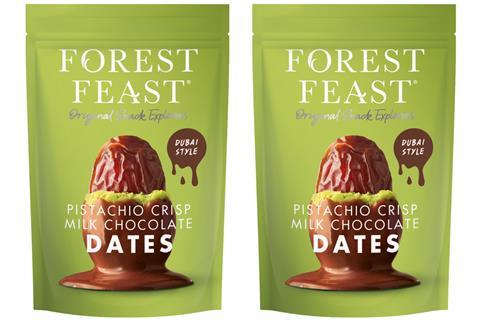
Grocery has been going nuts for pistachios since the Dubai-style chocolate trend took off. For this novel take on the craze, Forest Feast covers dates in pistachio butter, wafer and Belgian milk chocolate. It’s not just the product’s novelty or decadence that’s won this treat our chocolate launch prize. It’s also one of several innovations from Forest Feast that have helped catapult the brand into the big time. Retail sales value passed the £20m mark earlier this year.
How the psychology of price hikes has played out on shelves

The unwelcome return of inflation has prompted a wide range of tactics. How have shoppers responded and what should brands do next?
- 1
- 2
- 3
- 4
- 5
- 6
- 7
- 8
- 9
- 10
- 11
- 12
 Currently
reading
Currently
reading
Confectionery - chocolate 2025: Dubai craze can’t prevent volumes drop
- 14
- 15
- 16
- 17
- 18
- 19
- 20
- 21
- 22
- 23
- 24
- 25
- 26
- 27
- 28
- 29
- 30
- 31
- 32
- 33
- 34
- 35
- 36
- 37
- 38
- 39
- 40
- 41
- 42
- 43
- 44
- 45
- 46










No comments yet