





North London
Population: 536,182
Total annual grocery spend: £1.36bn
Average weekly grocery and convenience spend per household (online and offline): £123.27
Despite being separated by just a few miles, certain north London neighbourhoods are worlds apart. Tottenham and much of Edmonton remain among the most deprived areas of London, while the likes of North Finchley, Southgate and Barnet include some of the capital’s wealthiest residential areas.
This week’s mystery shop focused on the latter. North Finchley is known for its 1930s semi-detached houses, parks and busy high street; Palmers Green is less affluent, but still firmly middle class, and notably more diverse thanks to its large Greek, Turkish and Cypriot communities. There there are Southgate and Barnet, both leafy outer-London suburbs known for extensive green space, excellent schools and large, detached houses often home to family-oriented professionals.
The demographics, then, are somewhat unsurprising. CACI reports that this north London catchment is “overwhelmingly defined by urban professional and metropolitan wealth layered with a substantial young, mobile, renting population and meaningful urban diversity”.
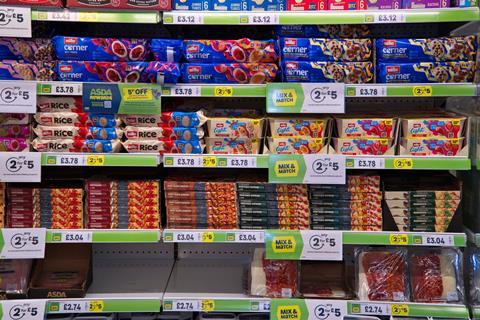
But in this region of conspicuous affluence, it was Asda that picked up a rare win and completed a service and price double in our Green Week special. Its 48,709 sq ft store at the end of the high street in Southgate registered this week’s best performance on availability, with just one item not stocked, and never looked back.
Our shopper particularly liked the large clothing and homeware sections and noted the “great choice” on offer in the “large free-from aisle”. She also praised the “good” layout and, “clear” signage, which made it “easy to find the aisle you needed”. There were good offers available and a “very inviting and well-stocked” sushi stand. Though she did feel the store could do with a bit of a refresh and found the toilets “quite dirty and smelly”.
About 2.5 miles north west, Sainsbury’s on East Barnet Road was just two points behind on 87, with one out-of-stock item proving the difference. Our shopper said the best part of the shop was “how easy it was to get help from the team” who were “helpful” and “knew the store well”. He also appreciated the “clear” signage and mentioned “how spacious and well organised the store was” but would like to see “one or two more staffed checkouts” open.
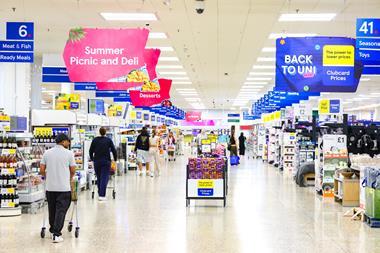
A four-mile drive south to the edge of the North Circular Road lies Tesco, our largest store this week at 65,854 sq ft, which took third place on 73. The store was “modern and well presented”, which helped make it “easy to get around”. Our shopper also found it “easy” to locate an “extremely helpful” staff member who went “above and beyond” by “checking the Tesco website to find the product code and then using their work device to check the store’s stock availability”. The main downside was the “limited availability” and out of stock items, which was “inconvenient”.
About 1.5 miles away on Ballards Lane in Finchley, Waitrose finished fourth with 64 points despite a relatively strong showing on availability. Our shopper was indeed impressed by that “good stock of products” but found the store “tired and older compared, for example, to the [nearby] Mill Hill branch”. She found the “very average” store “didn’t feel vibrant and exciting” and lacked “atmosphere”. And while the staff were “helpful, not all were knowledgeable about plant-based products” and “no one was available to answer my query about the Duchy organic chicken”.
Seven points back in last place was Morrisons on Aldermans Hill in Palmers Green, just moments from the famed north London artery that is Green Lanes. The small store’s catastrophic performance on availability – three items out of stock and six items not stocked – prompted our shopper to note the “gaps on shelves” in a store that was “messy, with crates and stock on the floor” and a self-checkout that “stopped working”. She did, however, appreciate the “easy navigation” of the store and found the staff “friendly and hard-working”.

Shopper profiling is measured using Grocery Acorn shopper segmentation.
Store catchment data (market share, population, expenditure, spend by household, competition) is within a five-mile radius.
For more info visit www.caci.co.uk/datasets/grocery-footprint




No comments yet