






Young people today face a challenging jobs market. But many food and drink companies are helping them get their foot in the door with apprenticeships, graduate schemes and qualifications
Without experience, you can’t get a job. But without employment history, you can’t get experience. That’s the catch-22 facing young people.
“It’s difficult to get a foot in the door,” says Luke Brand, senior automation engineer at HelloFresh, who acts as a mentor for apprentices in the company’s engineering apprenticeship programme. “It can feel like there aren’t many clear entry points.”
The recipe box brand is one of many fmcg employers looking to give young people that entry point – whether through apprenticeships, grad schemes or something as simple and informal as a Saturday job.
These opportunities are more important than ever as youth unemployment climbs. Unemployment among 16 to 24-year-olds rose again, to 16.1% in December, according to ONS figures out this week – a situation not helped by a 6.7% rise in the minimum wage for workers over 21 and a 16.3% increase for those aged 18 to 20. A further 8% increase is planned for younger workers in April. As employers have less incentive to give young workers their first break – and in many cases are slashing hours and jobs – ministers are reportedly reviewing their promise to equalise national minimum wage rates by the time of the next election.
As the UK’s largest manufacturer, however, the food and drink industry has significant potential to help young people take their first steps into work. While some opportunities are declining, there are vital roles that need to be filled in many areas.
“The industry plays a major national role in reducing youth unemployment because of its scale, regional spread and variety of entry-level opportunities,” says Naomi Kissman, social impact director at IGD. “It offers young people accessible routes into stable work, often in communities where opportunities are limited.”
Already, the fmcg workforce skews heavily to younger age groups. Under-30s make up 26% of the workforce in agriculture, 33% in retail and 46% in hospitality, compared to an average of 22% nationally, IGD points out.
- Research from M&S found nearly one in four 16 to 24-year-olds began their careers in retail
- 15.9% Unemployment among 16 to 24-year-olds in 2025
- 4.2m people are employed by the food and drink industry
Meanwhile, research from M&S found nearly one in four 16 to 24-year-olds begin their careers in retail – more than double any other UK sector. Yet the industry still punches below its weight as a career option, often seen as an entry point – stacking shelves or working in depots – rather than a sector with long-term prospects.
“Awareness of food and drink careers remains low,” says Kissman. “IGD research shows one in three young people don’t realise creative and tech-led roles exist in the sector, despite them being essential to its future.”
That sentiment is backed up by MDS, a not-for-profit offering placements to young people across the food supply chain. “One of the industry’s greatest assets is the variety of roles we can offer young people,” says Kirsty Barden, head of careers & development at MDS.
“There are misconceptions that it’s just working in a line or the field, but tech advances mean we’re looking for engineers, food scientists, project managers. There really is a role for everyone.”
John Lewis Partnership Building Happier Futures

Launched in 2022, JLP’s Building Happier Futures is designed for young people who have experience of going through the care system. The aim is to break down barriers to employment by offering opportunities to “explore the world of work through channels including job shadowing and interview support”. So far, 402 participants have been offered roles with the partnership.
In fact, the industry is crying out for some of these more specialist, lesser-known roles. A poll by IGD found half (48%) of recruiting managers in the food industry cited engineering roles as the most difficult to fill.
As such, IGD kicked off a partnership with EngineeringUK in January. Its outreach programme in secondary schools highlights the sector’s wealth of engineering opportunities. The HelloFresh apprenticeship scheme is also aimed at future engineers (see p37).
The role of graduate schemes
Meanwhile, Sainsbury’s hopes to attract a diverse range of skills through its revamped graduate scheme. The FutureMaker programme also debuted in January, focusing on four skill sets that will “shape the future of retail”: digital and AI; data and analytics; change and transformation; and business decision making.
Nearly 50 roles will be available under the 24-month programme, split into eight-month rotations. “By opening accessible pathways for graduates, we’re investing in both our business growth and a more inclusive workforce, ensuring our teams reflect the diversity of the communities we serve,” said Sainsbury’s at the time.
Of course, a graduate scheme is nothing new in itself. All the major retailers run their own schemes for university leavers – from Aldi’s Area Manager Graduate Programme to the M&S Retail Leaders initiative.
As the economic backdrop worsens, applications for such schemes are soaring. MDS, which offers rotations across numerous employers as part of its grad scheme, received 2,500 applications last year for up to 70 places.
From the numbers alone, it’s clear these programmes aren’t a silver bullet. There are other factors to consider. MDS says traditional company-led graduate schemes can pigeonhole young people too early in their careers.
“With those programmes, you have to be pretty sure this is the side of the industry you want to go into,” says Barden. “But you may have skill sets you’ve never looked into.”
There’s a more fundamental issue: these programmes only cater to those who have been to university. And increasingly, young people are questioning that route.
“What we’re seeing are concerns around the cost of university and whether a degree with debt they won’t pay off until their 40s is the route for them,” says Barden. There’s also scepticism over the power of a degree to boost employment chances. Just this month, The Telegraph reported on “straight-A” graduates struggling even to secure work experience placements.
HelloFresh engineering apprenticeship
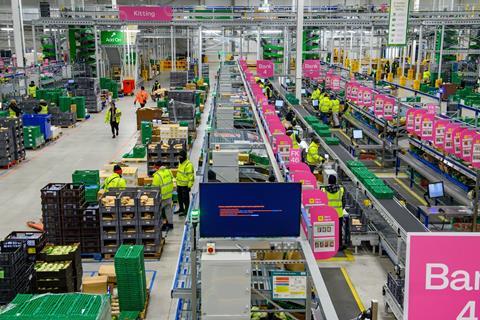
HelloFresh describes its four-year engineering apprenticeship programme as one of its “key initiatives” for young people. Launched in summer 2025, it gives would-be engineers the opportunity to work with the HelloFresh UK operations team at its flagship distribution centre in Derby. Apprentices “earn while they learn” and are offered positions as reliability engineers upon successful completion.
For that reason, MDS has been piloting a placement programme for school leavers. Among employers, apprenticeships are an increasingly popular way of attracting this demographic. All the retailers offer their own apprenticeship schemes – and a growing number are funnelling more investment into this route.
Last month, Aldi announced it would create 500 apprenticeship roles in 2026 across its stores and warehouses in an extension of its long-running programme. “This is an opportunity to learn on the job, build skills and earn market-leading pay,” said Aldi UK training and development director Lisa Murphy at the time.
Rival Lidl also shouts about its apprenticeship programme. Its Degree Apprenticeship aims to help applicants run their own stores within four years and includes off-the-job training with Kingston University.
Meanwhile, Co-op offers apprenticeships across the business to provide an entry point into “food retail, logistics, customer operations, legal services, digital, data, engineering and cyber roles”.
“Employers have a responsibility to remove barriers and make entry routes accessible, practical and relevant,” says Rob Crabtree, apprenticeship delivery partner at Co-op. “Early exposure to work, mentoring and employability resources help young people build confidence and make informed choices.”
What’s more, Co-op is collaborating with Digital Engineering to offer access to degree-level apprenticeships, enabling school leavers to secure “high-quality technical roles without university debt, while gaining real, hands-on experience from day one”.
The move plays into a sense that apprenticeships are no longer considered second rate compared to graduate schemes. In fact, they can be a more vocational, less costly alternative to the university experience.
M&S Marks & Start

In 2013, youth unemployment was at an all-time high. That inspired the Make Your Mark programme in partnership with the King’s Trust. Now called Marks & Start, it offers a four-week placement in an M&S store, with a uniform, £5 lunch contribution and travel costs. Participants also receive a structured learning log, one-to-one coaching and support. Most go on to secure a 12-week, 16-hour contract with M&S, with the possibility of a longer-term role.
That’s how HelloFresh sees its scheme, launched last summer. “The programme offers an accessible route into an engineering career without following a traditional university pathway,” says James Gorman, global senior director of employee governance, UK people & legal at HelloFresh. “On completion, apprentices are offered permanent roles as reliability engineers, so they hit the ground running with the skills and confidence they’ve developed in the workplace.”
Still, it’s important to acknowledge long-term programmes aren’t for everyone. “Not every young person is able to step straight into an apprenticeship or graduate role,” says Martin Talbot, CEO at youth employment charity LTSB. “Programmes that focus on employability skills, workplace exposure and confidence-building can help young people understand what employers are looking for and what different careers involve.”
That insight fuelled the launch of the M&S Make Your Mark programme in 2013 (see box, above). Now branded Marks & Start, the four-week initiative aims to “build confidence, soft skills and familiarity within a real work environment”.
It seems to be working: M&S recruits 600 people to the scheme each year, the majority of whom go on to work for the retailer in some form. Last year, 89% of those who completed it secured a 12-week, 16-hour contract. Two-thirds of those had their contract extended.
Such schemes are increasingly important. When M&S launched it in 2013, one million young people were not in education, employment or training (NEET). That number is creeping up again: up to 987,000 young people were recorded as NEET in government figures for October-December 2025. “Against this backdrop, employability programmes are vital in helping break the ‘no experience, no job’ cycle,” says M&S.
Disadvantaged demographics
That support is even more vital for disadvantaged demographics. JLP launched its Building Happier Futures programme for young, care-experienced people in 2022 (see box, above). The programme works alongside JLP’s T-level placements, which offer students on-the-job experience alongside their school or college attendance, and 12-month industrial placements.
Programmes within schools, in particular, can help flag up the opportunities on offer to a young age group.
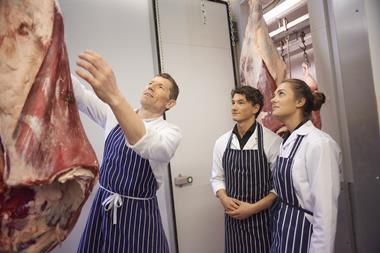
Meat processor ABP has reaped the benefits of offering T-level placements in partnership with local colleges. “We’ve had great success. We’ve actually recruited a number of the students back in on our apprenticeship programme,” says Kate Taylor, apprenticeships & early careers manager at ABP UK.
What’s more, that hands-on experience can challenge misconceptions around the meat industry, which Taylor admits isn’t seen as a “sexy” career choice. “Students who did T-level placements with us the year prior now talk to other students and share their experience to get more young people in,” she reports.
However, Taylor believes the industry ultimately needs greater educational support. Progress is hindered by the lack of A-level options for students interested in food & drink in Great Britain, she says. In Northern Ireland, where students can study nutrition and food science at that level, she’s noticed a difference.
Asda schools programme
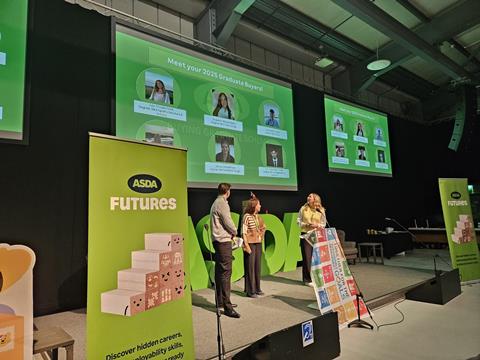
Getting the word out in schools is vital to making careers in food & drink more attractive. As such, Asda expanded its schools programme in September to include a broader reach and range of activities. Designed to spotlight the sector’s “lesser‑known and ‘hidden’ roles”, it explores issues such as food and packaging waste while building employability skills across primary, secondary and college age groups.
“Apprentices with an A-level equivalent are worlds apart,” she reports. “For some students, even though they do a GCSE in food, they don’t get to fully understand the different roles available in the industry.”
IGD also calls for intervention in schools as a priority. It urges the government to “ensure the curriculum better reflects food’s importance to the economy” and make work experience easier to deliver by simplifying health & safety requirements for short placements.
For Taylor, these gaps reflect a wider issue in how the food & drink industry is perceived. “It’s surprising how little attention the sector receives, given its size and importance. How have we got to this stage?”
For the industry to change that narrative, it will need to win hearts and minds at a young age. And more support from government wouldn’t go amiss.








No comments yet