



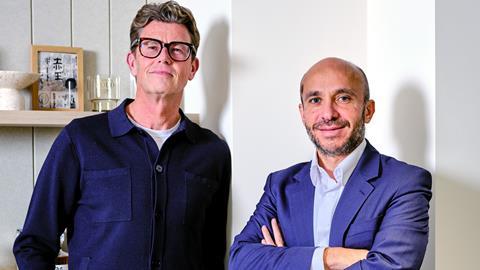
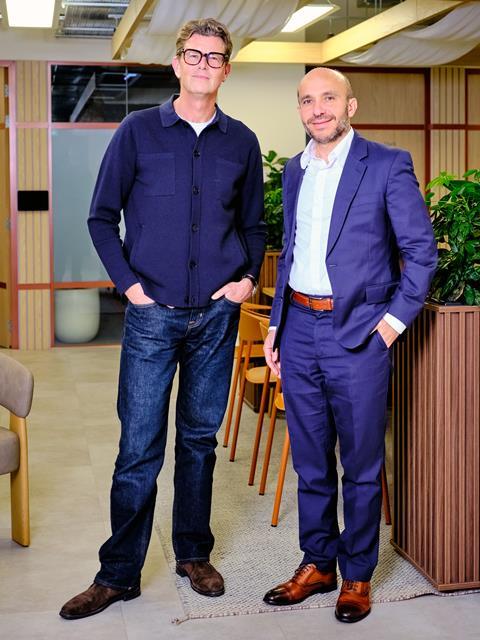
GroceryAid’s Kieran Hemsworth and Rami Baitiéh are on a mission to raise awareness of the financial and emotional support on offer for grocery workers
The grocery industry is built on love – the love of serving others, supporting people and giving back.” For any worker who’s spent time calming down an irate customer or started a delivery shift at 4am, this could sound idealistic. But for Rami Baitiéh, Morrisons CEO and president of GroceryAid, it’s a fundamental part of the charity’s reinvention.
As he talks about the sector’s long hours, early starts and relentless demands, it’s clear the industry’s flagship support charity is far more than a professional obligation for Baitiéh.
“I’ve worked in retail for 30 years across many countries, and I’ve never seen anything like GroceryAid,” he says. “Our industry employs over 2.6 million people – it’s a society of its own, with people facing the same challenges and difficulties you see everywhere else. But the love, pride and commitment in this sector is tangible, and GroceryAid embodies that.”
As increased pressure and the cost of living crisis drive more workers to seek help, the charity is doubling down on those values with an ambitious new approach and rebrand. The goal sounds deceptively simple on paper: to break down the stigma around asking for help and reach more frontline workers. However, that means getting through to the hundreds of thousands of colleagues who don’t even know the charity exists.
That was the starting point, says GroceryAid CEO Kieran Hemsworth. “For us, the rebrand is about helping more people. Right now, we help around 22,000 people a year, which is amazing – but we believe the real need is closer to 330,000. We asked frontline workers where they would go for financial grants, emotional or practical support, and only 2% mentioned GroceryAid unprompted. It was immediately clear that awareness was extremely low and we needed to do something about that.”
Ramping up awareness about the range of welfare services and practical help on offer was key. To do that, GroceryAid needed to become more visible (and more relevant) to the people actually working behind tills, on the shop floor and in stores, warehouses, lorries and factories.
“GroceryAid is about honouring people, not exposing them. Trust is very important”
Rami Baitiéh, Morrisons CEO and president of GroceryAid
The team behind the new direction left nothing to chance. Drawing on previous fmcg branding experience from Coca‑Cola, Ginsters and Warburtons, they developed a clear plan for GroceryAid’s new identity, setting out exactly who they needed to reach and which messages would resonate.
Speaking with previous beneficiaries allowed GroceryAid to map the emotional journey people go through before asking for help. A standout theme was the need for relief – practical, emotional or financial – during periods of crisis.
“We looked at everything we’d found out and asked ourselves what we wanted the GroceryAid brand to stand for,” Hemsworth says. “That’s when we landed on the idea of ‘Relief in tough times’. We don’t want people to feel like they have to hit rock bottom before they ask for help.”
This insight became the core of the new brand positioning: one designed to feel more accessible to a diverse workforce as well as younger people entering the industry. Access was also improved, with digital upgrades including a dedicated welfare app, live chat function and a clearer, quicker website, all designed to make support faster, easier and more discreet.
Changing the narrative
But the team still needed to confront a major barrier: workers often feel uncomfortable reaching out to a charity. “Grocery workers are proud, hardworking people who don’t want a handout,” Hemsworth explains. “So we flipped that on its head. This is not a charity, it’s help they’ve earned through their hard work, commitment to a tough job and long hours. It’s a huge shift, both emotionally and practically.”
That idea sits at the heart of the new tagline, ‘The help you’ve earned’. That runs through the entire rebrand – including the decision to use real grocery workers as the faces of the creative campaign, some of whom have previously used GroceryAid to get back on track.
“Authenticity matters,” Hemsworth says. “There’s no shame or judgement here. People need to be able to see themselves in our campaign.”
This is backed up by the impact of GroceryAid’s results to date. The campaign highlights the organisation’s 8,500 financial grants (totalling £4.6m) from last year, making it clear that workers who need support are by no means alone.
“And it’s all done with the promise of dignity and confidentiality,” adds Baitiéh. “That is what we do. GroceryAid is about honouring people, not exposing them. Trust is very important.”
He also believes there are unique cultural barriers at play, pointing out that people in the UK often find it difficult to ask for help.
“In other cultures, it’s much easier to ring someone, or to say: ‘Hey boss, I’m short of money, please help me out’,” he says. “That would never happen here. So GroceryAid must go knocking at people’s doors and say: ‘We can help you’.”
That reluctance to ask for help also formed part of a key behavioural insight uncovered by the charity’s research: when people hit a crisis, they instinctively speak to family and friends first.
“That discovery reshaped our entire communication strategy,” says Hemsworth. “Suddenly, raising awareness among workers’ families became a really important part of our plan.”
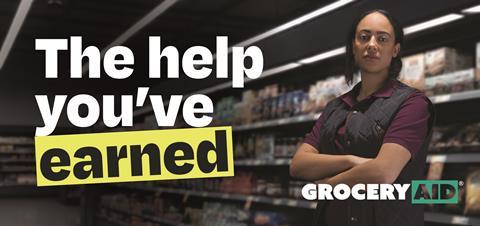
The resulting two-pronged campaign includes a public-facing broadcast and out-of-home campaign. Major retailers and suppliers will also spread the word via internal comms channels, colleague briefings and in-store materials.
“We need to be everywhere that grocery workers are to join those dots and normalise the message,” Hemsworth adds.
While individual awareness is essential, it’s industry collaboration that supercharges GroceryAid’s reach. Retailers and suppliers have put commercial rivalry to one side to create a resilient fundraising ecosystem.
Cycling challenges, charity nights and industry events such as Barcode Festival raise a lot of money – 85% of GroceryAid’s income, in fact – but they also help to forge relationships between rivals, creating a sense of unity.
Since becoming president in early 2025, Baitiéh has championed the charity at every opportunity. “I’m not the CEO of Morrisons when I put my GroceryAid hat on. It’s so much more than that.”
With this push for greater, nationwide awareness coming alongside ambitious growth plans, there’s still plenty for GroceryAid to be getting on with. But for Baitiéh, the focus remains clear.
“Five years from now, no one will talk about like-for-like sales figures or market share or promotions. But they’ll remember the people we helped.”




No comments yet