





Today’s budget was delivered in a manner that “falls short of standards that the House expects”, Rachel Reeves was told before she’d even started.
In a rebuke before calling the Chancellor to make her speech, deputy speaker Nusrat Ghani slammed the “premature disclosure of the contents of the budget” as a “supreme discourtesy to this House”.
“Weeks ago, we saw the Chancellor delivering a speech in Downing Street, setting the scene for the budget, as well as specific policy announcements being briefed out to the media in advance of today’s financial statements,” Ghani said.
“And just a moment ago, it seems the OBR analysis has also appeared online.”
Reeves began by shifting blame, saying the OBR had leaked its economic and financial outlook on its website.
But dodgy comms are not the worst way this budget has short-changed the grocery industry.
Business rates were supermarket chiefs’ “number one priority”, many of them told the Chancellor back in October. They left those meetings confident she’d listened, meaning shops would be exempted from a plan to hit the largest properties with a business rates surtax from next year.
This afternoon came confirmation that faith was misplaced.
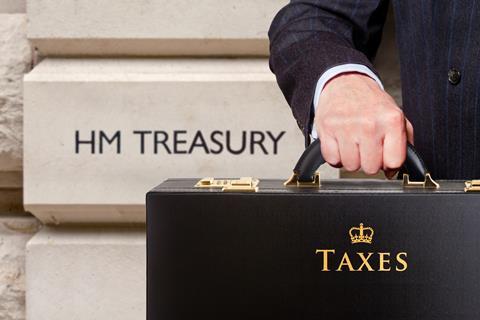
The big issue: business rates
Reeves confirmed she would introduce a business rates surtax on the largest properties to fund ‘permanently lower’ rates for smaller premises in retail, hospitality and leisure (RHL). Crucially, there will be no exemption for large shops, despite BRC warnings in September that the move could force 400 closures.
The issue has split the industry. The BRC argues small shops could receive discounts without imposing a surtax on larger ones, while the Co-op has focused on securing the biggest possible discount for smaller stores.
It was the FWD that perhaps most directly torpedoed supermarket chiefs’ work though, telling the Treasury in October it would be uncompetitive to give retailers exemption without doing the same for wholesalers.
Responding to today’s budget, FWD CEO James Bielby says: “We welcome the government’s u-turn on exempting the major supermarkets from this cost, which we told HM Treasury would be dangerously anti-competitive and give a deeply unfair advantage to one sector of the market.”
And it wasn’t as bad as it could have been for supermarkets. The surtax on larger properties will add 2.8p to the standard business rates multiplier – far below the 10p Reeves could have imposed under legislation. From next year, the new ‘high-value multiplier’ will rise to 50.8p.
It benefits smaller RHL premises to have a 5p lower multiplier than non-RHL equivalents. The threshold for an RHL property to qualify for that discount – or be classed as a shop that pays the surtax – is a rateable value of £500,000.
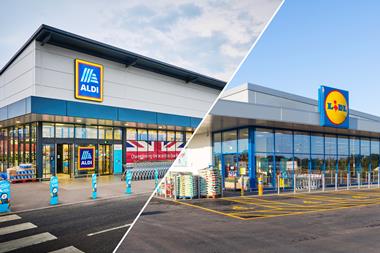
The surtax is set to impact traditional supermarkets more than it will Aldi and Lidl, whose smaller stores are more likely to fall below the threshold.
BRC CEO Helen Dickinson says: “This budget offered much-needed relief for some retailers, but fell short of the bold action needed to secure the long-term future of our high streets and mitigate the inflationary pressures which are currently pushing up prices for households.
“While the announced changes to business rates are a step in the right direction, many felt the Chancellor should have gone further.
“The 5p rates reduction for RHL properties with a rateable value below £500,000 is unlikely to fully fix the situation where retail, as 5% of the economy, pays over 20% of all business rates.
“Including supermarkets and anchor stores in the new surtax is a retrograde step that does little to mitigate the rising cost of food and essentials. Larger stores, which already pay one third of the industry’s business rates bill and employ around a million people, should have been exempted from a surtax intended to fund support for the high street.”
In her speech to the commons Reeves also promised “a package of support worth over £4.3bn over the next three years for a property of any size seeing a large increase in their bill”.
“And to support a level playing field in retail, I will stop online firms from undercutting our high street businesses by ensuring customs duty applies on parcels of any value,” she added.
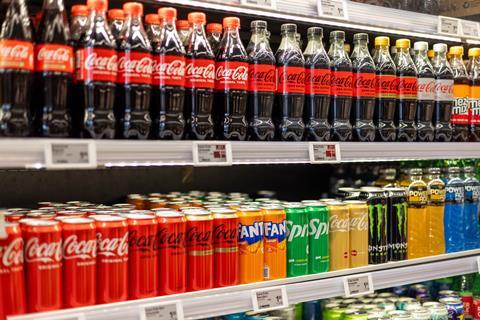
Soft drinks sugar tax
While the government’s extension of the Soft Drinks Industry Levy (SDIL) – better known as the sugar tax – to milkshakes and other milk-based drinks captured much of the nation’s attention, most of the soft drinks industry was more focused on its plans to shake up the thresholds for other drinks in the firing line.
The result, as The Grocer exclusively revealed today, was a fairly hefty government climbdown, after the original proposals mooted in April to toughen the threshold of the tax from 5g per 100ml to include drinks with over 4g/100ml were amended to 4.5g/100ml or more.
The move means hundreds of soft drinks, including household names such as Tango, Sprite and Lucozade, have escaped being dragged into the clutches of the Treasury’s tax net.
A whopping 152 SKUs containing exactly 4.5g/100ml, including Pepsi, Fanta and 7up, will still need to make some changes, but sources said they would avoid the huge investment that would have been required to get under 4g.
As well as easing reformulation worries, sources told The Grocer the change to 4.5g/100ml was hugely significant because it corresponds with the level at which products are classified as HFSS under the existing nutrient profiling model – a major factor in securing supermarket listings.
The government has also extended the deadline for implementing the changes, opting for January 2028 instead of the originally suggested April 2027. Drinks bosses had described the initial timeline as a ‘kick in the teeth’ for the soft drinks sector, given its leading role in developing the UK’s deposit return scheme, set to launch that October.
FDF chief executive Karen Betts said: “We’re pleased the government has listened to industry.
“The new proposals take into account the costly and technically complex work that companies have to do to bring healthier products to market and go some way to protecting the investment companies are making to help people follow healthier diets.
“Drinks manufacturers will continue conversations with government to ensure we have the right conditions to keep investing in healthier product innovation in the UK, even while the rate of food inflation continues to run so high. Government support and partnership to ensure industry has the R&D investment it needs for healthier product development would help food and drink companies move further and faster.”
On the milkshake extension, Dairy UK CEO Judith Bryans describes the move as “disappointing”, a sentiment echoed by Will Jones, MD at Yazoo owner FrieslandCampina. Jones says the threshold “could raise production costs across the industry and, in turn, affect shelf prices”.
However, Jones and Bryans, along with other dairy drink brands, welcomed the move to introduce a lactose allowance, which will mean naturally derived sugars from lactose will not count towards that limit.
“This is a crucial step towards acknowledging the inherent nutritional value of dairy products,” says Jones.
Farmers will ‘keep fighting’
The Chancellor also announced a marginal change to the family farm tax, with the £1m threshold now transferable between spouses to bring it in line with other Inheritance Tax policies.
Both the NFU and the Country Land and Business Association say the concession shows the government knew its policy was “flawed”.
While the NFU recognises it will help a “handful of farms” it says does not go far enough. NFU president Tom Bradshaw says the union will “keep fighting”.
“Today the government accepted its changes to Inheritance Tax are flawed, which we welcome,” says Bradshaw. “But this step does not do nearly enough to reduce the damage to the British farming community.”
The continued calls to bring about further changes are echoed by the CLA.
“Across the country, family businesses have been reducing their investment, at an enormous cost to the economy and the British public,” says CLA president Gavin Lane. “It is not too late for her to scrap the entire policy, and finally recognise the enormous value family-owned businesses bring to the UK.”

Pressure on booze
Reeves also confirmed a widely expected rise to alcohol duty in line with retail price inflation next year.
Scotch Whisky Association CEO Mark Kent says it will put “huge pressure” on a sector suffering job losses and stalled investment.
“Hiking duty today, for the third time in two years, not only limits our sector’s ability to contribute to much-needed economic growth and productivity, but will once again fail to deliver for the public purse and needlessly cost jobs.”
However, Katherine Severi, chief of the Institute for Alcohol Studies, hit back: “Ministers aren’t bowing to the barrage of misinformation and aggressive lobbying from the alcohol industry.
“Past cuts to alcohol duty have handed out more than £28bn in tax breaks to multinational producers, even as alcohol deaths, hospital admissions, and inequality have soared.
“Tackling alcohol harm is also vital for economic growth, as England alone loses well over £5bn a year in lost productivity due to alcohol.”
Growth strategy, what growth strategy?
While the industry avoided any of the massive shocks of last year’s budget, trade bodies were still highly critical over what they claimed was a lack of growth strategies, despite claims that it is at the heart of policy making.
Betts said: “We recognise the Chancellor had difficult decisions to make given the challenging fiscal situation.
“But we would have liked to see more in this budget on growth. While it’s positive to see the government engaging on inflation, there’s much more government and industry can do together now to address this.
“This includes ensuring the UK’s largest manufacturing sector receives an adequate share of government R&D funding, maintaining stable regulation, and not overlooking food and drink in support for energy intensive industries.”
Rupert Ashby, CEO of the British Frozen Food Federation, called the budget a “missed opportunity”, adding: “At a time of high food inflation, rising employment costs and poor growth, it was a chance to encourage and inspire frozen food businesses when confidence is already fragile.
“Nearly half are now reducing staff organically by maintaining a recruitment freeze, while others are seeking to manage costs by accelerating automation plans and reassessing capital investment.
“Members also tell us they are suspending planned projects, placing tighter conditions on suppliers and considering extended payment cycles simply to absorb the pressures they already face.
“Against this backdrop, today’s announcement offers little sense of relief or encouragement.”

A pause on plastic
Despite speculation, which will continue regardless of the budget, that the government is considering a major hike and shake-up of the plastic packaging tax (PPT), today’s budget confirmed the tax will only increase by the rate of inflation (CPI) in 2026/27.
The government also confirmed it will legislate in the Finance Bill 2025-26 to allow a mass balance approach for attributing chemically recycled plastic under the tax, starting April 2027.
Industry sources welcomed the move, saying it addresses what they saw as a major unfairness: companies using recycled plastic still paying the tax because mass balance wasn’t previously permitted.
The move was announced in March, but this is the first time the government has committed to including it in this current Finance Bill.
While for those in the industry still reeling from the arrival of EPR no further news on the plastic tax was a big relief, others were left disappointed.
Earlier this week, a report suggested the Chancellor could generate £100m a year in extra tax revenues from developing a new escalator for the tax to cover any items that contain less than 50% of recycled plastic, as opposed to the current 30%.
The Hybried Economists report, commissioned by waste services giant Biffa (which, as sources pointed out, has no shortage of skin in the game), called for Reeves to overhaul the tax while phasing out the export of unprocessed plastic packaging waste to other countries by 2030.
Wages and pensions
There was also reaction to the Chancellor capping salary sacrifice pension contributions at £2,000 a year, as well as yesterday’s announcement of a 4.1% rise in the national living wage.
The BRC’s Dickinson says: “The NLW uplift announced by the Chancellor was in line with the core expectations announced by the Low Pay Commission, providing stability for retailers’ financial planning.”
On the other hand, “changes to salary sacrifice will hurt retail employees and businesses alike”, she adds.
“For many retail colleagues, this will act as a brake on their pension savings.
“For retailers, these changes will cost hundreds of millions, punishing those businesses with strong pension offerings, and/or forcing them to reduce the contributions they make to their employees’ retirement security.”
The FDF’s Betts says: “We’re concerned that the changes to salary sacrifice for pension contributions will discourage people from adequately saving for their retirement, creating further costs for the state down the line.”









1 Readers' comment