




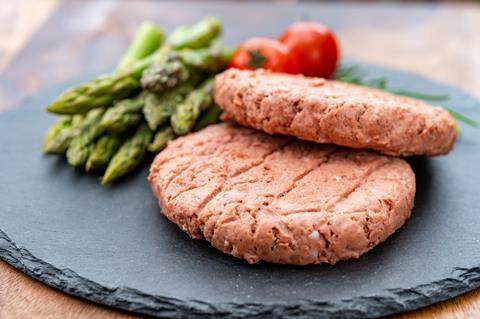
The UK’s plant-basedmeat sector has experienced a turbulent few years, with sales steadily falling since around 2021 following rapid expansion during the 2010s.
🔔 Get exclusive industry insight direct to WhatsApp
It’s a trend that should concern anyone interested in a healthier and more resilient UK food system, as this food offers currently unrealised benefits.
Plant-based meat and mycoprotein can help diversify the UK’s protein sources and reduce dietary ill health, with research finding that swapping out processed meat for popular plant-based options in a UK shopping basket could increase fibre and cut saturated fat. It can also provide a straightforward swap for the 51% of adults who say they want to eat less meat or more plant-based options.
A simple explanation for the category’s decline is that the public thinks plant-based meat is an ultra-processed food, and this is dampening demand. But while affordability, familiarity and taste are well-understood barriers, there’s been little real evidence of how UPF perceptions interact with these factors.
New research we commissioned from Public First (now PF Global), based on focus groups with British consumers open to changing their protein sources, begins to answer that question. As with all qualitative research, it can’t show how widespread these views are, but it does reveal that the relationship between processing and plant-based food isn’t straightforward.
From the start, our participants reminded us that everyday food choices mean balancing competing priorities, particularly the cost of living. Healthy eating was a goal for most people, and reducing meat intake was often cited as a way to achieve it.
When asked whether they had tried plant-based meat to replace some meat in their diets, we found people clearly viewed it as ultra-processed – often drawing on terms such as “artificial” and “unnatural” to describe a broad distrust of the food industry.
Crucially, however, this didn’t always mean they rejected it. In one camp, we found people who were already sceptical about plant-based meat for reasons beyond processing, such as poor taste or cost. They tended to see scratch cooking with veg and pulses as just as convenient and used UPF concerns to entrench existing perceptions.
In the other camp were people willing to accept some processing as a trade-off for the convenience, taste or health benefits they saw plant-based meat as offering.
“It feels like you’re having a burger and chips even though it’s not meat,” one man in his 20s from London said. Another man in his 30s from Glasgow said: “I substitute plant-based stuff sometimes for spaghetti bolognese and curries.”
Food choices based on everyday realities
For people like this, fitting plant-based meat into familiar routines helps manage time and household pressures, showing that options like plant-based mince or sausages offer practical value and demonstrating that food choices are driven by everyday realities rather than health ideals.
Participants didn’t judge plant-based meat against a single benchmark, and instead viewed it differently depending on what they compared it against, considering it as occupying a “middle ground” – healthier than processed meat and fast food but less healthy than chickpeas and vegetables.
As one man in his 40s from Glasgow said: “It would be better than having a full-on beef burger that’s processed… It’s the lesser of two evils.”
This may not be a starry-eyed vision of food systems transformation, but it is a practical one grounded in lived experiences. As Food Foundation research points out, almost a third of the meat eaten in the UK is processed. Replacing some of this with plant-based meat would be a big win for healthier diets.
Plant-based meat’s UPF image isn’t going away. Although the ongoing debate makes some people less likely to try it, processing isn’t an insurmountable obstacle, particularly for those who value its convenience.
Rather than trying to convince people that processing doesn’t matter, brands, retailers and those advocating for healthier and more sustainable diets should lean into the “middle ground” that plant-based meat occupies. And they should make its nutritional benefits as a direct swap for processed meat much clearer to those most likely to benefit.
Linus Pardoe is senior UK programme manager at the Good Food Institute Europe






No comments yet