



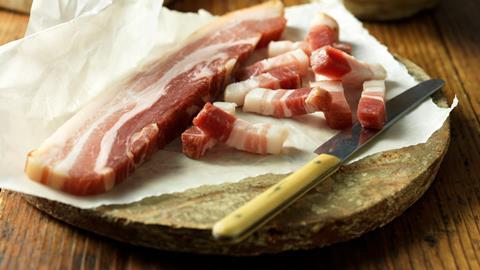
Whether it’s a scare story that requires a commonsense approach or cast-iron evidence backed by some of the globe’s most eminent scientists, the debate over the safety of nitrites in bacon looks like it’s finally catching the public’s imagination.
A decade after a World Health Organization agency published a damning report linking processed meats – and the nitrites used to cure them – to cancer, The Grocer reported back in October that UK governments had done “virtually nothing” to reduce exposure to the chemical, citing the comments of the original report authors and the likes of food safety expert Professor Chris Elliott.
And that slow progress was mirrored in the low availability of nitrite-free options in supermarkets – with our research showing some 86.8% of ham, bacon and continental meats sold in the mults still contained the chemical, barely better than the 89.9% figure seen in 2015.
But on the back of Elliott and his colleagues’ criticisms in October – under the banner of campaign group Coalition Against Nitrites (CAN) – it looks like shoppers are now paying attention.
’May cause cancer’
New research, exclusively commissioned by The Grocer for our Health Week, shows a majority of consumers would now support a move for a tobacco-style health warning on processed meat packs – as proposed by CAN.
As we report, that suggestion has secured the backing of 55% of bacon and ham eaters, who say they would support a front-of-pack “may cause cancer” warning on products.
While this may sound extreme, the research, compiled by The Harris Poll UK, also found that 46% of consumers would support a ban on nitrite-cured meat, with just 16% opposing it.
And this support would, in theory, be largely undimmed if a ban caused products to become more expensive – 84% of those who backed a ban would still do so if it meant paying more for ham and bacon.
So is it now time for the government to consider changing its policy on nitrite use in pork supply chains, and how realistic would that be?
One caveat is that, despite the urgency that some members of the public feel for this issue, consumer understanding around the whole ‘bacon causes cancer’ debate still remains low. Only 29% of consumers polled were aware of the 2015 report (by the WHO’s International Agency for Research on Cancer), which claimed processed meats such as bacon and ham pose as great a cancer risk as asbestos and tobacco.
However, it had a significant impact on those who did read the report, with 84% changing their diet afterwards.
Wot, no bacon?
This sentiment looks like it’s already playing out on supermarket shelves. Earlier this year The Grocer revealed sales of nitrite-cured bacon had plunged by £18.7m in the 12 weeks to the end of January, as shoppers shied away from products containing controversial nitrite additives.
It suggests that increasing noise around the issue is making a compelling case for consumers.
But the question of whether nitrites are safe or not still fails to make any real headway with people who have the power to bring about any changes.
The Food Standards Agency still permits the use of nitrites in meat products but continues to monitor its advice on the controversial additive. It maintains that “the exact cause of these risks remains unclear”, advising that any processed meat consumption increases the risk of bowel cancer and other diseases.
Chief scientific officer at the FSA, Ian Young, stressed: “It’s important to understand that choosing nitrite-free processed meat does not remove all of the health risks associated with high consumption of processed meat.”
Processed meat is clearly not a health food, but it does seem nonsensical that the government’s food safety watchdog won’t support further work to assuage CAN’s fears – despite months of lobbying and engagement on the matter.
As a spokesman for Coalition Against Nitrites puts it: “When a known carcinogenic chemical is no longer needed in food production, there can be no justification for continuing to use it.”
The argument to keep using nitrites is that it keeps costs down for consumers and offers choice. However, those shopping with smaller budgets arguably do not have the same choice and so will continue to buy nitrite options until they are banned.
The sector itself, however, is doing work to bring down nitrite usage. British Meat Processors Association technical operations director, David Lindars, says that while nitrites still play an “important role in food safety”, members were now “implementing new methods to get nitrite use as low as possible without jeopardising public health”.
As consumers become more savvy and move towards nitrite-free options, and the sector continues to keep pace with demand, the FSA risks being left behind.
It may not be confident that the additive causes cancer, but is that really a risk it is willing to take?
The Grocer Health Summit 2026 is helping the industry turn healthy eating insight into action. Covering everything from regulation to reformulation and science to strategy, the one-day conference will be taking place on Tuesday 15 September 2026 at the QEII Centre in London.
Visit thegrocerhealthsummit.co.uk to book your tickets and find out more.





No comments yet