2025 was the year of fried chicken and matcha lattes, helping some in the hospitality industry thrive following a tough few years 

But while trends have paved the way to success for the likes of Dave’s Hot Chicken and Wingstop, other QSR segments, notably pizza, have struggled.

As we close out the year, the future remains far from clear for some. With turnarounds, sale talks and fresh menu innovations in full swing, we take a look back at some of the events that really shook up the food-to-go sector in 2025.

Leon’s return to healthy fast food

leon outlet London

Just last week, Leon appointed administrators as part of turnaround efforts to get the chain back in shape

The past few months of 2025 have been a rollercoaster ride for healthy fast food chain Leon.

In September, Leon co-founder and former food tsar Henry Dimbleby warned that a shift to unhealthier options could “destroy” the food-to-go brand in the long term. At the time, it was owned by Asda

However, Dimbleby’s co-founder and ex-Leon CEO John Vincent vowed to reinvigorate Leon and return it to its core values after buying it back from the supermarket giant just a month later. 

The cut-price deal for Leon, which he sold to EG Group for £100m in April 2021, included all 46 restaurants, 22 UK franchises and three franchise sites in the Netherlands. 

But there is much work to be done. 

Just last week, Leon appointed administrators as Vincent kicked off turnaround efforts to get the chain back in shape. He plans to close several loss-making restaurants with a number of job losses on the cards.

Coca-Cola looks to offload Costa Coffee

Costa Coffee

Coca-Cola is exploring the sale of Costa just five years after acquiring it from Premier Inn owner Whitbread in a £3.9bn deal

One of the key takeaways for 2025 is that coffee and carbonated soft drinks simply don’t mix. 

It was revealed in August that Coca-Cola was exploring the potential sale of Costa just five years after acquiring it from Premier Inn owner Whitbread in a £3.9bn deal.

When Coca-Cola snapped up Costa in 2018 it was a watershed moment, aimed to reduce the drink giant’s reliance on sugary drinks. But it hasn’t quite gone to plan, and analysts have now suggested Costa may be sold for just £2bn.

In the past year, Coca-Cola’s coffee sales declined by 3%, which it attributed primarily to the performance of Costa in the UK.

During the fmcg giant’s second quarter earnings call in July, CEO James Quincey admitted that Costa had “not quite delivered” and was “not where we wanted it to be from an investment hypothesis point of view”.

And the process to find a new buyer has not been an easy one. While private equity firms including Apollo Management Group, the owner of Wagamama’s parent company The Restaurant Group, and US-based investor KKR were among those named as possible suitors, banking insiders revealed that Coca-Cola had received fewer proposals than expected.

As the year comes to a close, Coca-Cola is understood to have held last-ditch talks with Asda owner TDR Capital in a bid to rescue a sale. But the outcome? It’s likely we’ll need to wait until the new year for a conclusion to this story.

Raising Cane’s ramps up UK fried chicken market

Raising Cane's 3 (1)

Raising Cane’s has become a viral sensation on TikTok in recent years with over five million social media followers

In September, US fast-casual chicken chain Raising Cane’s, which has become a viral sensation on TikTok in recent years with over five million social media followers, unveiled plans to enter the UK market next year. 

The restaurant brand, which has more than 900 US locations and celebrity fans such as Snoop Dogg and Post Malone, will open its first UK flagship site in London’s Piccadilly Circus at the end of 2026

Several more locations will follow, including The Strand, Oxford Circus, Paddington, South Bank and drive-thru locations across Greater London and beyond. 

While it does leave UK fans patiently waiting for the arrival of its first store, the announcement alone caused quite a reaction. While it came as a welcome surprise for many Gen Z consumers, it was less pleasing for the QSR brands already looking to steal share in the UK’s rapidly growing fried chicken market. 

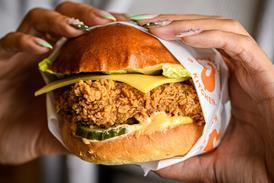
Popeyes now has over 85 UK restaurants, while Wingstop has around 60 and Dave’s Hot Chicken, which only launched in the UK last December, has plans to launch 60 locations across the UK. With expansion plans not slowing down anytime soon, 2026 may be ‘the year of fried chicken’. 

Pizza delivery giants get sliced

Pizza+Hut+Luton

Pizza Hut owner Yum Brands has initiated a formal review which will explore ‘a range of strategic options’

It’s been a tough year for the pizza segment. Domino’s posted a 1.5% decline in total orders in Q3 and a 0.1% drop in like-for-like sales in the first half. Meanwhile, Pizza Hut suffered a 15% decline in profit to $80m (£60.2m) for the second quarter due to growing competition in the sector and weak consumer spending.

To turn things around, former Domino’s boss Andrew Rennie decided that betting on the booming fried chicken market (see above) would be just what the brand needed. In September, the pizza giant launched its Chick ’N’ Dip brand, offering chicken tenders, wings and boneless bites alongside its typical pizza menu. 

Rennie went as far to say there is not “massive growth” left in the UK pizza market, adding that the chain’s expansion into fried chicken could have a “big impact” on its future. But in the same month, he stepped down with immediate effect.

Domino’s chair Ian Bull said the board believes “there are a number of opportunities to drive further growth and value creation in Domino’s core business”.

2026 might be the year the pizza takeaway market makes its comeback, but dine-in pizza restaurants are likely not to fare so well. In October, Pizza Hut UK acquired 64 dine-in restaurants through a pre-pack administration in October, but 68 sites remain at risk of closing. While Pizza Hut owner Yum Brands has since initiated a formal review which will explore “a range of strategic options”, a refresh of its stores and, most importantly, its offer will be a must on the 2026 checklist. 

Starbucks’ turnaround begins to pay off

starbucks cup

Starbucks CEO Brian Niccol set out a turnaround plan to boost sales and address issues from long waiting times to frustrated staff

While the end of the year is looking rather gloomy for some, Starbucks execs will be preparing to turn on their out-of-office emails feeling more confident in the brand’s future than they were this time last year.

In September 2024, Starbucks CEO Brian Niccol set out a turnaround plan to boost sales and address issues from long waiting times to frustrated staff.

In the latest update to the strategy, Starbucks unveiled plans to close hundreds of coffee shops and lay off 900 non-retail employees – a plan that is expected to cost around $1bn (£750m) due to severance packages and long-term rental contracts.

These are some big changes, and while the majority are to be made in the US and Canada, the coffee chain confirmed an unspecified number of closures would take place in the UK.

But the turnaround plan seems to be paying off so far. For the 13 weeks to 28 September, global store sales increased 1%, marking the first time in seven quarters Starbucks has delivered sales growth.

Pret looks to take a bite out of the meal deal market

Pret - Chilled unit at store in Balham, south London - 2100x1400

Source: Pret

Customers peruse chilled options at a store in Balham, south London

It was about time when Pret a Manger jumped on the meal deal bandwagon in September

It began testing a whopping seven meal deal formats covering both breakfast and lunchtime occasions to inform a permanent meal deal to be rolled out early next year.

The formats include a breakfast croissant and coffee deal, rolling out at various price points from £4 to £5, alongside a three-part lunch deal, which features a drink, crisps and any bread-based sandwich priced between £6 and £7.

But it’s a crowded market. Pharmacy chain Boots launched the first such promotion way back in 1999, with Tesco, Sainsbury’s and other supermarkets soon following suit.

Pret CEO Pano Christou believes the brand has a “fantastic opportunity to [offer] the best-quality meal deal on the market”, pointing out “the freshness” of Pret’s ingredients as its USP.

With meal deals from supermarkets “you’re buying a product that’s been made hundreds of miles away, many days ago”, says Christou. In contrast, Pret will be offering a product that had been made “metres away, minutes ago”.

It’s a big bet, but one that makes a lot of sense for the sandwich chain.