




The wildfires and drought conditions that have wreaked havoc across Europe this summer are a “clear” sign climate change represents “one of the greatest threats to European food security and food sovereignty”, experts have warned.
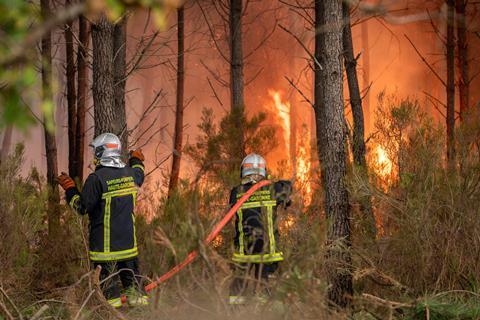
Over the past week, major fires across France and Spain have forced hundreds of thousands of people to evacuate, scorched tens of thousands of hectares of land and disrupted transport infrastructure, raising fresh concerns over the resilience of Europe’s food supply chains.
In France alone, more than 40,000 hectares have been burned by a major blaze in Gironde – home to the Bordeaux wine producing region – with authorities warning soaring temperatures and dry conditions could reignite outbreaks, despite progress in containing the fire.
While vineyards had so far avoided the worst of the wildfire’s impact, according to the Bordeaux Wine Council (CIVB), the wider crisis meant crop yields across Europe were down, while water supplies were under pressure and farm animals were suffering often fatal heat stress, said Tom Lancaster, land, food and farming analyst at the Energy and Climate Intelligence Unit.
And this year’s Bordeaux vintage could still be badly impacted by smoke taint, according to wine industry insiders and French media outlets.
“These impacts will only get worse if we don’t do more to get to net zero,” Lancaster added. “We can and should do more to adapt our food system to these impacts, but tackling the problem at source by reducing greenhouse gas emissions is the only way to stop the costs of climate change for food and farming from becoming completely unmanageable.”
It comes as drought conditions across the continent meant the outlook continued to deteriorate for summer crops such as maize and, to a lesser extent, sunflower and soybean, said Aurélien Blary, crop analyst for price reporting agency Expana.
France and Hungary were the hardest-hit countries, he added. “The EU harvest is now forecast to be below 50 Mt (vs 56.97 Mt in 25/26) – the lowest level since the 2007/08 marketing year.”
Elsewhere, the principal concern for olive farmers in the world’s largest producing region of southern Spain was not heat, but a “continuing lack of rainfall”, said Walter Zanre, CEO of Filippo Berio UK.
“With little meaningful rainfall forecast for southern Spain over the coming weeks, it is increasingly likely that initial production forecasts for the 2026/27 harvest will be revised downwards once the industry returns from the summer break,” Zanre warned.
Under prolonged drought stress, olive trees naturally shed part of their fruit as a survival mechanism, conserving water and energy to protect the tree itself.
However, the combination of this drought-induced fruit loss and an expected earlier harvest had the potential “to materially influence olive oil production volumes and market prices for the 2026/27 season”, he warned.
Extreme heat is also impacting the UK. Drought conditions were officially confirmed across 51.4% of England on Wednesday, following a similar announcement for the north of Wales last week. A major incident was also declared in East Anglia on Thursday, with firefighters battling a large heathland fire on the Suffolk coast.
“Farmers and growers have always had to contend with the weather, but what they are experiencing now is climate change in action,” said NFU deputy president Paul Tompkins, who called for government action in areas such as planning to allow the sector to build water storage.
“Across every sector and every part of the country, farmers and growers are seeing first hand the impact of dry weather and drought, with more extreme conditions making it harder, riskier and more costly to produce the nation’s food,” he added.
“There are practical steps government and the water supply chain can take now. That means creating a risk register for vulnerable farm businesses, improving local communications, being as adaptable as possible with abstraction so farmers can access water when it rains, and unlocking the investment and planning changes needed to build more reservoirs.”










No comments yet