






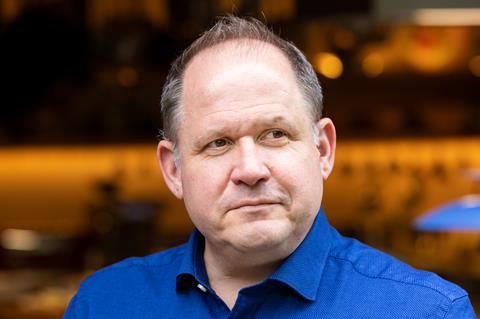
Former government health tsar Henry Dimbleby has predicted it will take the government “at least five years” to introduce the controversial 2018 nutrient profiling model (NPM), by which time the majority of consumers will be getting their health advice from AI chatbots rather than the government.
Delivering the keynote address at the launch of a new blueprint calling for action by the industry to tackle the obesity epidemic, by the British Nutrition Foundation (BNF), Dimbleby said he believed the government would be replaced by new technology firms as the key source of healthy eating advice.
The government is under pressure from the industry to delay or scrap the new NPM, even though it was first recommended by government health experts eight years ago, because of the economic impact on companies facing an inflationary crisis caused by the war in Iran.
Dimbleby, whose health strategy is five years old next month, said he believed by the time ministers got round to introducing the new model the NPM would be ancient history.
“The new NPM model is great, it is definitely a better model than the old one,” he said. “But it’s eight years old already and I don’t think the government is going to be able to keep up.
“My guess is the new NPM is not going to come in for at least another five years. It’s just too slow. I think people will be looking for the source of truth somewhere else and I actually think one of the places they will get it is AI.”
Dimbleby said that as well as the rise of AI chatbots and search advice on health, millions of adults were taking matters into their own hands on obesity with weight-loss drugs.
He said weight-loss drugs such as Ozempic, Wegovy and Mounjaro had taken off to such an extent they made the uptake of statins look like a “flatline”.
Meanwhile he said confidence in artificial intelligence to give health advice was growing across the population, whilst “people spending £2,000 a year across all demographics” on drugs.
“People are more confident about taking agency themselves,” he said. “A couple of weeks ago in one of our focus groups, I spoke to a 62-year-old woman from one of the most deprived areas in the country who was using AI to find out what was good for her stomach complaint.”
Meanwhile the government has been urged by food leaders to get on and publish its plans for mandatory health reporting for the food industry, which are said to be “in limbo” after the resignation of health secretary Wes Streeting, having been due to be published in the spring.
Kate Halliwell, the FDF’s chief scientific officer, told the BNF event that mandatory reporting was supported by most major retailers and manufacturers and could provide a vital framework for more transparency on health.
She said the message for the government was to “get on with it”.











No comments yet