


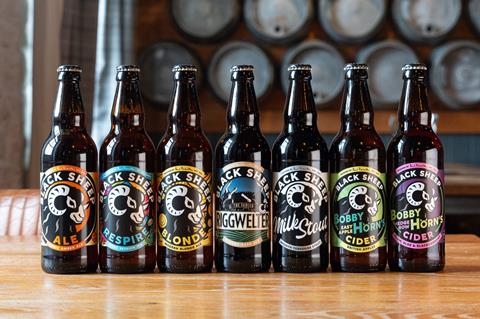
Paramount Retail Group has said its brewing arm is “not that far away” from breaking even, almost six months on from acquiring Keystone Brewing out of administration.
The Yorkshire-based fmcg conglomerate said it would seek to return the former Keystone business – which includes Black Sheep, Purity Brewing Co, North Brewing, Fourpure, Brew By Numbers, Brick Brewery and Magic Rock Brewing – to profit by shrinking to a sustainable core focused around a smaller set of brands.
Sales across Keystone’s combined brands in the six months to 30 September 2025 stood at £13.9m (circa £28m annualised), while its net losses were £3.4m (£8.6m).
Revenues at the newly formed Great British Drinks Company (GBDC) – which comprises the Keystone brands and Saltaire Brewing – were likely to be 20%-30% below the Keystone run-rate this year, Paramount chairman Paul Taylor told The Grocer.
“This is not a vanity play on sales,” he said. “You need to have a position of profitability to sustain a business. We’re not going to overreach with the expectation of a £30m turnover right now. If we can drop this down to £5m a year and be profitable that will be the starting point for us.”
Paramount had received some “self-help” in cutting costs following the departure of between 10 and 15 former Keystone execs, Taylor said. The business would now look to maintain existing margins while also stripping out excess overheads to reach profitability, he revealed.
“The biggest constant drain on a lot of these brands is an over-pumped overhead structure, which doesn’t support the actual reality of where that brand lands commercially,” he said. “We’re going to move away from the corporate structure and build a team of people who see the business through a different lens to Keystone.
“It will be hands-on, practical, at-the-coalface people who do not make their first port of call an organisation chart and a hierarchy.”
Damaged legacy
Meanwhile, Keystone’s decision to shutter local production for the likes of Fourpure, Magic Rock and Brew By Numbers and migrate production to Black Sheep was “totally the wrong move” that had damaged the “the heritage and the legacy,” of the brands, Taylor said.
“If you look at how Keystone was running this business, and what their end goal was, it is pretty well 180 degrees polar to what our beliefs are,” he said. “We walked into a business and found in front of us a plan from Keystone to rationalise the business down to one production hub in Masham with a complete disregard for what the implications would be on a brand level.
“From our perspective, pretty much everything was broken in terms of their strategic outlook.”
However, the consolidation was unlikely to be reversed unless local production outposts beyond Black Sheep and Purity could be proven commercially viable, he added.
“We need to be pragmatic,” he said. “At the end of the day, a business fails because it fails to generate commercial profit, and one of the issues the brewing world has faced is a lack of ability to create profit whilst hanging on to the heritage of local brands. Unless you get that balance right, too much in one of those domains will sink you equally.”
Portfolio rationalisation
Meanwhile, Paramount director Sunny Sharma refused to give assurances about the future of all brands within the GBDC roster.
“What Keystone had tried to do was a traditional private equity buy-and-build: stack another brand on top, the numbers will keep building and somehow the profit will flow,” he said. As a result, the business acquired by Paramount in January contained a large, overlapping stable of brands with “a lot of liquid crossover”, he added.
While Paramount did not yet have a defined plan for every brand, it was focusing its initial attention and resources on Black Sheep and Purity, alongside North, Magic Rock, Brick and Brew By Numbers, Sharma revealed.
Fourpure, meanwhile, was “a bit of a challenge”, and could be retired, however.
“It’s going to be very brand-focused, taking each brand in isolation, looking at where and why it stands to exist and what the innovation and NPD pipeline needs to look like,” he added.
Supplier relationships
With the collapse of Keystone Brewing leaving unsecured creditors £2.7m out of pocket, GBDC had spent much of its early existence seeking to repair relationships with its suppliers and customers, Sharma said.
“We made our runway really busy for the first three weeks meeting with suppliers,” he said. “For some of them it was the first time they had actually met the leadership or ownership of the business for the last five or six years.”
Despite this, the business had not offered discounts or other financial incentives to those left empty-handed, Taylor said.
“If we start giving away percentage points in our supply chain from day one, we’re running a business which is in the worst state than it was the day before we got it,” he said, adding most suppliers had been keen to keep working with GBDC.
“When you get past the emotion of what has happened, most people get to the point where they see the only way that they can actually benefit and have a position of recovery is to continue to trade and to earn that money back over a period of time.”
Paramount Retail Group first entered beer in 2024 with the takeover of Saltaire Brewery.
It also rescued Montezuma’s Chocolate out of administration in 2023 and owns several pet businesses, as well majority stakes in lifestyle company Dibor and confectionery businesses Bristows of Devon and Crawford & Tilley.
Last year, it snapped up independent meat wholesaler DB Food Group, taking combined annual revenues to around £230m.


No comments yet