





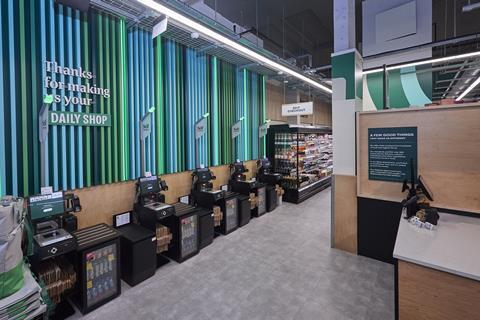
Self-checkouts increase a retailer’s loss through theft by an average 22% in the year after they are installed, a major study by ECR Retail Loss has found.
The largest ever study of self-checkout loss, based on millions of transactions across 39 retailers, with a combined turnover of €1 trillion, also found losses were 33% higher in stores with the technology than those without.
The study – involving retailers from the UK, Australia, Canada, Czech Republic, Denmark, Germany, Ireland, Netherlands, Turkey, UAE and the US – found that mis-scanning was the most frequent source of loss (reported in between 1% and 4.8% of transactions), while ‘walkaways’ generate the highest loss in terms of value (averaging at €88).
Self-checkout related losses as a percentage of total store sales are estimated to have increased since 2018.
The study findings “highlight the reality of what we are seeing as retailers and the size of the opportunity that we face within the self-checkout area” said Alex Ritchie, head of shrinkage at Tesco.
“It supports the direction of our plans and the journey we have been on for a number of years. This acts as another tool to further strengthen our business cases for key rollouts at the front-end including scan avoidance and physical security measures at checkouts.”
Overall, the study found that globally 54% of purchases were made via self-checkouts where available.
While malicious, intentional theft was to blame for a considerable amount of the losses through self-checkouts, the study found that ‘nudges’ to the customer that “the system is paying attention” were hugely effective in stemming the shrinkage.
The most effective nudges are on-screen prompts that ask shoppers to check or rescan items. Customers self-correct in more than 80% of cases once this nudge fired, the study found.
“Most self-checkout loss is generated by ordinary people making everyday mistakes,” said Colin Peacock, group strategic co-ordinator at ECR Retail Loss. “That’s good news… it means retailers can engineer their way out of the problem.”
Exit gates and display monitors that show footage of the customer as they are scanning items were also effective. One retailer reported a 28% drop in walkaways and a 30 to 40 basis point improvement in store loss over 12 months once exit gates had been implemented at a store.
“This is the clearest view yet of how self-checkout drives loss, and how retailers can mitigate it,” said the report’s lead author Professor Matt Hopkins, from the University of Leicester. “The biggest gains come from designing systems that make accuracy easier for customers, not from trying to read their intent.”
A separate study by The Grocer last year found that almost 40% of UK shoppers have failed to scan at least one item when using self-checkouts. A third (32.5%) also admitted to having weighed loose items incorrectly, while 38% had put through an incorrect loose item.









No comments yet