


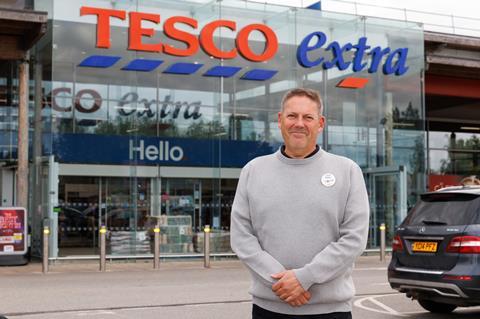
Chris Pettinger will celebrate 40 years with Tesco next year. During that time, he’s become a bit of a seasonal store specialist having spent the past decade running Tesco’s Skegness and Mablethorpe stores on the coast. This week brought a different challenge in the shape of Tesco’s massive Lincoln Extra, our store of the week, where he’s covering while store manager Rachel Fores takes a well-earned holiday.
Luckily, Pettinger knows the store and Lincoln well having closed the previous Tesco 13 years ago. He talked to The Grocer about the benefit of having so much competition, coping with ever more demanding customers and the trends that he sees shaping shopper behaviour.
Can you tell us about your career in retail? I joined in 1987 and will mark 40 years’ service in May. I’ve spent the past decade managing really seasonal stores, like Skegness and Mablethorpe, which experience huge holiday uplifts. However, this week I’m covering Lincoln for store manager Rachel Fores, who is on holiday. It’s a store I know really well, though, as I helped to close and move the previous store 13 years ago.
What’s it like to be a retailer in Lincoln? It’s a massive privilege. The customers have high expectations, but it’s great because Tesco is always able to meet their needs. It’s not a seasonal store, but there are a lot of the market town events that you’d expect for a place like Lincoln, like the Steam Punk festival, so we get some spikes in trade throughout the year.
The town itself has such a lovely walk-through type of shopping experience. You’ve got an extremely steep hill, called Steep Hill, that’s cobbled all the way down, and there’s so many small shops. Then being able to get your main shop from us at the edge of town really adds to that offer.
Who are your shoppers? Opposite the store is Bishop’s College and Lincoln University too, so there’s a big student base. But then later in the day is when our ‘big’ shoppers turn up. We’re an 80,000 square foot building, with 500 colleagues and 17 delivery vans – we’re here to cater for families.
Is there a particular demand for Lincolnshire products in store? A lot of Tesco produce is grown in the county, including our potatoes, carrots, parsnips and turnips. We’re able to make suggestions to buyers about some of the lines we get in, but as a business we already offer a lot of big Lincolnshire brands like Piper’s Crisps, Lincolnshire Poacher cheese and Lincoln coffee.
You have both Aldi and Lidl on your doorstep, how does that shape trade? There’s a real pulse of people coming into store trying the offer because of the amount of stores that surround us. It’s not just the discounters, there’s a Waitrose a couple miles away, Sainsbury’s, Asda and Morrisons the other side of town, as well as a heavy concentration of convenience stores. We’re always being compared to other offers, which is why we have to be outstanding all of the time. Given the size of our range, we’re very well armed to be able to fight our corner.
It was a fiercely competitive week with high scores across the board; do you think that’s down to the added competition in town? There’s a huge passion within the store to maintain the standards that they’ve always had. I thought I had good service at 39 years, but there’s a lady in the office next door that’s got 47!
What trends are driving shopper behaviour at the moment? There’s been a noticeable move towards frozen. Whether that’s to do with convenience or budget or the current climate, whatever it is, the focus has really expanded, and the quality of the offer has improved. Compared to when I first started my career, people are so much more aware of the sort of things that can reduce your life span and want to make healthier swaps.
On that, Tesco recently announced plans to ban over 100 UPF ingredients. Early days, but have shoppers reacted? I can’t say I’ve noticed anything in particular. But more generally, I do feel that we’re held to account quite strongly when it comes to making sure we’ve got those options available. Customers, especially the younger customers, are more likely to actually ask you about ingredients. They want to know how an animal or product has been sourced. I never got asked that in the olden days. Customers nowadays are far more demanding when it comes to social awareness. We need to know the answers, and we need to be able to offer alternatives if we don’t have what they need.

No comments yet