






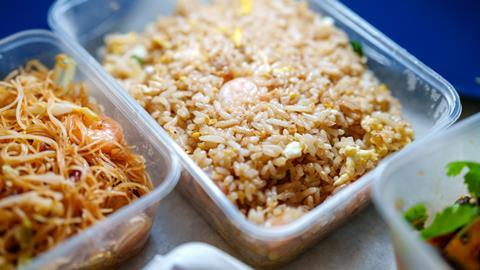
Why would someone struggling to pay their bills spend £1,400 a year on takeaways and ready meals? This is what Alicia Weston of food charity Bags of Taste says their typical participant has told them they spend. “To the outside observer, this looks like a ’bad choice’, but through the lens of behavioural science, it’s a sophisticated survival mechanism,” she explains…
At Bags of Taste, we’ve spent years deconstructing the “Food Trap” using the frameworks of Learned Helplessness and Scarcity Theory. If we want to solve food poverty, we have to stop talking about “willpower” and start talking about the reality of the environment.
1. Learned Helplessness & The “No-Slack” Zone
In poverty, the “cost of failure” is catastrophic. As identified by Martin Seligman, when repeated efforts to change an outcome fail, individuals stop trying to avoid the pain of further disappointment. For a middle-class cook, a burnt dinner is a minor annoyance. For our participants, a failed recipe is a financial disaster—the money is gone and the kids go hungry. Choosing a £1 frozen pizza isn’t “laziness”, it’s risk aversion. It is a rational defence against the financial catastrophe of a meal that might not work out.
2. The Bandwidth Tax
In their seminal work Scarcity, Sendhil Mullainathan and Eldar Shafir demonstrate that the state of “having too little” creates a functional tax on the brain. The mental load of managing a crisis budget reduces cognitive capacity by up to 13 IQ points. When your “mental RAM” is entirely consumed by survival maths (rent, bills, meters), there is simply no room left for the complex planning required to shop for and execute healthy meals.
3. The Moral Outsourcing of Agency
The constant pressure to make “correct” ethical and health choices (organic, plastic-free, sustainable) creates intense cognitive dissonance for those who cannot afford them. By opting for a ready meal or takeaway, participants often “outsource” the moral load to the manufacturer. It is a protective shield for their remaining self-esteem: if the packaging is plastic or the food is unhealthy, that’s the provider’s failure, not theirs.
4. The Solution: Restoring Agency through Success
You don’t solve this with information – you solve it with Scaffolding. At Bags of Taste, we provide a ‘guaranteed win’. By removing the risk (providing exact ingredients and helping people cook them) and simplifying the process, we provide the ‘psychological slack’ needed to break the loop of helplessness. We don’t cure it with a lecture; we cure it with evidence of their own competence. When we remove the fear of failure, we restore the power of choice.
Alicia Weston is the founder of Bags of Taste, a charity that supports people living in poverty to make better food choices and improve their finances. For more information go to www.bagsoftaste.org
Food deserts: the problem and how to solve it

For the poorest shoppers, access to healthy food is scarce. Affected areas are caught in a vicious circle of reduced choice and more fast food. What steps need to be taken?
- 1
 Currently
reading
Currently
reading
£1,400 a year on takeaways? How at-risk people make food choices




No comments yet