





The Grocer gained rare access to Chinese e-commerce giant JD.com’s CEO Sandy Xu to discuss the company’s appetite for growth beyond China’s borders.
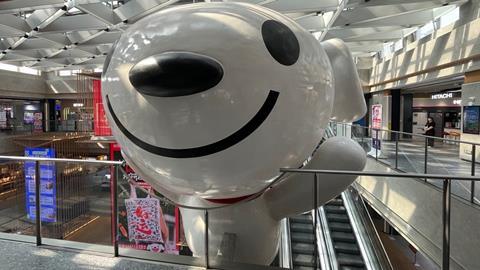
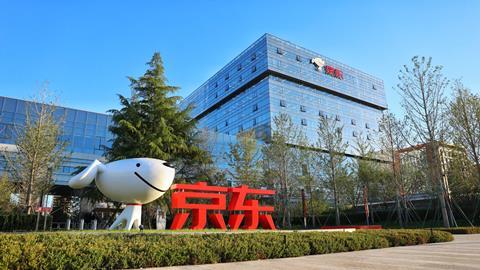
Joy – the cutesy canine mascot of China’s biggest retailer by revenue, JD.com – can be seen all over China. It’s there on the sides of the countless delivery vans and bikes that zip across the country, bringing online orders to homes and offices in as little as nine minutes. It’s there in statue form at the entrance of the company’s 70 (and counting) estate of 7Fresh supermarkets, and 30 (and counting) company-owned malls. It’s there on the fascia of its hundreds of convenience stores, and smiles down from atop JD.com’s 30-hectare HQ campus in Beijing, home to 60,000 employees.
And it’s there, smiling out from the phone screens of the more than 700 million annual active customers that shop on JD.com – for everything from TVs to luxury handbags to cosmetics to furniture to fridges to toys to car parts to medicine.
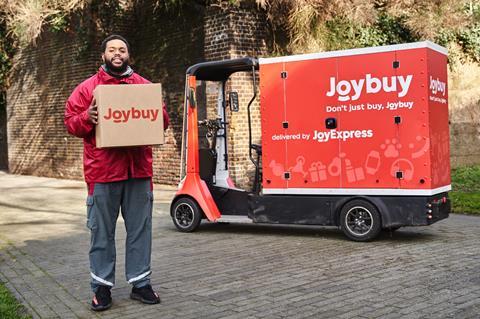
But this dog has grown too big for its own backyard. Having quietly established a slick and speedy, continent-spanning logistics network of more than 60 warehouses and depots in Europe over the past few years, in March JD.com launched Joybuy, a full-category e-commerce site now operating in the UK, France, Germany, the Netherlands, Belgium and Luxembourg. As the company puts it: “Our competition is everybody.”
The Grocer gained rare access to JD.com’s CEO Sandy Xu to discuss the company’s appetite for growth beyond China’s borders.
“If we see there is a customer demand and we can do it,” she says, “why not do it?”
The Chinese Amazon
JD.com’s scale, e-commerce dominance and supply chain-spanning operations – and its forays into grocery, cloud computing, AI agents and more – has prompted many in the west to consider it ‘the Chinese Amazon’.
Speaking to the first group of European media to be given access to the company’s marble-lined headquarters since 2020, Xu claims not to have “done deep research of Amazon’s business model”.
Just like Amazon, JD.com’s retail platform takes the form a marketplace for both direct sales and, as The Grocer revealed earlier this month, third-party sellers soon too. But, Xu insists, “there are many other ways that we are very different”.
Xu is acutely aware that Amazon tried and failed to break the Chinese market – exiting in 2019 – because “their business model doesn’t fit the Chinese consumers very well”. JD’s own global expansion, in contrast, will be guided by the experience of “the local team who understand local consumers”.
The main distinction, however, is the level of customer satisfaction JD.com strives for. Be it Amazon or any other online shopping brand, “consumers are entitled to better service”, Xu says.
In the UK, Joybuy orders are fulfilled by dedicated JoyExpress drivers arriving in branded uniforms and vehicles, with same-day delivery as standard for the more than 17 million people covered by its ‘Double 11’ (order by 11am get it by 11pm) promise, and there are actual humans on the end of its complaints hotline. Buy a large appliance and the driver will install it for you, and recycle your old one free of charge. Its Trustpilot score is 4.6/5 versus Amazon’s 1.7/5 rating.
A two-way trade
Other commentators have drawn closer comparisons to other Chinese e-commerce powerhouses that have reached Europe, like Temu and Shein.
JD.com does share similar aims of bringing Chinese-made goods to new markets. Last year, the company’s founder Richard Liu told local media of his ambition to introduce 1,000 Chinese brands into overseas markets within five years.
“It’s a two-way trade,” Xu says. After all, she explains, JD.com has provided a straightforward route to the huge Chinese market for many western brands, among them Danone, Dyson (“we are always short of inventory”, Xu says), LVMH, Nestlé and L’Oréal Paris. Xu’s own home, she says, is full of German appliances.
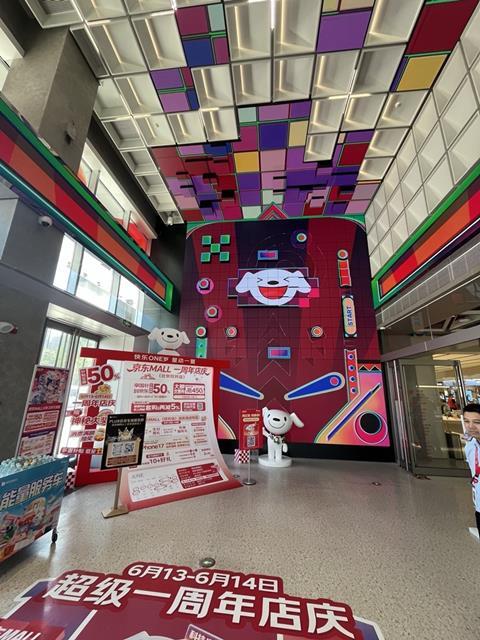
The JD.com platform sells more French wine than any other online retailer in the world. And at its last summer sales event, £11m worth of Apple products were shifted in the opening minute alone.
There’s hope within the company and among Chinese manufacturers that its international expansion will provide home-grown brands the same opportunity to prosper overseas.
But Joybuy will not be flooding the UK with “poor-quality, low-price products” as per the model of those other retailers, Xu insists. Rather, it will showcase the “group of Chinese brands who offer good-quality products at reasonable cost”, for which she believes “there will be demand among Europeans”.
Xu, who spent close to 20 years with PricewaterhouseCoopers in Beijing and San Jose before joining JD.com as CFO in 2020, doesn’t believe JD.com will be tarred with the same brush. The poor reputation of the Chinese online retailers that have proceeded it in Europe is an opportunity, she says, for JD.com to prove “what a Chinese e-commerce player can be” and distinguish itself with “premium services”.
Commission concerns
Western regulators may take some convincing. French authorities have imposed millions of euros in fines on Shein for data privacy and consumer rights violations, earlier this month issuing the fast fashion retailer fines of €22m over issues with returns, product information and order confirmations. In May, the European Union slapped a €200m fine on Temu for having illegal products such as dangerous baby toys and faulty chargers for sale on its platform.
JD.com’s $2.5bn bid for German electronics retailer Ceconomy has raised “concerns” from the European Commission, which last month opened an “in-depth investigation” into whether JD.com’s acquisition bid was aided by “foreign subsidies” from the Chinese government. It’s also investigating whether the subsidies mean the merged company will be able to “adopt investment and business strategies that could impact competitive conditions in the EU internal market”, the Commission said.

Xu laughs at the idea the Chinese government would “subsidise a private company to do an acquisition overseas”. Ceconomy hadn’t invested in technology or innovation or stores in years, Xu says. JD.com’s investment “would definitely help to provide more energy for the local economy”, she adds.
But the acquisition block – the Commission has until October 2026 to make its decision – is a big problem.
While JD.com has always taken a long-term view – its current strategic roadmap runs until 2043 – there is an urgency to its expansion beyond China’s borders. In March, the Chinese government cut its annual economic growth target to a range of 4.5%-5%, the lowest expansion goal since 1991. Household spending is sluggish and sales of home appliances and consumer electronics on the JD.com marketplace – two of its core categories – in the three months to the end of March are down 8.4% year on year. Growth of its overall retail business revenues has slowed to 1.8% from 16.3% a year ago.
Meanwhile, the company’s aggressive bid to capture still more consumer interactions with the launch last year of a takeaway delivery business has proven costly – the company forgoing restaurant order commissions completely to squeeze share from market leader Meituan and rival Alibaba’s Eleme service.
And there is the nagging need for the company to prove what founder Liu last year called its “lost five years” of “no innovation, no growth, no progress” is over.
“Since we are a company of this size we feel it’s necessary to expand our operations outside of a single market,” Xu says.
While it’s more “natural” for the company to build out its own operations – its 3,600 warehouse-strong, £8.4bn JD Logistics business only exists because its founder couldn’t rely on local couriers to deliver in the company’s early years – “sometimes it may take too long to build all the capabilities we need”, Xu says. Acquisitions mean JD.com can “quickly assemble the team, gain some users” and ultimately “accelerate the process of building the business”, she says.
In early 2024 it entered talks to acquire Currys, which ultimately rejected its bid. Late last year, it was in secret negotiations with Sainsbury’s to buy Argos. But talks collapsed a day after becoming public because the supermarket couldn’t accept JD.com’s heavily revised terms. Regardless of the outcome of the Ceconomy investigation, “we’re open for M&A opportunities”, Xu says.
After all, for its Joybuy operation in Europe to work, “we have to accumulate a certain scale to reach the scale benefit for a retailer”, Xu explains.
Big dog
Joybuy is the young pup of European e-commerce. It’s a market long dominated by Amazon, and the competition from major supermarkets launching their own marketplaces as well as local upstarts is growing.
But the sheer might of its owner means it must be taken seriously. In China, “from day one there was always competition”, Xu says. Alibaba had hundreds of millions of users when JD.com first launched. While Alibaba remains the bigger company, JD.com outperforms it in revenue terms.
“Competition itself is not something we feel is challenging, even though it is a challenge,” Xu says.
It remains to be seen how Joy will fare in the dog eat dog European market. In any case, as Xu puts it: “Joybuy promised to shake up the market – and this is what we are doing.”







No comments yet