




It’s been a decade since a landmark report linked nitrites in processed meat to cancer. So why has progress been so slow?
A decade after a World Health Organization agency published a damning report linking processed meat to cancer, UK governments have done “virtually nothing” to reduce exposure to potentially harmful nitrites.
That was the stark message delivered last week by food safety expert Professor Chris Elliott, alongside four of the authors of the International Agency for Research on Cancer’s 2015 report – which classified processed meats containing nitrites such as bacon, ham and frankfurters alongside asbestos and tobacco for their carcinogenic potential.
Nitrites have long been used as a preserving agent in the curing process of processed meat, helping to maintain its characteristic pink colour and to inhibit the growth of bacteria such as clostridium botulinum – which can lead to potentially fatal botulism.
But its continued, widespread use also meant more than 50,000 British people had suffered from bowel cancer linked to processed meat consumption since IARC’s landmark study, costing the NHS £3bn, claimed the experts in a letter sent to health secretary Wes Streeting last week.
Policy “inaction” on nitrites was still leading to “avoidable” deaths, the group, under the umbrella of the Coalition Against Nitrites (CAN), warned.
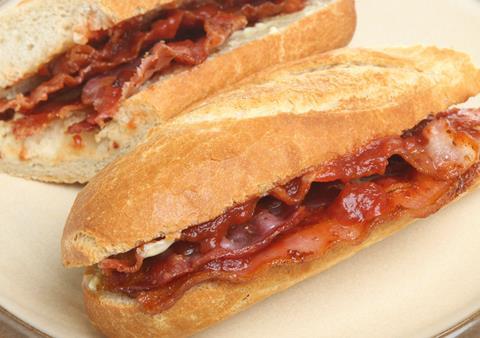
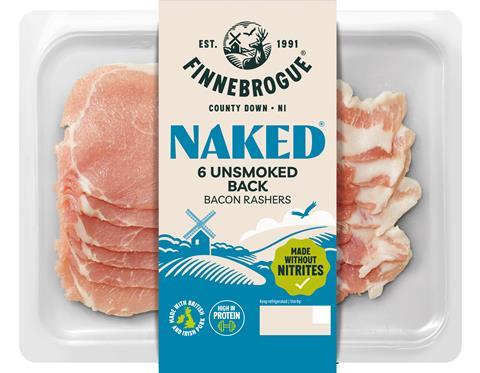
Despite successful innovation from Finnebrogue and other emulators of its pioneering ‘Naked’ nitrite-free bacon, adoption by supermarkets has been limited (and in foodservice even more so).
So, why haven’t we seen a widespread shift to nitrite-free processed meats, and could this latest intervention shift the dial?
CAN’s letter described its “profound disappointment” there had been “no meaningful phase-out of nitrite use, no mandatory front-of-pack cancer warning to inform consumers, and little support for producers to transition to safer alternatives”.
Read more: 10 years on, UK inaction on processed meat is costing lives
The coalition’s criticism is supported by The Grocer’s exclusive analysis of Assosia data, which shows retailer take-up of nitrite-free bacon, ham (except Parma ham, which is produced using dry-aging techniques) plus continental meats still represent a tiny proportion of the wider category.
Since IARC’s report was published, the precedent set by Northern Ireland-based Finnebrogue with its Naked range has been followed up by the likes of Denhay, Helen Browning’s and Heck, with own-label nitrite-free lines by producers such as Cranswick and Pilgrim’s Europe also available.
| Percentage of nitrites in bacon, ham and continental meat products in the mults | ||||||
|---|---|---|---|---|---|---|
| Tesco | Sainsbury’s | Asda | Morrisons | Waitrose | Total | |
| Nitrite in ingredients | 254 | 237 | 168 | 217 | 175 | 1051 |
| Number of products | 291 | 261 | 194 | 257 | 208 | 1211 |
| % of nitrite in ingredients | 87.3% | 90.8% | 86.6% | 84.4% | 84.1% | 86.8% |
Source: Assosia
This means most major retailers do offer at least some nitrite-free options, but Assosia’s data shows progress in switching away from nitrites is also slow.
Some 89.9% of ham, bacon and continental meats sold in the traditional big four and Waitrose contained nitrites in October 2015.
That figure has since fallen, albeit slightly, to 86.8% in 2025. Assosia’s data also shows an even higher figure when focusing solely on bacon and gammon, with 93.4% of products still containing the chemical.
European progress
France, by comparison, has been far more successful in reducing nitrite use in its processed meat supply chains, with one industry source suggesting up to half the ham it sells is now nitrite-free. That figure will doubtless rise further after a new European Union directive, mandating lower limits for the chamical’s use in pork products, came into force in October.
In contrast, the UK has made sluggish progress on what Elliott describes as “clear biological evidence” of the health risk of nitrites – backed by what CAN calls “repeated confirmation from independent studies and sustained public concern”.
But shoppers have clearly taken note, with the bacon category seeing a slump in sales of late. NIQ data for The Grocer’s 2024 Top Products survey showed bacon volumes fell by 0.8% last year, at a time when meat volumes generally soared.
AHDB highlighted at the time how shoppers were trending instead towards premium meat cuts, “many of which have a healthier reputation than bacon”.
One major stumbling block to the wider adoption of nitrite-free products is “fragmented and inadequate” policy responses to the “disproved” threat of botulism from nitrite-free pork, claims Elliott.
As The Grocer reports this week, CAN has been lobbying the Food Standards Agency to review its position on the risk of botulism, claiming it has “ignored” recent evidence.
However, a meeting between the regulator and the group on Tuesday ended in deadlock, with the FSAclaiming nitrites remain “essential” to protect against the illness.
“Increased health risks apply to processed meat overall, not specifically to nitrites,” says FSA acting chief scientific advisor Rick Mumford. There is “no evidence” removing them “makes processed meat safer”, he adds. “Our advice is simple: to reduce health risks, it’s best to limit consumption of all processed meats.”
As for the position of manufacturers, Heck co-founder Andrew Keeble says the success of its nitrite-free pork Rashers product, launched in April 2024, was driven in part by shoppers “picking this up as an alternative to bacon”, due to its lower perceived health risks.
But a wider look at the sector shows a distinct caution in abandoning use of nitrites due to that perceived botulism risk.
Reduced use
While the meat industry has been working hard to cut nitrite levels “for some time”, there are also “food safety risks, particularly while also reducing salt levels, and the impact on mis-cures and shelf life also need careful consideration”, urges Provision Trade Federation director general Rod Addy.
“Our producers have, over the last four years, been implementing new methods to get nitrite use as low as possible without jeopardising public health,” adds British Meat Processors Association CEO Nick Allen.
“BMPA members have achieved up to a two-thirds reduction in nitrite use in products, well below FSA limits.”
Rival meat trade body AIMS echoes Allen, with executive director Jason Aldiss stressing alternatives to nitrites “don’t yet offer the same level of protection or consistency, especially in traditional products, and reformulation can be costly and complex”.
The industry’s reticence on this issue can also be explained by a fear of “sticking your head above the parapet”, while the science is still clearly contested, says a senior meat sector source.
“Lots of suppliers tick that box for nitrite-free now as part of their wider offer. But they don’t just want to kiss that nitrite market goodbye and piss off their customers when the demand isn’t yet there,” they suggest, especially if their rivals stick with nitrites.
“There’s also that nervousness from retailers over shelf life, plus the need to increase testing (if they stop using nitrites) alongside the associated costs of transitioning,” they add – pointing to how inflation is widespread within the meat sector already.
That’s despite a second industry source with knowledge of the nitrite-free category suggesting a wholesale shift would cost as little as a “few pence per pack”. It’s “perfectly safe, we’ve not seen a single case of botulism from nitrite-free bacon”.
The UK’s inertia now means “the EU is safer than us when it comes to tackling the threat of cancer from processed meats”, the source points out. And this policy divergence could also create friction when the UK and EU finally commence negotiations on a new SPS deal.
CAN shares this view, urging government action on labelling, incentives for a transition to “safer curing methods” and a “long-term plan” to phase out nitrites in processed meats sold in this country.
“The UK has a strong record in public health leadership – notably in tobacco control – and can once again set a global standard,” it says. “Further delay will consign avoidable cancers to future patients and their families. Scientific evidence and public health ethics demand transparency and action.”
Ultimately, only the combined will of the industry and regulatory approval on the issue will engender the widespread shift in policy called for by CAN, the first source claims.
“The decision shouldn’t be as black and white as what CAN is calling for,” they argue, given the efforts already seen across the sector to reduce nitrite use.
That is unlikely to be enough to placate Elliott and his colleagues, however.
| Source: Assosia |






No comments yet